
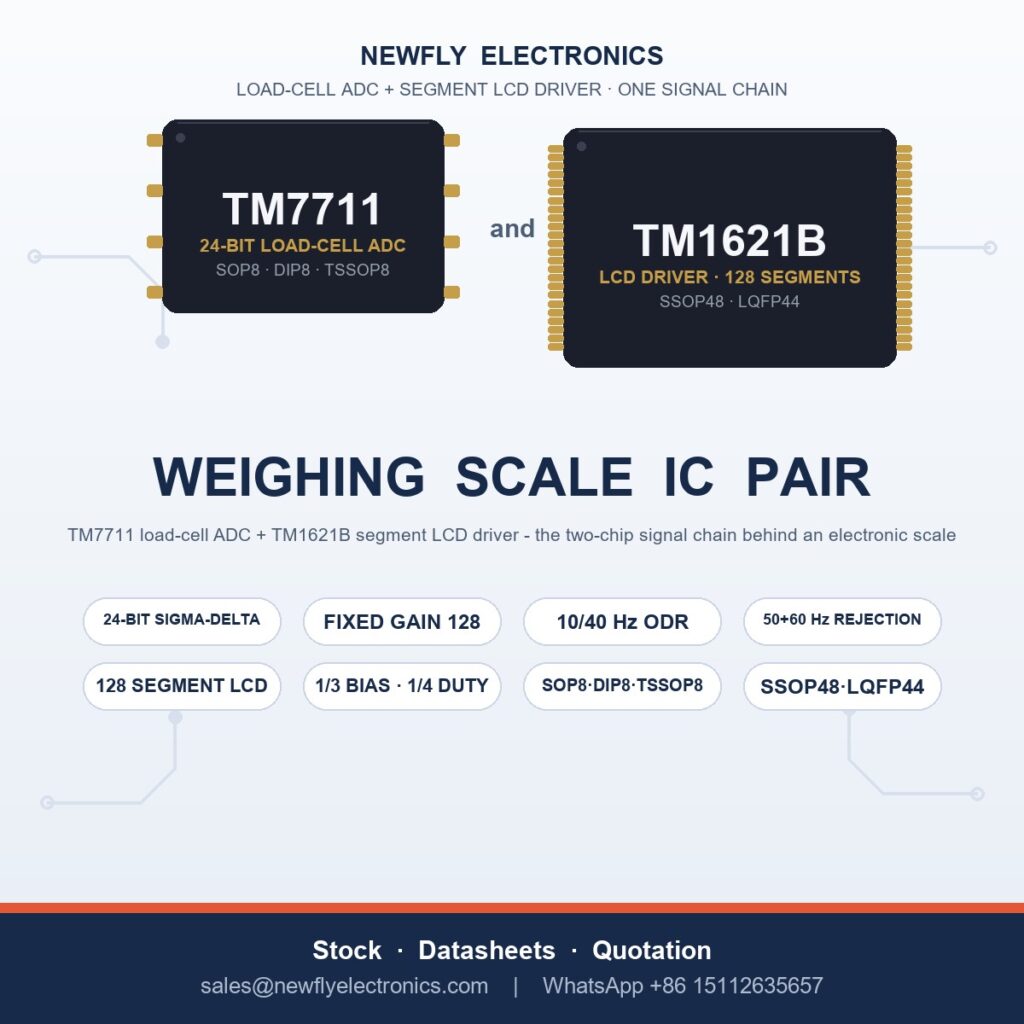
A printed circuit board inside an electronic scale makes two integrated-circuit decisions before anything else: the part that reads the load cell, and the part that drives the display. Get either one wrong and the product fails at the demo bench, not in the field. This guide walks through the Titan Micro (天微电子) pair that covers both decisions for segment-LCD weighing instruments — the TM7711 24-bit load-cell ADC on the input side and the TM1621B segment LCD driver on the output side — using only figures verified against the factory datasheets.
We are writing for purchasing managers and design engineers at scale and indicator manufacturers: retail price-computing scales for the Indian market, bench and platform scales across Southeast Asia, and compact portion scales for export brands in Europe and the Middle East. If your product has a segment LCD and a bridge-type load cell, this is the two-chip signal chain to evaluate first.
The signal chain in a segment-LCD weighing scale
The chain is short. A strain-gauge load cell outputs a differential signal of a few millivolts per volt of excitation. The TM7711 takes that differential pair straight in: its fixed-gain 128 low-noise amplifier brings the millivolt-level signal into range, a 24-bit sigma-delta converter digitises it, and the result leaves through a two-wire serial port (PD_SCK clock, DOUT data) to the MCU. The MCU applies calibration, converts counts to weight, and then writes the display.
The TM1621B sits between the MCU and the glass. It is a RAM-mapping LCD driver: the MCU writes segment patterns into its internal display RAM over a four-wire serial bus (CS, WR, DATA, RD), and the chip maintains the waveform on up to 128 segments (32 segments × 4 commons) autonomously, using its own built-in RC oscillator. The MCU never has to multiplex the LCD itself — it updates the RAM only when the reading changes, which is exactly what a battery-powered indicator wants.
Two off-the-shelf parts, no display multiplexing firmware, no analog front-end design work. That is the pitch — and also the trap, because each part has hard boundaries that a datasheet summary will not show you. The five rules in the next section are where designs actually fail.
TM7711: the load-cell front end
The TM7711 is a single-channel 24-bit analog front end built by Titan Micro Electronics for one job: reading a bridge sensor in a low-frequency weighing instrument. It pairs that converter with an on-chip temperature sensor with digital output and a power-down mode, both useful in portable indicators. Full pinout, package and sourcing detail live on our TM7711 24-bit ADC supplier page; the verified headline figures are below.
| Parameter | TM7711 (verified against datasheet V1.1/V1.4) |
|---|---|
| Manufacturer | Titan Micro Electronics (天微电子) |
| Function | 24-bit sigma-delta ADC with fixed-gain 128 LNA, for load cells |
| Input channel | 1 fully differential channel (AIN+ / AIN−) |
| Resolution | 24-bit, no missing codes |
| Linearity | ±0.001 % |
| Output data rate | 10 Hz / 40 Hz selectable |
| Line rejection | Simultaneous 50 Hz + 60 Hz rejection |
| Serial interface | 2-wire: PD_SCK (clock + power-down control), DOUT (data) |
| Reference | External VREF, 1.8 V to AVDD — no internal reference |
| Supply | AVDD and DVDD each 2.6 / 5.0 / 5.5 V; AVDD must not exceed DVDD |
| Logic input | VIH = 0.7 × DVDD |
| Extras | On-chip temperature sensor (digital output), power-down mode |
| Packages | SOP8, DIP8, TSSOP8 |
| Operating temperature | −40 °C to +85 °C |
One comparison matters here. Most scale designs historically start from the HX711, and the TM7711 is not a pin-compatible drop-in for it: the supply arrangement, the reference and the serial timing all differ. We published the full side-by-side in our TM7711 vs HX711 comparison — read it before anyone promises you a one-for-one swap.
TM1621B: the display side
The TM1621B is a RAM-mapping LCD segment driver with 32 × 4 = 128 segment outputs, a four-wire serial write interface and a built-in RC oscillator. It was designed for exactly the display family that weighing indicators use: custom segment glass showing weight, unit, price-per-kg, zero/tare and battery icons across a handful of 7-segment digits. Our TM1621B LCD driver supplier page carries the full sourcing detail and the pin-level comparison against the Holtek HT1621B.
| Parameter | TM1621B (verified specification) |
|---|---|
| Manufacturer | Titan Micro Electronics (天微电子) |
| Function | LCD segment display driver, RAM-mapping |
| Display capacity | 32 segments × 4 commons = 128 segments |
| Serial interface | 4-wire: CS, WR, DATA, RD |
| Operating voltage | 2.4 V – 5.2 V |
| LCD bias / duty | 1/3 bias, 1/4 duty |
| Oscillator | Built-in RC oscillator (no external clock) |
| Display RAM | 16 × 8 bits internal |
| Packages | SSOP48, LQFP44 |
| Operating temperature | −40 °C to +85 °C |
The 2.4–5.2 V range is the practical bridge between the two chips in a portable product: the same battery-friendly rail that feeds the MCU can feed the TM1621B, and the display keeps running on its own oscillator while the MCU sleeps between conversions.
Five design rules that decide whether this pair works
These are the points where we see field failures and support tickets originate. Each one is a rule you can check on a schematic in five minutes.
Rule 1 — PD_SCK is both the clock and the power-down control. On the TM7711, the same pin that clocks out each conversion also parks the device in power-down when it is held high. Firmware that leaves the clock line high after the last bit will produce a converter that reads fine once and then appears frozen — the classic “first reading works, then nothing” ticket. Park PD_SCK low between conversions.
Rule 2 — AVDD must never exceed DVDD. The datasheet constrains AVDD ≤ DVDD. The split that people attempt — 5 V analog side, 3.3 V digital side — is precisely the case the constraint rules out. Run both supplies at the same rail, or put the level problem on the interface instead.
Rule 3 — check VIH before mixing 3.3 V and 5 V. The TM7711 logic input threshold is 0.7 × DVDD. At DVDD = 5 V that is 3.5 V, which a 3.3 V MCU cannot reliably deliver. Either run the TM7711 at DVDD = 3.3 V-class supply, or add proper level translation. This is a hardware fact, not a suggestion — see the boundary section below.
Rule 4 — the reference is external, so design it ratiometric. The TM7711 has no internal voltage reference. For a weighing product the clean answer is a ratiometric hookup: derive VREF from the same excitation that drives the bridge, so excitation drift cancels in the ratio. Budget that reference network into the schematic from day one rather than discovering the missing pin later.
Rule 5 — order the glass to match the driver, not the other way round. The TM1621B drives 1/3 bias, 1/4 duty glass, 128 segments maximum, from a 2.4–5.2 V rail. Custom LCD tooling is ordered weeks before the ICs arrive; if the glass is drawn with a different duty or bias, or with more than 128 segments, the driver choice is already locked out. Confirm the duty/bias line on the glass drawing before you freeze the BOM.
One more expectation to set: the 10/40 Hz output data rate is calibrated for a human reading a display. It is entirely adequate for retail, bench, kitchen and body-weight products. It is not the converter for a high-speed checkweigher or a dynamic catching application — if your spec sheet talks about pieces per second, this is the wrong analog front end and we will say so before you buy.
Where this pair fits — and where it does not
| Product | TM7711 + TM1621B fit | Why |
|---|---|---|
| Retail price-computing scale (segment LCD) | Strong fit | Single load cell, human reading rate, unit + price segments within 128 |
| Bench / platform scale indicator | Strong fit | Same profile; temperature sensor helps outdoor and cold-room variants |
| Kitchen and portion scale | Strong fit | Battery product: power-down mode + self-maintained LCD |
| Body-weight scale | Fit | Adequate data rate; confirm glass duty/bias matches 1/3 · 1/4 |
| High-speed checkweigher / dynamic catching | Not this pair | 10/40 Hz ODR is too slow for dynamic weighing |
| Indicator with LED display | Not this pair | Use the LED driver family — see the TM1628 supplier page or the Titan Micro LED driver selection guide |
| Graphic LCD product | Not this pair | TM1621B is a segment driver; a graphic panel needs a different controller |
Applications and where the demand sits
India. The retail weighing market is one of the largest in the world and overwhelmingly uses price-computing indicators with segment LCDs. Buyers here search for the ADC and the LCD driver as separate line items, negotiate on package (DIP8 for in-house rework lines, SOP8 for volume SMT), and need date-code consistency across repeat orders. The TM7711’s 50 Hz + 60 Hz simultaneous rejection is a practical detail for markets where mains quality varies by district.
Southeast Asia — Vietnam, Thailand, Malaysia, the Philippines. OEM and contract-manufacturing demand concentrates on bench and platform scales for agriculture, food processing and logistics. These buyers typically source the TM7711 and TM1621B together on one purchase order and want the datasheets in English for their own customer audits.
Middle East. Retail modernisation and port logistics drive indicator volumes. Quotations here more often reference export documentation and shipping terms up front, so we keep those in the first reply rather than the third.
Europe and the USA. Volumes are smaller but better specified: portion-control scales for food service, lab-adjacent bench scales, and retrofit indicators. These buyers ask the sharpest questions about supply continuity and defect handling — both answered below in the commercial block, in writing, before the order.
What moves a TM7711 + TM1621B quotation
We can quote this pair fastest when an RFQ states five things: (1) the package per part — SOP8/DIP8/TSSOP8 for the TM7711, SSOP48/LQFP44 for the TM1621B; (2) the quantity band, since reel-based supply prices differently from cut-tape small batches; (3) whether the project is a new design or a second source, because second-source buyers should send us the current sourcing spec to match; (4) the destination port or delivery terms; and (5) the required documentation — datasheet revision, date-code policy, and any acceptance criteria your QC applies on receipt. Every one of those five is confirmed in writing with the quotation; none of them is invented to win the order.
The TM7711 + TM1621B pair: where it does not belong
Specification tables tell you what a part can do. Design failures come from what it cannot do. Before you commit a The TM7711 + TM1621B pair to a production board, check these cases — if any of them applies to your design, this is the wrong part and we will say so.
- your indicator uses an LED display, not an LCD — the TM1621B drives segment LCD glass only. Use the Titan Micro LED driver family instead (TM1628, TM1637 or TM1638) — start from the LED driver IC selection guide. We will route you there before we quote.
- your MCU runs 3.3 V and you expect to clock a TM7711 powered at DVDD = 5 V — the TM7711 logic threshold is 0.7 × DVDD, so a 5 V part needs 3.5 V minimum on PD_SCK. Run the digital supply at a rail your GPIO can meet, or add level translation. This is a datasheet constraint, not a recommendation.
- your product weighs multiple load cells or needs selectable gain — the TM7711 is a single fully differential channel with gain fixed at 128. There is no gain-64 option and no second channel. Ask us before designing around capabilities it does not have.
- you expect to drop the TM7711 into an HX711 footprint — it is not pin-compatible and the supply, reference and serial rules all differ. See our TM7711 vs HX711 comparison and re-validate on your own board.
- your LCD glass is drawn with more than 128 segments, a duty other than 1/4, or a bias other than 1/3 — the TM1621B tops out at 32 × 4 = 128 segments at 1/3 bias and 1/4 duty. Fix the driver choice before the glass tooling is ordered, not after.
- your product must be sold as an AEC-Q100 or otherwise automotive-qualified part — both parts are commercial-grade with no automotive qualification. We will decline the order rather than imply a grade they do not hold.
- your display is a graphic LCD panel — the TM1621B is a segment driver. A graphic panel needs a different controller entirely; this pair does not apply.
Working with Newfly: the numbers
Buyers evaluating a supplier want the commercial parameters stated, not implied. Here is ours. Where a figure depends on your quantity, package or destination, we say so rather than publishing a number that will not hold.
| Item | What we commit to |
|---|---|
| Sample order | Sample and small-batch quantities are supported. Sample fee, freight terms and dispatch time are confirmed in writing with each quotation. |
| Minimum order | Flexible. We support partial-reel and small-batch quantities for first orders and scale with you. |
| Lead time | Confirmed in writing per order, against the quantity and destination you specify. |
| Inspection | Marking, packaging and date-code verification before dispatch. Tell us your acceptance criteria and we will align to them. |
| Defect claims | The defect resolution process is agreed in writing before the order, not after a problem appears. |
A six-point pre-order checklist. Before you confirm a purchase order on either part: confirm your LCD glass duty and bias match 1/3 · 1/4; confirm the DVDD rail your MCU will clock the TM7711 with (Rule 3); send us the load cell impedance and sensitivity so the reference network is sized correctly; take a sample of both parts and validate on your own board before committing production; confirm package and date-code policy for the lot; and agree the defect-claim process in writing before shipment, not after.
When we tell you not to buy
A supplier who accepts every enquiry without question is not screening anything. These are the situations where we will recommend against the purchase:
- You ask us to quote the Holtek or HX711 side of the design together with the Titan Micro parts. We supply the Titan Micro side only — we do not stock HT1621B, HX711 or other competing brands, and we will not pretend otherwise to win the order.
- You plan to swap the TM7711 into a running HX711-based design without re-validating the supply, reference network and serial timing on your own board. The parts overlap in job, not in footprint.
- You want a production order before either part has been validated on your own load cell and your own LCD glass. We will recommend a sample first and say why.
- The lot on offer is mixed date codes on one reel with no traceable origin. On instruments that get stamped for legal metrology, we will describe that risk rather than quote it as normal stock.
- Your target price can only be met with material we cannot verify as original Titan Micro product. We will decline the order rather than carry that exposure into your product.
- Your procurement rules require a franchised-channel certificate of conformity that only the manufacturer or its authorised channel can issue. We are an export distributor, not the franchised channel — if that paper is mandatory, we are not the right supplier for the line.
Frequently Asked Questions
Which ICs do I need to build a segment-LCD weighing scale?
At minimum: a load-cell ADC (the TM7711), an MCU, and a segment LCD driver (the TM1621B) matched to your glass. The TM7711 reads the bridge; the TM1621B drives up to 128 segments from its internal RAM. Both are supplied by Newfly Electronics with datasheets and export service.
Is the TM7711 a drop-in replacement for the HX711?
No. It serves the same job but is not pin-compatible, has one channel instead of two, fixed gain 128 instead of selectable gains, an external reference instead of an internal one, and different supply constraints. Read our TM7711 vs HX711 comparison and re-validate on your own board before switching.
What display can the TM1621B drive?
Custom segment LCD glass: up to 32 segments × 4 commons (128 segments), 1/3 bias, 1/4 duty, from a 2.4–5.2 V supply. That covers the typical weight + price + unit + icon layout of a weighing indicator.
Can the TM7711 work with a 3.3 V MCU?
Yes, if the supply constraint holds: AVDD must not exceed DVDD, and the TM7711 input threshold is 0.7 × DVDD. Run the TM7711 digital side at a rail your MCU can meet, or add level translation. Do not clock a 5 V DVDD part from a 3.3 V GPIO.
What package does the TM7711 come in?
SOP8, DIP8 and TSSOP8. Pin order: 1 VREF, 2 AGND, 3 AIN−, 4 AIN+, 5 PD_SCK, 6 DOUT, 7 DVDD, 8 AVDD.
What package does the TM1621B come in?
SSOP48 and LQFP44.
Do you provide datasheets and technical support?
Yes. We provide the current factory datasheet for both parts with every quotation, and we answer pin-level and firmware-level questions ourselves rather than forwarding you to a forum.
Can I buy small quantities or samples first?
Yes. Sample and small-batch quantities are supported on both parts; fee, freight and dispatch time are confirmed in writing with each quotation. See the commercial block above and our IC supplier selection guide.
Request a Quotation
Send us the part number, the package and the quantity you need. We will reply with price, confirmed stock and lead time for the a TM7711 / TM1621B weighing-instrument requirement.
See also the TM7711 24-bit ADC supplier page. See also the TM7711 vs HX711 comparison. See also the TM7711 product page. See also the TM1621B LCD driver supplier page. See also the TM1621B vs HT1621B comparison. See also the TM1628 LED driver supplier page. See also the Titan Micro IC product portfolio. See also where to buy Titan Micro IC chips online.
Contact Newfly Electronics
Email: sales@newflyelectronics.com
WhatsApp: +86 15112635657