
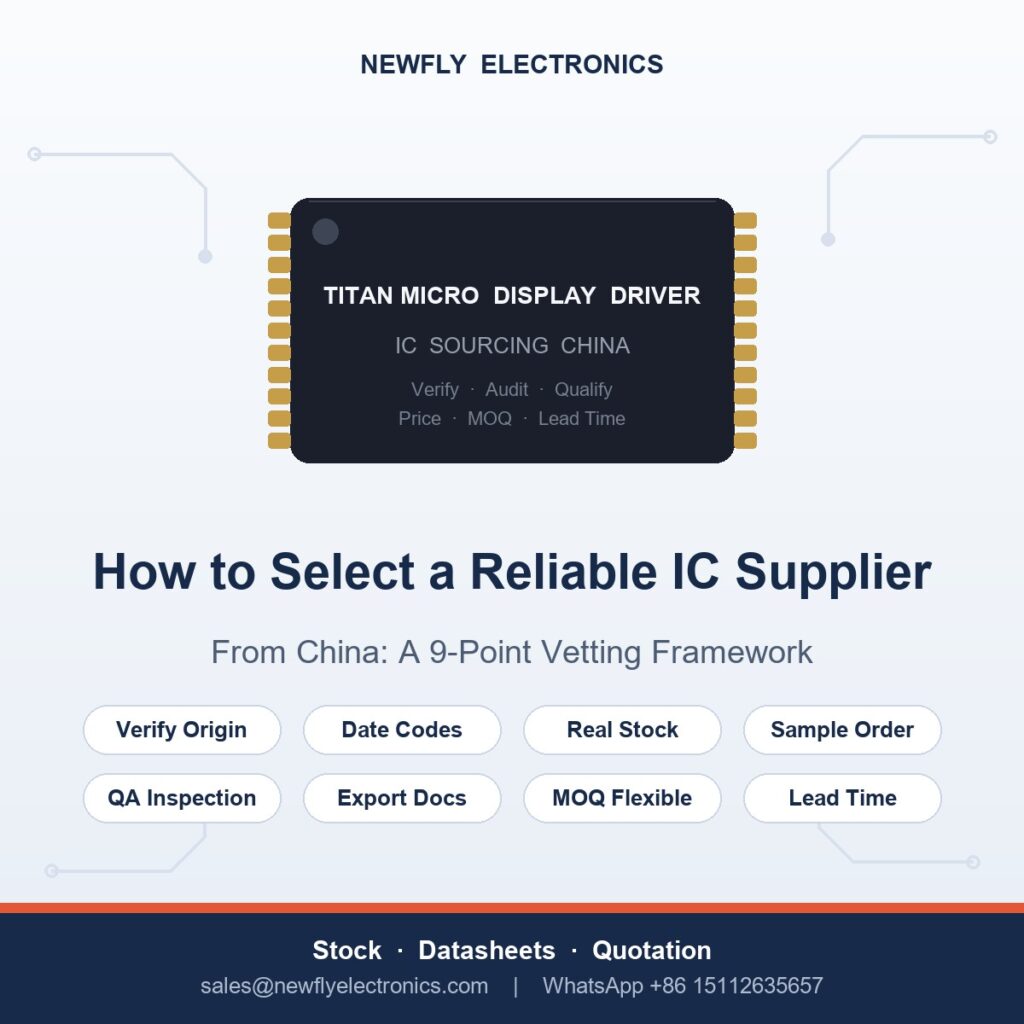
Searching for an IC supplier in China takes about ten minutes. Choosing one you can still rely on for the third repeat order takes considerably longer, and that is where most overseas buyers lose money. The Chinese electronic component market is enormous, open, and largely unregulated at the trading layer. For every factory-linked export distributor there are dozens of trading companies reselling the same part numbers without ever touching the inventory, and a smaller number of sellers moving re-marked, re-balled, or salvaged product into the same listings.
For buyers in India, Vietnam, Thailand, Malaysia, the Philippines, the Middle East, Europe, and the USA, the problem is not availability. Display driver ICs such as the TM1637 or the TM1640 are widely listed. The problem is knowing which listing will deliver original, traceable, production-grade material on a repeatable schedule, and which one will deliver a partial shipment, a different date code, or nothing at all after the deposit clears.
This guide sets out a practical, nine-point framework for evaluating an IC supplier from China. It is written for purchasing managers and hardware engineers who need to qualify a vendor before a production run, not after a field failure.
What You Are Actually Buying: Display Driver ICs from Titan Micro
Before vetting suppliers, it helps to be precise about the product category, because generic suppliers cannot support it as well as specialists can. The part numbers most overseas buyers source from China cluster around display driver ICs manufactured by Titan Micro Electronics (天微电子), a Shenzhen-based fabless semiconductor company whose devices are designed into consumer appliances, instrumentation, and industrial control panels worldwide.
Two product families dominate demand. The first is the LED display driver family, which drives 7-segment and dot-matrix LED displays and, in several cases, includes an integrated keyboard scan matrix so that a single chip handles both the display and the front-panel buttons. The TM1637, TM1650, TM1628, TM1638, TM1668, and TM1616 all belong to this group.
The second is the LCD segment driver family, represented chiefly by the TM1621B and its package variants. These are RAM-mapping segment drivers used where an LCD rather than an LED display is required, typically in energy meters, thermostats, and measurement instruments.
Why does this matter for supplier selection? Because a supplier who genuinely specializes in display driver ICs will know the difference between a TM1637 and a TM1650 pinout, will hold the correct packages in stock rather than substituting a lookalike, and will be able to tell you when a part is being phased out. A generalist trading company will quote you whatever you ask for and sort out the mismatch later.
Technical Specifications: A Reference Table for Vetting Claims
Use the table below as a sanity check. When a supplier quotes you a “TM1637 in SOP28” or a “TM1621B with keyboard scan”, the answer is wrong, and that is your first filter. Any vendor who cannot answer these basic specification questions accurately is not a specialist.
| Model | Function | Display Capability | Interface | Supply Voltage | Keyboard Scan | Package |
|---|---|---|---|---|---|---|
| TM1637 | LED display driver | 8 seg × 6 bit | 2-wire serial | 5 V | Yes | SOP20 / DIP20 |
| TM1640 | LED panel driver | 8 seg × 16 bit (128 dots) | 2-wire serial | 5 V | No | SOP28 / SSOP28 |
| TM1650 | LED display driver | 8 seg × 4 bit / 7 seg × 4 bit | 2-wire serial | 2.8–5.5 V | Yes | SOP16 / DIP16 |
| TM1628 | LED display driver | 10 seg × 7 bit to 13 seg × 4 bit | 3-wire serial | 5 V | Yes | SOP28 |
| TM1621B | LCD segment driver | RAM-mapping segment drive | 4-wire serial | 2.4–5.2 V | No | SSOP48 / LQFP44 |
| TM1638 | LED display driver | 10 seg × 8 bit | 3-wire serial | 5 V | Yes | SOP28 |
| TM1668 | LED display driver | 10 seg × 7 bit | 3-wire serial | 3.3–5.5 V | Yes | SOP24 / SSOP24 |
| TM1616 | Compact LED driver | 7 seg × 4 bit | 2-wire serial | 2.8–5.5 V | No | SOP16 / DIP16 |
All of the LED driver devices above provide 8-level brightness control and are designed for common-cathode or common-anode display configurations depending on the model. The full model-by-model breakdown is covered in the Titan Micro LED driver IC selection guide.
Where These ICs Actually Ship: Applications and Regional Demand
Understanding the end applications makes it easier to judge whether a supplier’s stated stock profile is credible. A vendor claiming 500,000 pieces of TM1621B in stock is more plausible than one claiming 500,000 pieces of a niche package variant, because the demand profile is different.
In India, the dominant pull is for energy meters and instrumentation, which drives sustained TM1621B and TM1621C/D volume alongside TM1637 for small appliance front panels. Indian contract manufacturers frequently need moderate volumes with short lead times, and they value a supplier who can ship a partial reel rather than insisting on full MOQ.
In Vietnam and Thailand, the appliance and consumer electronics assembly sector consumes TM1650 and TM1628 in air conditioner control panels, washing machine displays, and set-top boxes. These buyers generally operate on scheduled production and care most about date-code consistency across repeat shipments.
In Malaysia, the Philippines, and across Southeast Asia more broadly, demand is split between EMS providers building industrial control panels, which favor TM1640 for larger dot-matrix panels, and smaller consumer-goods manufacturers using TM1616 and TM1668 where PCB space is tight.
In Europe, the Middle East, and the USA, buyers often come through distribution or aftermarket repair channels. Volumes are lower, documentation requirements are higher, and the ability of the supplier to provide correct datasheets, compliance paperwork, and honest packaging counts for more than a marginal price difference.
Comparison: The Four Channels You Can Buy From
Almost every overseas purchase of a Titan Micro display driver IC travels through one of four channels. They are not equally suited to every buyer, and the cost difference between them is largely a price paid for risk transfer.
| Channel | What It Is | Typical MOQ | Price Level | Traceability | Best For |
|---|---|---|---|---|---|
| Authorized / franchised distributor | Contract distributor with formal manufacturer agreement | High, often reel or carton | Highest | Full, with certificates | Large OEM programs with audit requirements |
| China export distributor | Supplier linked to the China supply chain with export operations | Flexible, from partial reel | Competitive | Good, on request | Small to mid-volume production and repeat orders |
| Open-market broker | Trading company reselling inventory it does not own | Flexible | Variable, can be lowest | Usually none | Urgent one-off shortages, with full incoming inspection |
| Marketplace listing | Generic B2B or consumer marketplace seller | Very low | Lowest headline | Typically none | Samples and hobby use only |
The practical rule for production buyers is this: channels one and two are the only ones that should be feeding a production line without full incoming inspection. Channel three can be defensible when you are recovering from a shortage and you have the test capability to verify what arrives. Channel four is a sampling channel, not a procurement channel, regardless of how attractive the price looks. Counterfeit and re-marked display driver ICs are most commonly introduced at the broker and marketplace layers.
If you are comparing specific devices rather than channels, the detailed device-level comparisons are covered separately: TM1637 vs TM1650, TM1640 vs MAX7219, TM1650 vs HT16K33, TM1628 vs HT1628, TM1621B vs HT1621B, and the cross-brand overview in Titan Micro vs HT series.
Buying Guide: Nine Checks Before You Place a Production Order
Apply these in order. The first four take under an hour and eliminate most of the risk.
1. Verify the origin of the material, not just the part number. Ask directly whether the goods are original Titan Micro production, and ask for the manufacturer’s marking convention on the package. A supplier who can describe the top marking, the reel label format, and the packaging standard is working with real material. One who answers only “original, 100% new” is giving you a slogan, not information.
2. Ask for date-code consistency across lots. Mixed date codes are normal in broker stock and problematic in production. If you are building a product that will be in the field for years, you want a single date code per shipment where possible. Suppliers who cannot commit to this are selling whatever comes to hand.
3. Confirm the stock position is real. For display driver ICs, “in stock” should mean physically held and shippable within days. Ask for the quantity on hand, the warehouse location, and the shipping window in writing. A supplier who is honest about having 20,000 pieces of TM1650 rather than 200,000 is more useful than one who inflates numbers, because you can plan around the truth.
4. Test a sample order before a production order. Order a small quantity of the exact device and package. Inspect the top marking under magnification, check pin finish and coplanarity, verify the reel or tube labeling, and run the parts on your own board. A supplier who resists a sample order at a fair price is signalling that the material will not survive inspection.
5. Establish who is doing quality inspection, and how. Ask what incoming inspection is performed before goods leave China: visual, marking verification, and whether any electrical or functional test is available. For critical programs, third-party inspection before shipment is worth the cost, and a good supplier will accommodate it without friction.
6. Confirm real export experience and documentation. Export capability is not a formality. Ask which countries they ship to regularly, how they handle commercial invoices and packing lists, whether they can provide a certificate of origin, and how they declare the goods. Suppliers who hesitate on documentation create customs delays that cost far more than the price saving.
7. Test MOQ flexibility against your actual demand. One of the persistent frustrations with buying Titan Micro parts overseas is that the manufacturer’s own export channel is oriented toward volume and quotes accordingly. A supplier worth keeping will support a first order at partial-reel quantities and scale with you, rather than demanding a carton on the first transaction.
8. Ask what happens on the second order. This is the single most revealing question you can ask. Anyone can source a part once. Ask how the supplier maintains continuity: do they hold buffer stock, do they have multiple upstream sources for the same part number, and what is the typical lead time when the spot market is empty. Supply stability is the difference between a vendor and a transaction.
9. Judge the technical support honestly. For display driver ICs, support questions are specific: brightness register configuration, scan matrix wiring, drive current setting, package thermal considerations, and adaptation notes when you are moving a design from a competing device. A supplier who can route these questions to someone competent, rather than forwarding a PDF you already have, is worth a small price premium.
Two additional checks matter for buyers in regulated markets. First, ask for conflict-minerals and RoHS documentation if your compliance framework requires it. Second, ask about the warranty position on non-conforming material and the process for a claim, in writing, before you order. A supplier who will not commit to a defect resolution process is not planning to be there when a problem occurs.
For a broader view of where Titan Micro parts can be purchased and how the channels are priced, see Where to buy Titan Micro IC chips online and the Titan Micro TM IC sourcing guide. Buyers qualifying a vendor for the first time should also review where to buy original Titan Micro ICs for international projects.
Why Choose Newfly Electronics
Newfly Electronics is a China-based distributor specializing in Titan Micro (天微电子) display driver ICs, serving electronics manufacturers, EMS providers, and design houses across India, Southeast Asia, the Middle East, Europe, and the Americas.
Our position in the supply chain is deliberate. Titan Micro does not run a dedicated foreign trade sales team, and its direct quotations to overseas buyers reflect volume requirements that most small and mid-sized manufacturers cannot meet. Newfly closes that gap. We buy within the China supply chain, hold inventory across the LED and LCD driver families, and export in quantities that match how our customers actually produce.
What that means in practice:
- Competitive China supply chain pricing. Direct sourcing without the broker margin layers, quoted against your specific annual requirement rather than a list price.
- Stable supply and honest stock positions. We tell you what we hold, not what we can theoretically find. Repeat-order continuity is the core of our business, not spot transactions.
- Export experience. Established shipping and documentation processes for India, Vietnam, Thailand, Malaysia, the Philippines, the Middle East, Europe, and the USA.
- Technical support. Application guidance on register configuration, scan matrix design, drive current, and model substitution or replacement within the Titan Micro range and across to competing families.
- Small quantity and bulk orders both supported. Sample and prototyping quantities through to production volumes, with the ability to scale as your program ramps.
If you are currently qualifying suppliers for a display driver IC requirement, the fastest way to evaluate us is to send the part number, package, and quantity you need. We will come back with price, availability, and lead time. Email sales@newflyelectronics.com or reach us on WhatsApp at +86 15112635657.
FAQ: Selecting an IC Supplier from China
How do I verify that an IC supplier in China is legitimate?
Start with a small paid sample order, then verify package markings, pin finish, and reel or tube labeling against the manufacturer’s convention. After that, ask for a written statement of origin, date-code consistency, and defect resolution terms. Legitimate suppliers answer these directly and without delay. Suppliers who deflect on documentation or resist sample orders are the ones to eliminate first.
Is it risky to buy display driver ICs from China?
The risk is concentrated in the broker and marketplace layers, where re-marked and salvaged parts circulate. Buying from a China export distributor that is linked to the supply chain, holds the inventory it quotes, and supports a sample order reduces that risk substantially. Full incoming inspection is still advisable on the first shipment of any new supplier relationship.
What is a reasonable MOQ when buying Titan Micro ICs overseas?
A specialist distributor should be able to support partial-reel quantities for first orders and prototyping, then scale with you. If a supplier insists on full cartons from the first transaction and you are not running a large program, you are talking to a channel that is not structured for your demand.
Can Newfly Electronics provide datasheets and technical support?
Yes. We supply datasheets for the Titan Micro parts we stock, including the TM1637, TM1640, TM1650, TM1628, TM1621B, TM1638, TM1668, and TM1616 families, and we support application questions on register configuration, display wiring, and drive current settings.
Do you support small quantity orders as well as bulk orders?
Yes. Sample and small-batch quantities are supported alongside production volumes. This is one of the practical differences between working with a distributor structured for export orders and buying directly from a manufacturer whose quotation policy assumes large annual commitments.
How long does shipping take from China?
Lead time depends on the destination and the shipping method chosen. In-stock items ship quickly; express courier is typically the fastest option for samples, while air and sea freight are more economical at volume. We confirm the shipping window in writing with each quotation.
What should I do if the parts fail inspection?
Raise the claim with the batch reference and the inspection findings. This is why the defect resolution process should be agreed before the order rather than after a problem appears, and why we document the process up front for every customer.
Can you suggest a replacement if the part I need is unavailable?
Yes. For most Titan Micro display driver ICs there is a functional alternative within the same family, or a cross-family equivalent. For example, the TM1637, TM1638, and TM1650 overlap in function, while the TM1668 and TM1628 and the TM1616 and TM1650 can substitute in specific cases. We confirm pin and protocol compatibility before recommending a switch.
Request a Quotation
Supplier selection comes down to evidence, not assurances. Send us the part number, package, and quantity you need, and we will respond with pricing, confirmed stock, and lead time so you can evaluate us on the same criteria you would apply to any other vendor.
For buyers working through the qualification process, our Titan Micro distributor overview and the best LED driver IC for digital display applications guide provide additional context on part selection and supply.
Contact Newfly Electronics
Email: sales@newflyelectronics.com
WhatsApp: +86 15112635657
Tell us the model, the package, and the quantity. We will send price and availability, the datasheet if you need it, and a clear shipping window.