
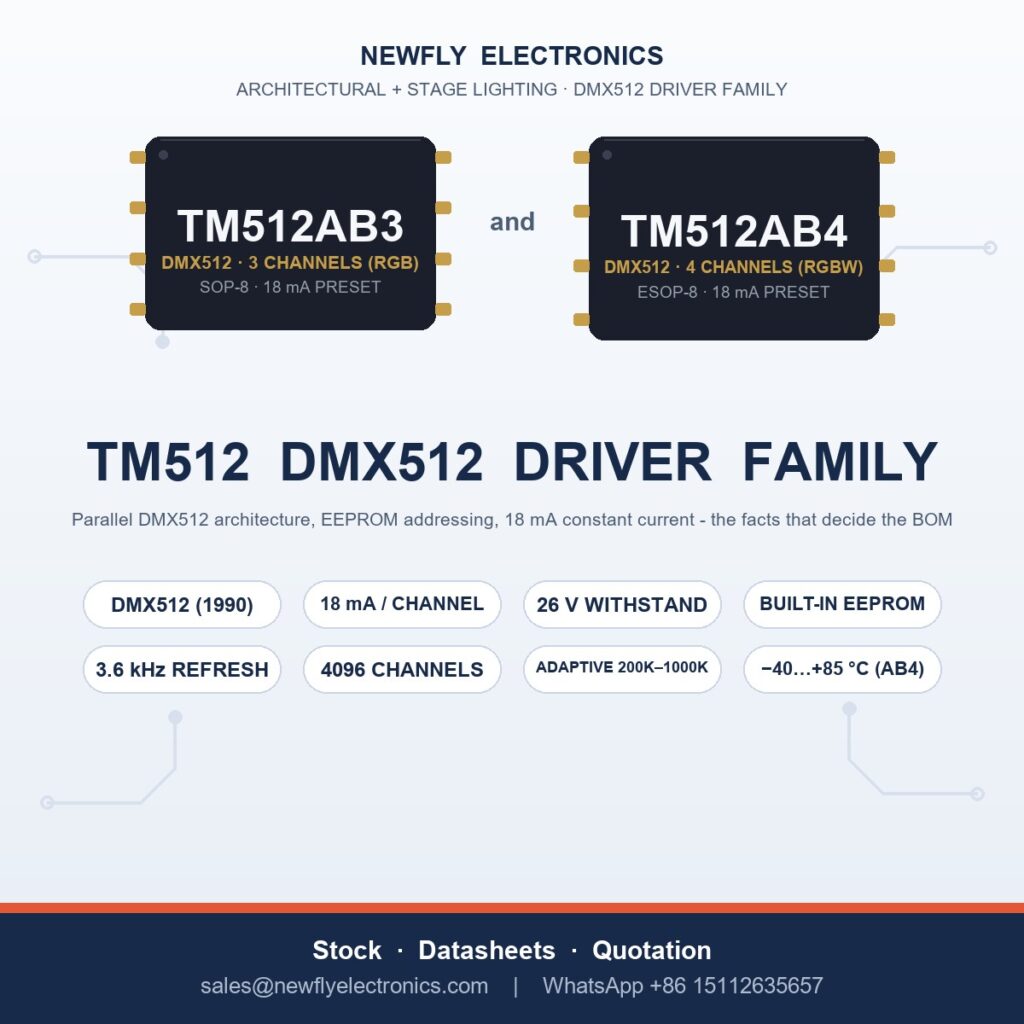
Purchase teams for architectural and stage lighting brands do not search for “LED driver IC”. They search for the exact part their BOM already names: TM512AB3 supplier, TM512AB4 price, TM512 datasheet, or a DMX512 decoder IC that can be addressed online without pulling fixtures off the ceiling. If that is how you arrived here, this page is written for you.
The TM512 family is Tian Micro Electronics’ (天微电子, Titan Micro Electronics) DMX512-protocol LED driver line. It is a different architecture from the cascade pixel drivers (TM1804, TM1809, TM1812, TM1814) we covered in earlier articles: instead of every chip forwarding data to the next one down the string, every TM512 device taps the same parallel data line and holds its own address in built-in EEPROM. For large installations — facades, wall washers, stage washes — that topology decision affects wiring, failure behaviour and maintenance cost more than any single electrical parameter.
This page covers what the family does, the verified specifications of the two flagship catalogue parts (TM512AB3 and TM512AB4), how the address system works, how to verify incoming goods, and what to send us for a quotation. Newfly Electronics is an export distributor for Titan Micro product from China; every part number below links to our live product pages.
What the TM512 Family Is — and Why Topology Is the First Decision
All TM512 variants decode the DMX512 (1990) signal protocol with Titan Micro’s own extensions. Three family characteristics drive the purchasing decision:
- Single-wire parallel control, up to 4096 addressable channels. One data line feeds every device in the installation; each IC reacts only to its own stored address. There is no serial cascade to size, and no maximum string length in the pixel-driver sense.
- Fully adaptive decoding from 200 Kbps to 1000 Kbps. The decoder locks to the incoming DMX512 data rate with no speed configuration, so controller substitutions do not force a firmware or BOM change.
- Built-in EEPROM addressing. The address lives inside the chip. No external memory device, no address pins to strap on the PCB, and addresses can be rewritten in circuit — a failed unit is replaced and re-programmed on the spot.
Because every device sits on the same line in parallel, a fault in one IC does not take down the rest of the installation. For a 500-fixture facade, that difference against a cascade design is the whole service argument: you swap one node instead of tracing a broken data chain.
The family is broader than two part numbers. Our current catalogue carries TM512-AL1 (1–4 channel), TM512AB3 (3-channel RGB), TM512AB4 (4-channel RGBW), TM512AC0 (with forwarding function), TM512AC4 (differential parallel protocol), TM512ACE, TM512AD (high-precision constant current), TM512AE0 (decoder), TM512BC and TM512BCE (16-bit grayscale, gamma 2.2). If your BOM names a variant you do not see here, send it to us — the family has more members than any catalogue page lists.
TM512AB3 and TM512AB4: Verified Specifications
These are the two variants most lighting BOMs start from — AB3 for RGB fixtures, AB4 for RGBW. The values below are compiled from Titan Micro product data as published in the major component catalogues (LCSC C5174550 and C21882406, JLCPCB part library). As always on this site: confirm the exact values against the current datasheet revision we ship with your order, because Titan Micro revises documents and catalogues lag.
| Parameter | TM512AB3 | TM512AB4 |
|---|---|---|
| Protocol | DMX512 (1990), compatible + extended | DMX512 (1990), compatible + extended |
| Control method | Single-wire parallel | Single-wire parallel |
| Addressable channels (system) | Up to 4096 | Up to 4096 |
| Output channels per IC | 3 (R/G/B) | 4 (R/G/B/W) |
| Output type | Constant current, 18 mA preset | Constant current, 18 mA preset |
| Constant-current accuracy | ±3% | ±3% (inter-chip) |
| Output withstand voltage | 26 V | >26 V |
| Supply voltage (VDD) | 3.8–6 V | 3.8–6 V |
| Voltage regulator | Built-in 5 V regulator | Built-in 5 V regulator |
| Frame refresh rate | 3.6 kHz class | 3.6 kHz |
| Adaptive decoding range | 200 Kbps – 1000 Kbps | 200 Kbps – 1000 Kbps |
| Address storage | Built-in EEPROM, online write | Built-in EEPROM, online write |
| Package | SOP-8 | ESOP-8 |
| Operating temperature | Confirm against datasheet revision | −40 °C to +85 °C |
Two practical notes on this table. First, the 18 mA output is a preset constant current — it is set inside the part, not trimmed by an external resistor on the AB3/AB4 pinout. If your LED budget needs a different current per channel, tell us before you design the board around it; other family members handle current setting differently. Second, the 26 V figure is an output-stage withstand rating, not a supply input range — the same distinction we flagged for the TM1804 output stage in our 12 V / 24 V rail guide. The chip runs from a 3.8–6 V logic supply; the outputs tolerate the higher voltage that long LED strings present.
How the Address System Works — the Section That Decides the Purchase
On a 400-fixture project, addressing labour is a real cost line. This is where the TM512 family earns its place on the BOM, and where cheap DMX512 decoders without these features fail in the field:
- Daisy-chained address-write line. Devices connect their write pins in a chain separate from the data line. One programming pass writes addresses to every IC in the chain — the documented online cascade span is 100 m point spacing by 1024 cascaded nodes, in a single batch operation.
- Install first, write later. Addresses can be programmed after the fixtures are physically installed. You do not pre-address at the bench and hope the site wiring matches the plan.
- No power cycle needed. A newly written address code takes effect immediately.
- Write protection built in. Eight anti-interference and checksum-matching settings prevent stray pulses on the write line from corrupting stored addresses, and an externally triggered write mode blocks erroneous writes during power-up, power-down and supply interference events.
- Dual EEPROM backup. Address codes are stored with redundancy — a single EEPROM cell failure does not lose the address.
- Visual verification. The outputs run a white self-test at power-up and show blue after a successful address verification, so a technician can confirm addressing from the floor without test equipment.
When you compare quotations across DMX512 driver ICs, ask each supplier exactly these questions: where is the address stored, how is it written, what protects it from write-line interference, and how does the installer verify it. If the answer is “an external EEPROM and a programmer”, the fixture-level service cost over five years will exceed the chip price difference many times over.
Goods-In Verification Checklist for TM512 Deliveries
Before TM512 stock reaches your SMT line, run this sequence. It is what we do before dispatch, and it is what we recommend your receiving team repeats:
- Marking and date code. Every reel and every bag carries the full part number and a consistent date code. Mixed date codes on one reel are a rejection trigger, not a discount opportunity.
- Package check against the BOM. AB3 ships in SOP-8, AB4 in ESOP-8 (exposed pad). Verify the footprint matches — an ESOP-8 landed on an SOP-8 pad pattern will pass visual inspection and fail thermally.
- Power-up self-test. Apply supply and observe the white self-test output state. No self-test behaviour is the first sign of a re-marked or damaged device.
- Address-write verification. Write a test address through the write line, confirm it reads back, power-cycle, confirm it holds, and observe the blue verification state.
- Constant-current check at your rail. Measure channel current at your actual VDD and LED load, not at nominal conditions. The ±3% accuracy figure assumes the datasheet test conditions.
- Protocol response. Feed a DMX512 frame from your console or a test generator across the 200–1000 Kbps range and confirm adaptive locking without configuration.
Applications and Where the Demand Comes From
The TM512 family was designed for architectural decoration and stage lighting LED systems — anywhere many fixtures share one control line and service access is expensive:
- Point light sources and linear light on building facades and coves
- Wall washer fixtures for hotels, malls and bridges
- Stage lighting systems — wash, blind and effect fixtures
- Indoor and outdoor video walls built from discrete LED nodes
- Decorative lighting — signage, theme-park and landscape installations
Regional demand patterns we see in enquiries: the Gulf and wider Middle East drives facade and mall lighting volumes, where wall washers and linear cove runs dominate. India combines stage and event lighting manufacturing with growing architectural retrofits — buyers there typically ask about the AB3 first and the price break at 10K pieces. Vietnam, Thailand and Malaysia buy for both domestic decorative manufacturing and contract production for Western brands, and their engineers ask the sharpest protocol questions. Europe and the US enquiries tend to be replacement and re-engineering orders — an existing fixture line whose original decoder IC became unavailable, which is exactly the scenario in our Titan Micro alternative and replacement guide.
What Moves a TM512 Quotation
When you request pricing, these five variables determine what we can offer — stating them up front removes a full round-trip of emails:
- Exact variant and package. AB3 and AB4 price and stock differently from AC0, AC4, AD, AE0, BC or BCE, and ESOP-8 and SOP-8 reel economics differ.
- Quantity and schedule. A one-off engineering batch of 500 and a rolling annual agreement of 500K price differently — and we will tell you honestly which one you are asking for.
- Packing preference. Reel, tape, or bulk; partial-reel quantities are supported for first orders.
- Destination and shipping terms. Port, courier or freight forwarder, and the documents your import process requires.
- Validation status. Whether this is a sample-stage evaluation or a production repeat order changes what we commit to in writing.
Six Points to Confirm Before You Place a Purchase Order
- Confirm the exact suffix on your BOM against our product catalogue — the TM512 family is not interchangeable suffix-to-suffix, and channel count, grayscale depth and protocol details differ across it.
- Confirm the current datasheet revision for that suffix before freezing your footprint and schematic.
- Confirm output current per channel against your LED specification — the AB3/AB4 18 mA preset is fixed, not programmable.
- Confirm the address-write procedure your production line will use, and that your fixtures expose the write line connector.
- Agree the acceptance criteria (marking, date code, electrical test) before dispatch, not after receipt.
- Agree the sample-to-production path in writing: what the sample validates, what the first production batch confirms.
The TM512 family: where it does not belong
Specification tables tell you what a part can do. Design failures come from what it cannot do. Before you commit a The TM512 family to a production board, check these cases — if any of them applies to your design, this is the wrong part and we will say so.
- your product is a serial-cascade pixel item — an addressable strip, a pixel module, a string light — the TM512 family is a parallel DMX512 architecture, not a forwarding cascade. Use the cascade pixel family (TM1804, TM1809, TM1812, TM1814) — see our three-way pixel-driver comparison. We will say this before you buy.
- you expect to address the ICs from a standard DMX512 console — TM512 decodes DMX512 (1990) protocol data, but address writing uses Titan Micro’s dedicated address-write line, not the console. Plan the addressing step into production and installation.
- your LED string presents more than the 26 V output withstand at the driver outputs — 26 V is an output-stage rating, not a supply input range — the logic supply is 3.8–6 V. Size your series strings within the output rating, the same rule we publish for the TM1804.
- you need a per-channel current other than the AB3/AB4 18 mA preset — the AB3/AB4 constant current is fixed inside the part. Do not design the board around a trim that does not exist — ask us which family variant matches your current budget first.
- your product must be sold as an AEC-Q100 or otherwise automotive-qualified part — the TM512 family is commercial-grade with no automotive qualification. We will decline the order rather than imply a grade the part does not hold.
- your design assumes pin compatibility across TM512 suffixes — the suffixes differ in channel count, grayscale depth, protocol detail and package. They are not interchangeable. Confirm the exact suffix against the current datasheet before freezing the layout.
Working with Newfly: the numbers
Buyers evaluating a supplier want the commercial parameters stated, not implied. Here is ours. Where a figure depends on your quantity, package or destination, we say so rather than publishing a number that will not hold.
| Item | What we commit to |
|---|---|
| Sample order | Sample and small-batch quantities are supported. Sample fee, freight terms and dispatch time are confirmed in writing with each quotation. |
| Minimum order | Flexible. We support partial-reel and small-batch quantities for first orders and scale with you. |
| Lead time | Confirmed in writing per order, against the quantity and destination you specify. |
| Inspection | Marking, packaging and date-code verification before dispatch. Tell us your acceptance criteria and we will align to them. |
| Defect claims | The defect resolution process is agreed in writing before the order, not after a problem appears. |
When we tell you not to buy
A supplier who accepts every enquiry without question is not screening anything. These are the situations where we will recommend against the purchase:
- You ask us to quote a competing DMX512 decoder brand as a package with the TM512. We supply the Titan Micro side only — we do not stock other decoder brands, and we will not pretend otherwise to win the order.
- You plan to swap one TM512 suffix for another (AB3 to AB4, AB4 to BCE) without re-validating channel count, grayscale depth and protocol behaviour on your fixtures. They are not drop-in equivalents.
- The lot available to you is mixed date codes on one reel with no traceable origin. On lighting installed at height or inside a finished build, we will describe that risk rather than quote it as normal stock.
- You want a production order before the part has been validated on your own fixture at your own rail and LED load. We will recommend a sample first and say why.
- Your target price can only be met with material we cannot verify as original Titan Micro product. We will decline the order rather than carry that exposure into your installation.
- Your procurement rules require a franchised-channel certificate of conformity that only the manufacturer or its authorised channel can issue. We are an export distributor, not the franchised channel — if that paper is mandatory, we are not the right supplier for the line.
Frequently Asked Questions
Where can I buy original TM512AB3 and TM512AB4 ICs?
Newfly Electronics supplies original Titan Micro TM512 family parts from China with export documentation. Product pages: TM512AB3 and TM512AB4. Email sales@newflyelectronics.com with the part number, package and quantity for price and confirmed stock.
Is the TM512 family compatible with a standard DMX512 console?
The family decodes DMX512 (1990) protocol signals with Titan Micro extensions and adapts automatically to data rates from 200 Kbps to 1000 Kbps. Addressing, however, uses Titan Micro’s dedicated address-write line rather than the console — plan the addressing step into your production and installation process.
What is the difference between TM512AB3 and TM512AB4?
AB3 provides 3 constant-current channels (RGB) in SOP-8; AB4 provides 4 channels (RGBW) in ESOP-8. Both run a preset 18 mA per channel, ±3% accuracy, 26 V-class output withstand, 3.8–6 V supply with built-in 5 V regulator, and 3.6 kHz-class frame refresh.
How many TM512 ICs can be programmed online in one installation?
The documented online cascade write span is 100 m point spacing by 1024 cascaded nodes in one batch operation, and the protocol supports up to 4096 addressable channels system-wide.
What package does the TM512 come in?
TM512AB3 ships in SOP-8 and TM512AB4 in ESOP-8. Other family members use different packages — confirm the suffix-specific package on the product page or in the datasheet we provide.
Does Newfly Electronics provide the TM512 datasheet?
Yes. We provide the current Titan Micro datasheet for every TM512 suffix we quote, and we state which revision your quotation is based on so your design freeze matches the document.
Can I order TM512 samples before a production commitment?
Yes. Sample and small-batch quantities are supported. Sample terms and dispatch time are confirmed in writing with each quotation — see the commercial block below.
How is the TM512 different from cascade pixel driver ICs like TM1812?
TM1812-class parts sit in a serial cascade where every chip forwards data to the next — the right choice for addressable strips and pixel modules, as covered in our TM1804 / TM1809 / TM1812 comparison. The TM512 family is a parallel DMX512 architecture with EEPROM addressing, built for installed lighting where one failed node must not darken its neighbours. If your product is a strip or a pixel module, you want the cascade family; if it is a fixture fleet on a shared line, you want TM512.
Request a Quotation
Send us the part number, the package and the quantity you need. We will reply with price, confirmed stock and lead time for the a TM512 requirement.
See also the TM512AB3 product page. See also the TM512AB4 product page. See also the TM512AE0 decoder product page. See also the TM512BCE 16-bit grayscale product page. See also the Titan Micro IC product portfolio. See also the Titan Micro IC alternative and replacement guide. See also where to buy Titan Micro IC chips online. See also how to select a reliable IC supplier from China.
Contact Newfly Electronics
Email: sales@newflyelectronics.com
WhatsApp: +86 15112635657