
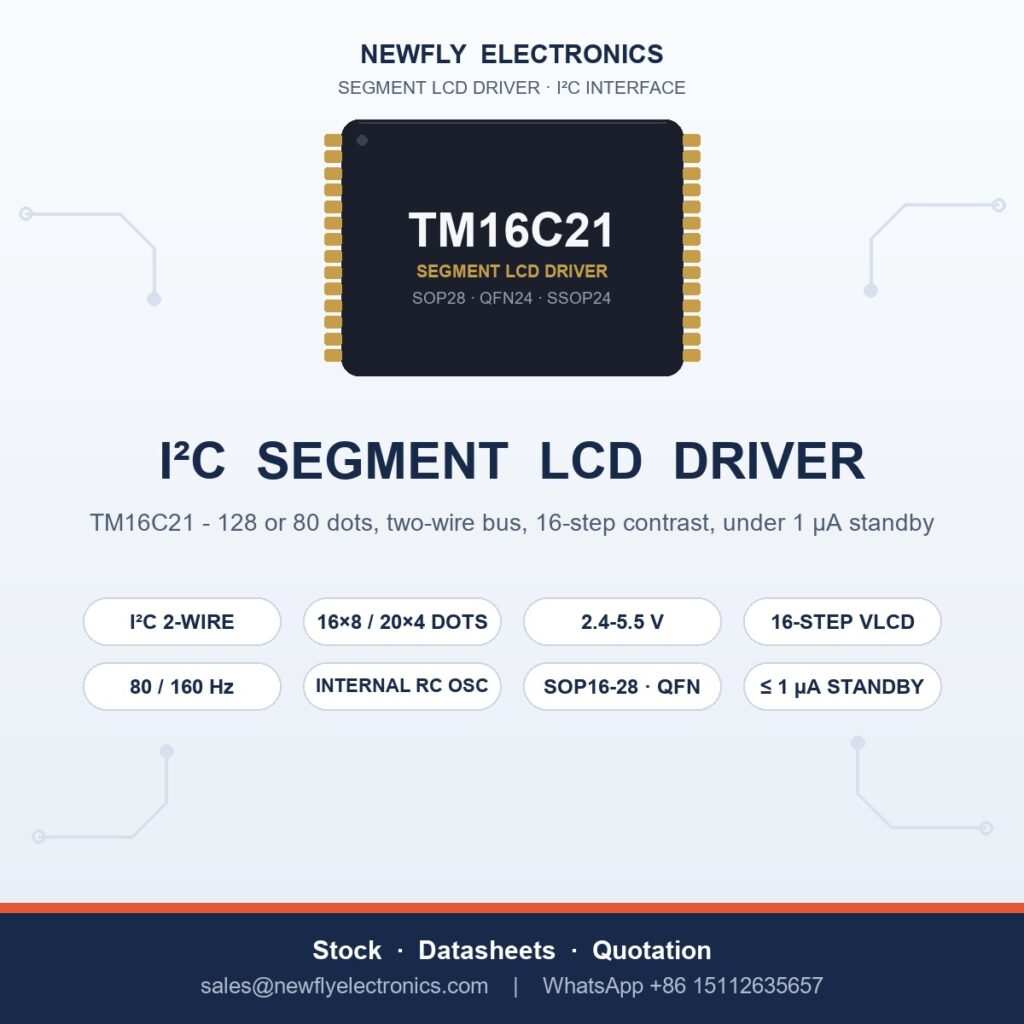
The TM16C21 is Titan Micro Electronics’ low-power segment (field) LCD driver with a two-wire I²C interface. It drives either 16 segments by 8 commons or 20 segments by 4 commons, runs from 2.4 V to 5.5 V, generates its own LCD bias voltage in 16 software steps, and holds display data in on-chip RAM so your MCU stops refreshing the glass. Titan Micro (天微电子) builds it for electricity meters, water and gas meters, small appliances and handheld instruments.
Most people who search for this part number are not browsing. They are holding one of three problems. Their glass is already tooled and needs a driver with fewer MCU pins than a 4-wire part. Their existing design uses a comparable I²C LCD driver and they need a second source that is not exposed to one brand’s allocation. Or a contract manufacturer has quoted a board built around the TM16C21 and they need confirmed stock before they commit the line.
This page answers the buying questions a datasheet does not: what the part can actually drive, which single pin decides whether you get 128 dots or 120, what its power-on default does to firmware ported from another brand, how to test a lot in an hour, and how we quote.
What the TM16C21 actually is
It is a controller-driver, not a plain driver. Display data goes into a 128-bit static RAM inside the chip, and the chip scans the commons and drives the segments from that memory without further help from the host. The host writes a byte, the display holds it. For a battery instrument or a metering board with a busy MCU, that is the whole reason to choose this class of part.
The feature set, as published in Titan Micro’s datasheet V1.1:
- 20 SEG × 4 COM, or 16 SEG × 8 COM — 80 or 128 display dots
- 1/8 Duty with 1/4 Bias, or 1/4 Duty with 1/3 Bias (only these two pairings)
- Standard I²C: SCL and SDA, slave address 0x70 write / 0x71 read
- Supply 2.4–5.5 V, LCD drive voltage 2.4–5.5 V generated internally
- Frame frequency selectable 80 Hz or 160 Hz; blink 2 Hz, 1 Hz or 0.5 Hz
- Internal RC oscillator — no crystal, no external bias ladder
- 16-step VLCD adjustment, so contrast is set in firmware, not by a trim pot
- Eleven package families from SOP16 to QFN28, plus SSOP and QSOP bodies
TM16C21 technical specifications
Every figure below is taken from Titan Micro’s TM16C21 datasheet V1.1. Where a number depends on your supply rail, both conditions are shown.
| Parameter | Value |
|---|---|
| Manufacturer | Titan Micro Electronics (天微电子) |
| Function | Segment LCD driver with controller, RAM-mapped display memory |
| Display configuration | 16 SEG × 8 COM (128 dots) or 20 SEG × 4 COM (80 dots) |
| Display RAM | 128 bit in 1/8 Duty mode · 80 bit in 1/4 Duty mode |
| Duty / bias pairings | 1/8 Duty + 1/4 Bias · 1/4 Duty + 1/3 Bias |
| Interface | I²C, two-wire (SCL, SDA) |
| Slave address | 0x70 write / 0x71 read (7-bit address 0111000), fixed — no address pins |
| Bus clock | 100 kHz at VDD 2.4–5.5 V · 400 kHz at VDD 3.0–5.5 V |
| Supply voltage VDD | 2.4 V to 5.5 V |
| LCD drive voltage VLCD | 2.4 V to 5.5 V |
| VLCD adjustment | 16 steps, 1.00 × VDD down to 0.529 × VDD (1/3 bias) or 0.600 × VDD (1/4 bias) |
| Frame frequency | 80 Hz or 160 Hz, register selected |
| Oscillator | Internal RC, no external components |
| COM / SEG sink current | 250 µA min, 400 µA typ at VLCD 3 V (VOL 0.3 V) · 500 / 800 µA at VLCD 5 V (VOL 0.5 V) |
| COM / SEG source current | −140 µA min, −230 µA typ at 3 V · −300 / −500 µA at 5 V |
| Logic thresholds | VIH ≥ 0.7 × VDD · VIL ≤ 0.3 × VDD |
| Standby current | ≤ 1 µA at 3 V · ≤ 2 µA at 5 V (oscillator off, display off, no load) |
| Operating current | 25 µA typ / 40 µA max at 3 V · 35 / 50 µA at 5 V (80 Hz, 1/3 bias, display on, VLCD at maximum) |
| Absolute maximum supply | VDD and VLCD −0.3 V to +6.5 V |
| Operating temperature | −40 °C to +85 °C (storage −40 to +150 °C, Tj max 150 °C) |
| Packages | SOP16 / 20 / 24 / 28 · SSOP20 / 24 / 28 · QSOP24 · QFN16 / 20 / 24 / 28 |
| External parts in the reference circuit | Two 4.7 kΩ I²C pull-ups, 1 µF plus 0.1 µF on VDD |
One pin decides whether you get 128 dots or 120
This is the detail that costs design teams a glass respin. On the SOP28 body, pin 28 is SEG19/VLCD — a shared pin (pin 26 on QFN28). It is either a twentieth segment or your LCD drive voltage input, never both, and the choice is made by the M[1:0] bits in register 0x8A.
| M[1:0] | Pin 28 behaves as | VLCD source |
|---|---|---|
| 00 (power-on default) | VLCD pin | External voltage applied to the pin |
| 01 | VLCD pin | Internal, adjusted by the LV[3:0] bits |
| 10 | SEG pin | Equal to VDD |
| 11 | SEG pin | Internal, adjusted by the LV[3:0] bits |
Run the arithmetic. In 1/8 Duty mode the pins COM4/SEG0 to COM7/SEG3 are consumed as commons, so the usable segments are SEG4 to SEG19: 16 segments × 8 commons = 128 dots. Give pin 28 to VLCD instead and you get 15 × 8 = 120 dots. In 1/4 Duty mode the same choice costs one segment: 80 dots, or 76.
The decision rule: if your glass needs all 128 dots, tie VLCD to VDD (M[1:0] = 10) and accept that contrast no longer moves with firmware. If your product needs adjustable contrast — a meter read in sunlight, an appliance panel with a wide viewing angle — budget 120 dots, not 128, before the glass is drawn. Design teams that discover this after tooling are the reason this section exists.
What the power-on default does to firmware ported from another brand
The TM16C21 powers up in a defined but quiet state: 1/4 Duty with 1/3 Bias, display off, internal clock off, blink off, the VLCD generation block inactive, and the shared pin set as a VLCD input under external control. Nothing lights until you write the enable bits. Two of those defaults matter commercially.
First, a comparable part from another brand powers up with the shared pin configured as a segment. Firmware ported line for line from that platform writes display data, sees nothing on the last segment, and blames the glass. Second, because the internal clock starts disabled, a design that writes display RAM but never sets the clock-and-display bit (register 0x84) shows a blank panel. Both faults look like a dead chip; neither is one.
Only two duty/bias pairings exist: 1/8 Duty with 1/4 Bias, or 1/4 Duty with 1/3 Bias. There is no 1/4 Duty with 1/4 Bias and no 1/8 Duty with 1/3 Bias. If your glass specifies any other combination, no register setting will rescue it — the driver is the wrong choice and we will say so before you order.
Two timing rules from the same document belong in your bring-up checklist. The power-on reset needs a supply rise longer than 1 ms, a fall longer than 1 ms, more than 100 ms off before the next power-up, and a floor below 0.1 V — a bench supply that snaps on in 200 µs can leave the part partly initialised, and that gets blamed on the supplier. And after a STOP condition the master must pull SCL low once before the next START, or the following command is not accepted. That line explains most “the second command is ignored” reports we see.
Where the TM16C21 goes
The datasheet names electricity meters, water meters, home appliances, game consoles and power meters. In export terms the clusters are narrower. India and Bangladesh: single-phase energy meters and appliance panels, where the two-wire bus saves pins on a full 8-bit micro. Vietnam, Thailand, Malaysia and the Philippines: contract-manufactured rice cookers, humidifiers, induction hobs and thermostats, where a brand owner specifies the bill of materials. The Middle East: metering and HVAC panels that must hold contrast in high ambient heat. Europe and the United States: instrumentation and low-volume products, where buyers care more about the same date code shipping twice than about the last cent of unit price.
The standby figure is what wins battery designs: 1 µA maximum at 3 V with the oscillator and display off lets a coin cell or supercapacitor-backed instrument hold its state for years. The 2.4 V minimum supply is what wins two-cell designs.
TM16C21 vs TM1621B: same 128-dot class, different bus
Both parts are 128-dot segment LCD drivers from the same manufacturer, and buyers regularly confuse them because the dot count matches. They are not interchangeable.
| Item | TM16C21 | TM1621B |
|---|---|---|
| Display capacity | 16 SEG × 8 COM (128 dots) or 20 SEG × 4 COM (80 dots) | 32 SEG × 4 COM (128 dots) |
| Interface | I²C, 2 wires (SCL, SDA) | 4-wire serial (CS, WR, DATA, RD) |
| Duty / bias | 1/8 + 1/4, or 1/4 + 1/3 | 1/4 Duty, 1/3 Bias |
| Supply range | 2.4–5.5 V | 2.4–5.2 V |
| COM lines on the glass | 4 or 8, your choice | 4 only |
| MCU pins consumed | 2, shared with the rest of the bus | 4, dedicated |
| Packages | SOP16–28, SSOP20–28, QSOP24, QFN16–28 | SSOP48, LQFP44 |
| Best fit | Small glass, tight pin budget, battery instruments | Wide 32-segment glass, existing 4-wire platform |
Choose the TM16C21 when the glass is small and the MCU has no pins to spare — a two-wire bus that already carries an EEPROM or a sensor costs nothing extra. Choose the TM1621B when the glass needs 32 segments on 4 commons, or when the board is already built around a 4-wire interface and requalifying is not worth the saving. Both are stocked through us; the mistake to avoid is ordering a TM16C21 to replace a TM1621B on an existing layout, because the footprints and the bus are different.
TM16C21 vs HT16C21: a functional alternative, not a documented drop-in
Buyers arrive here looking for a second source for an I²C 16×8 LCD driver. The comparison is fair, so here is the honest version, with the other column taken from that manufacturer’s public datasheet and shown for orientation only.
| Item | TM16C21 (Titan Micro) | HT16C21 (Holtek) |
|---|---|---|
| Display patterns | 20×4 or 16×8 | 20×4 or 16×8 |
| Interface | I²C, 0x70 / 0x71 | I²C, two-line bidirectional |
| Duty / bias | 1/8 + 1/4, or 1/4 + 1/3 | Duty 1/4 or 1/8; bias 1/3 or 1/4 |
| Frame frequency | 80 Hz or 160 Hz | 80 Hz or 160 Hz |
| VLCD adjustment | 16 steps | 16 steps |
| Power-on default, shared pin | VLCD pin, external voltage control | SEG pin |
| Packages | SOP16–28, SSOP20–28, QSOP24, QFN16–28 | 20/24/28-pin SOP/SSOP, 16-pin NSOP, plus chip form |
| Available from us | Yes — this is our stock | No |
The two parts overlap in job and register-level behaviour, which is why sourcing teams treat them as alternatives. They differ in the power-on default above, and the package portfolios are not identical. We do not publish a pin-for-pin compatibility claim we have not verified: if you intend to swap one for the other, send us the package drawing and we will confirm the pin assignment before you commit. We supply the Titan Micro side of this comparison only — we do not stock Holtek product and will not quote it to complete an order.
the TM16C21: where it does not belong
Specification tables tell you what a part can do. Design failures come from what it cannot do. Before you commit a the TM16C21 to a production board, check these cases — if any of them applies to your design, this is the wrong part and we will say so.
- your glass needs any duty/bias pairing other than 1/8 Duty + 1/4 Bias or 1/4 Duty + 1/3 Bias — the TM16C21 offers exactly those two combinations. There is no 1/4 Duty with 1/4 Bias and no 1/8 Duty with 1/3 Bias, and no register setting creates one. Check the glass datasheet before the driver, not after.
- your panel needs all 128 dots AND firmware-adjustable contrast — pin 28 is either the twentieth segment or the VLCD input. Keeping VLCD adjustable costs the last segment, so 1/8 Duty tops out at 120 dots in that configuration. Decide which of the two you need before the glass is tooled.
- you need a second LCD on the same I²C bus — the slave address is fixed at 0x70/0x71 and there are no address-select pins. Two TM16C21 devices cannot share a bus — plan a bus switch or a second bus in the schematic.
- you need key scanning, a buzzer driver or an LED driver on the same chip — the TM16C21 drives segment LCD glass only. For an I²C LCD part that also scans keys, look at the TM1730; for LED displays the whole Titan Micro LED family applies — start from the LED driver selection guide.
- your display is a graphic or character LCD module — this is a segment driver for a glass with discrete segments. A graphic panel needs a different controller entirely, and a character module has its own onboard driver.
- you are carrying an existing 4-wire TM1621B layout across to this part — the footprint and the bus are different. The 128-dot figure matching does not make them exchangeable — see the TM1621B supplier page if 32 segments on 4 commons is what your glass actually needs.
- the product must be sold as AEC-Q100 or otherwise automotive-qualified — the TM16C21 is a commercial-grade part rated −40 to +85 °C with no automotive qualification. We will decline the order rather than imply a grade it does not hold.
What moves your quotation
Five variables change the number, and four are decided by you. The dot count and duty choice fix which package can physically do the job. The package itself is the largest single factor — a QFN is not priced like an SOP. Whether you need tape-and-reel or accept tubes matters on small quantities. Volume and repeatability matter more than any single order size, because a part we can hold on the shelf is cheaper than one sourced per order. The date-code requirement matters most to buyers running a metering approval: a single homogeneous lot costs more than a mixed-date-code shipment, and pretending otherwise only moves the problem to your incoming inspection. We do not publish a price band we cannot hold — send the package, the quantity and the destination and you get a figure against that, in writing.
How to verify a TM16C21 lot in one hour
You do not need a characterisation bench to catch a wrong or re-marked part. Five tests, all from the datasheet, tell you whether what you received behaves like a TM16C21.
- Address acknowledge. Write to 0x70 with correct START/STOP framing. A part that does not ACK is not this device or is not alive; a part that ACKs at another address is a different part.
- Power-on silence. Apply power, send nothing, look at the glass. Correct behaviour is a blank display with the outputs at the VLCD level. A panel that lights up on its own is running different firmware than the datasheet describes.
- Contrast walk. Write register 0x8A with LV[3:0] = 0000, then 1111. VLCD should move from 1.00 × VDD toward 0.529 × VDD in 1/3 bias mode. A part whose contrast barely shifts has no working internal regulator.
- Frame rate. Toggle the FR bit in register 0x86 between 80 Hz and 160 Hz. The flicker character of a multiplexed glass changes visibly; if nothing changes, the register path is not what it should be.
- Marking and date code. Read the top mark against the reel label and packing list, and check the date code is consistent across the reel rather than mixed within a tube.
Any of those five failing is a conversation about the lot, not about your code. Ask us for the datasheet revision as well: the current published revision is V1.1, and a quotation that cannot name the revision it was priced against is worth a second question.
Six checks before you raise a purchase order
- Package drawing. Confirm SOP, SSOP, QSOP or QFN and the pin count against your footprint, not the part number alone.
- Duty and bias. Match your glass to one of the two available pairings. Neither can be renegotiated in firmware.
- Dot budget. Decide the shared-pin question early — it changes the dot count, the glass drawing and the contrast method together.
- Bus rail. The part runs comfortably at 3.3 V, but the 400 kHz bus limit requires 3.0 V or more; below that the bus tops out at 100 kHz.
- Co-tenancy on the bus. The address is fixed. Two TM16C21 devices cannot sit on one I²C bus — plan a bus switch or a second bus.
- Revision and date code. Buy against a named datasheet revision and state your date-code requirement in the order, not at goods-in.
Working with Newfly: the numbers
Buyers evaluating a supplier want the commercial parameters stated, not implied. Here is ours. Where a figure depends on your quantity, package or destination, we say so rather than publishing a number that will not hold.
| Item | What we commit to |
|---|---|
| Sample order | Sample and small-batch quantities are supported. Sample fee, freight terms and dispatch time are confirmed in writing with each quotation. |
| Minimum order | Flexible. We support partial-reel and small-batch quantities for first orders and scale with you. |
| Lead time | Confirmed in writing per order, against the quantity and destination you specify. |
| Inspection | Marking, packaging and date-code verification before dispatch. Tell us your acceptance criteria and we will align to them. |
| Defect claims | The defect resolution process is agreed in writing before the order, not after a problem appears. |
When we tell you not to buy
A supplier who accepts every enquiry without question is not screening anything. These are the situations where we will recommend against the purchase:
- You want us to quote the Holtek HT16C21 alongside the Titan Micro part to make the comparison convenient. We supply the Titan Micro side only and do not stock Holtek product. The comparison table on this page says so in the table itself.
- You plan to drop the TM16C21 into an existing I²C LCD design without changing the initialisation sequence. The power-on default for the shared segment/VLCD pin is different between brands, and a straight code port will show you a blank or half-lit panel that looks like a bad part.
- Your glass specification has not been fixed yet and you want the driver chosen first. On this class of part the glass decides the driver, not the reverse — we will ask for the duty, bias and dot count before quoting.
- You need two displays on one I²C bus and cannot add a bus switch. This part cannot do it, and we would rather lose the line item than ship you a schematic problem.
- The lot on offer is mixed date codes across one reel with no traceable origin. On metering and instrument products that carry an approval, we will describe that risk instead of quoting it as normal stock.
- Your target price can only be met with material we cannot verify as original Titan Micro product. We will decline the order rather than carry that exposure into your build.
Frequently asked questions
Where can I buy the TM16C21 in small quantity?
From us, in partial-reel and small-batch quantities as well as production volumes. Send the package, the quantity and the destination country and you will get price, confirmed stock and a shipping window in writing. Samples are supported before a production order, which is the right sequence for a part that has to match a specific glass.
Is the TM16C21 still in production?
Yes. Titan Micro’s current published datasheet for the part is revision V1.1, and the device is listed in their LCD display driver line-up across eleven package families. Ask us to confirm stock for your specific package and quantity rather than assuming the whole range is on the shelf at any given moment.
What packages does the TM16C21 come in?
SOP16, SOP20, SOP24 and SOP28; SSOP20, SSOP24 and SSOP28; QSOP24; and QFN16, QFN20, QFN24 and QFN28. Pin numbering differs between bodies, so always confirm against the pin arrangement drawing for the exact package you are buying.
Can you send the TM16C21 datasheet?
Yes — tell us the package and we will send the manufacturer datasheet revision that matches it, so that you are designing to the same document we price against.
Is the TM16C21 a drop-in replacement for the HT16C21?
It is a functional alternative in the same class: both drive 20×4 or 16×8 segment glass over I²C with 80 or 160 Hz frame rates and 16-step VLCD. We do not claim pin-for-pin compatibility, and the power-on default for the shared segment/VLCD pin is different between the two. Confirm the package drawing before you swap, and expect to change your initialisation sequence.
What is the I²C address, and can it be changed?
0x70 for write and 0x71 for read, with a 7-bit address of 0111000. It is fixed. There are no address-select pins, so a second device of the same type needs a separate bus or a bus switch.
How many display dots can the TM16C21 drive?
128 dots as 16 segments by 8 commons, or 80 dots as 20 segments by 4 commons. In 1/8 Duty mode, if you keep pin 28 as the VLCD input instead of a segment, the practical maximum is 120 dots. Titan Micro’s larger family members, the TM16C22 and TM16C23, cover bigger glasses — ask us for their datasheets before designing to a dot count you have read second-hand.
What is the difference between the TM16C21 and the TM1621B?
The bus and the glass topology. The TM16C21 is a two-wire I²C part with a choice of 8 or 4 commons and a small package range; the TM1621B is a 4-wire serial part with 32 segments on 4 commons in SSOP48 or LQFP44. Same manufacturer, same 128-dot class, not the same footprint.
Request a Quotation
Send us the part number, the package and the quantity you need. We will reply with price, confirmed stock and lead time for the a TM16C21 I²C segment LCD driver requirement.
See also the TM1621B LCD driver supplier page. See also the TM1621B vs HT1621B comparison. See also the TM1621B product page. See also the weighing-scale IC guide (TM7711 + TM1621B). See also the Titan Micro IC product portfolio. See also the Titan Micro IC alternative and replacement guide. See also how to select a reliable IC supplier from China. See also where to buy Titan Micro IC chips online. See also Titan Micro IC distributor China.
Contact Newfly Electronics
Email: sales@newflyelectronics.com
WhatsApp: +86 15112635657