
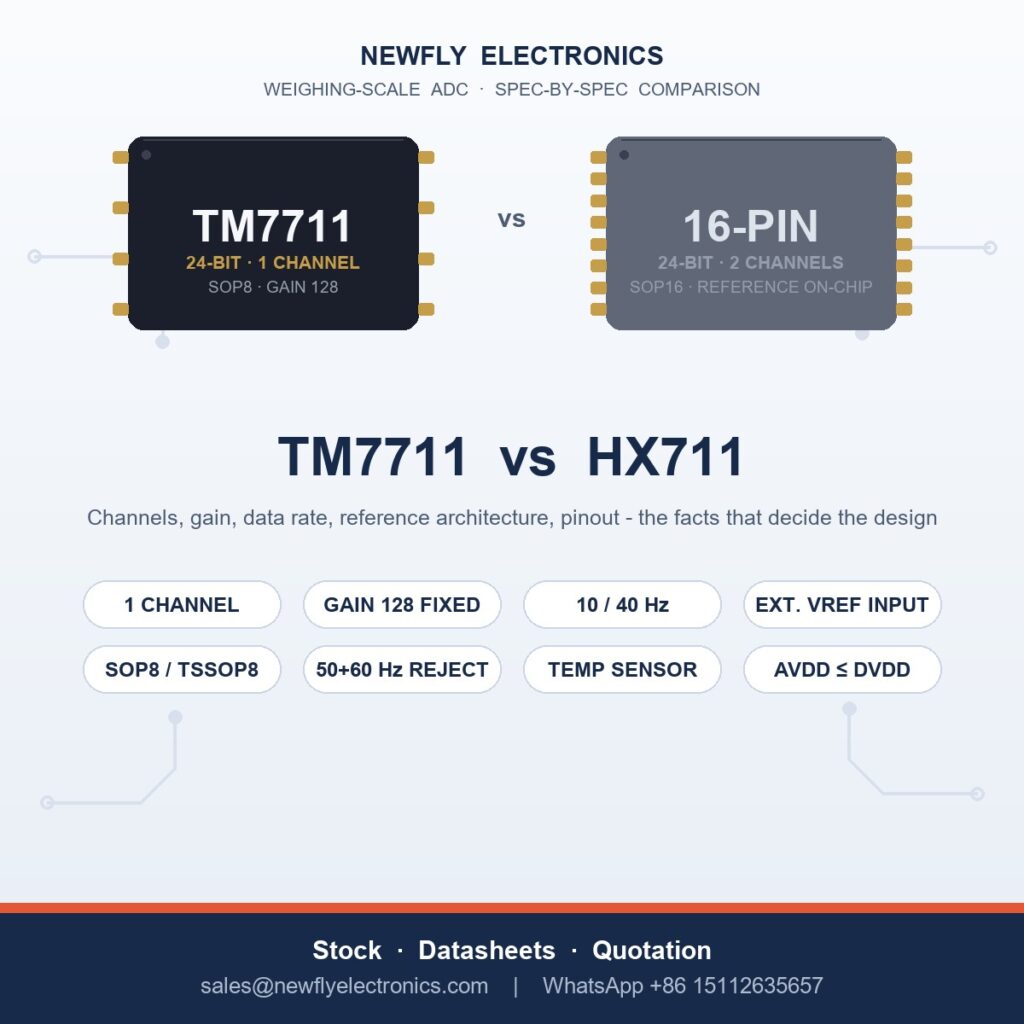
TM7711 vs HX711: why this comparison decides your next weighing design
Search interest in an HX711 alternative has one simple cause: the HX711 is the converter that a generation of low-cost weighing products was built around, and single-source dependence creates exactly the supply anxiety that sends design engineers and purchasing managers to Google. That makes TM7711 vs HX711 one of the most commercially significant converter comparisons in the weighing-instrument market — platform scales, kitchen scales, jewelry scales, load-cell indicators and small hoppers made for India, Vietnam, Thailand, Malaysia, the Middle East, Europe and the USA.
This page compares the two parts on the facts that decide a purchase: channels, gain, output data rate, reference architecture, package and supply-rail rules. The HX711 column of the table is compiled from that vendor’s publicly available datasheet and labelled as such — we do not sell it and we do not claim to represent it beyond its published document. We supply the Titan Micro (天微电子) side: the TM7711 is on our stock list and every TM7711 figure below was checked against the Titan Micro datasheet before it was published. If you are evaluating a second source for a weighing platform, this is the page to work from — and if a conclusion here argues against TM7711 for your design, we will say that too.
Where the two converters agree
Start with what transfers directly, because it explains why the comparison is realistic rather than forced. Both parts are single-supply sigma-delta converters built specifically for load-cell front ends. Both use a two-wire serial interface — one clock line, one data line — that any MCU can bit-bang without a hardware peripheral. Both provide a gain-128 front end sized for a full bridge excited at a few millivolts per volt. Both include a power-down mode, both run their oscillators on-chip with no external crystal, and both are specified for commercial temperature ranges rather than laboratory conditions.
A firmware team that already drives one of these parts already understands the shape of driving the other: assert the clock, wait for the data-ready edge, clock out the conversion word. But interface similarity is not substitutability. The differences below change the schematic, the layout and in one case the mechanical integration — not just a header file.
Side-by-side specification
TM7711 values are from the Titan Micro datasheet (revisions V1.1/V1.4). HX711 values are from that vendor’s public datasheet and are shown for orientation only.
| Parameter | TM7711 (Titan Micro) | HX711 (comparison column, vendor datasheet) |
|---|---|---|
| Architecture | 24-bit sigma-delta, no missing codes | 24-bit sigma-delta |
| Analog inputs | One fully differential channel (AIN+ / AIN−) | Two channels (A differential, B differential) |
| Gain | 128, fixed on-chip amplifier | 128 or 64 selectable on A; fixed 32 on B |
| Nonlinearity | ±0.001 % of full scale | vendor-datasheet figure applies |
| Output data rate | 10 Hz or 40 Hz, selectable | 10 Hz or 80 Hz via RATE pin |
| Line rejection | Simultaneous 50 Hz and 60 Hz rejection | not comparable line-by-line here |
| Reference | External VREF input, 1.8 V to AVDD | On-chip reference (AVDD-based) |
| Excitation control | None on-chip — board supplies the bridge | On-chip supply regulator for bridge excitation |
| Supply rails | AVDD and DVDD, 2.6 / 5.0 / 5.5 V each; AVDD must not exceed DVDD | Single analog supply, 2.6–5.5 V |
| Serial interface | PD_SCK (clock) + DOUT (data), 2-wire | PD_SCK + DOUT, 2-wire |
| Logic threshold | VIH 0.7 × DVDD | vendor-datasheet figure applies |
| Package | SOP8, DIP8, TSSOP8 | SOP16, DIP16 |
| Extras | On-chip temperature sensor with digital output | — |
| Temperature range | −40 to +85 °C operating | vendor-datasheet figure applies |
Difference 1: one channel with fixed gain vs two channels with selectable gain
This is the first hard boundary. The TM7711 has exactly one fully differential input pair and its on-chip amplifier gain is fixed at 128 — there is no register to select a gain of 64, and no second channel to multiplex. The HX711 offers two channels: A with selectable gain of 128 or 64, and B with a fixed gain of 32 that teams commonly use for a secondary slow-moving measurement such as battery voltage.
What does that mean in practice? If your product weighs one bridge and nothing else, the second channel on the 16-pin part is dead inventory on your board — you are paying for a larger package and a second input pair you never populated. But if your design genuinely reads a second transducer through the converter, TM7711 cannot absorb that function. The honest answer is a small external housekeeping ADC or a different converter, and we will recommend that path rather than sell a part your feature list will outgrow at revision B.
Difference 2: output data rate and what it limits
The TM7711 offers two output rates: 10 Hz and 40 Hz. At 40 Hz a conversion completes every 25 ms. The HX711 can be configured for 80 Hz by its RATE pin. The engineering consequence is simple: neither part is a dynamic-weighing converter. Checkweighers, filling lines and catch-weigher applications weigh a load in motion, and averaging cannot manufacture update rate that the converter does not produce.
For static weighing — platform scales, retail scales, kitchen and portioning scales, hopper weight after settling — 40 Hz is comfortably fast, and the lower rate buys better noise performance for free. The TM7711 also rejects 50 Hz and 60 Hz line interference simultaneously, which matters more than raw sample rate in markets where mains frequency varies between production sites and export destinations. If your application notes say “weighing in motion”, stop here: neither of these two parts is the right converter, and we will tell you so before you buy.
Difference 3: reference and excitation architecture — the biggest board-level change
This is where a migration between the two parts actually costs engineering time. The HX711 integrates an on-chip reference and an on-chip supply regulator intended to drive the load-cell bridge, which is why many HX711-era boards contain few components around the converter. The TM7711 has neither: VREF is an external input accepting 1.8 V to AVDD, and the bridge excitation must be supplied from your own rail or your own reference.
Three consequences follow. First, your schematic gains a reference source — a dedicated reference IC, a filtered tap of a stable rail, or a ratiometric arrangement tied to the excitation, which is the configuration ratiometric designs should use anyway because reference drift then cancels against excitation drift. Second, your bill of materials changes, so a “drop-in” replacement claim is false before layout even starts. Third, your accuracy budget is now set by the reference you choose — which is a loss on a sloppy board but a genuine improvement on a disciplined one, because you control the quality of that reference instead of inheriting it. Teams migrating from the 16-pin part should treat this as the first item on the change list, ahead of firmware.
Difference 4: package and pinout — these parts are not pin-compatible
The TM7711 ships in SOP8, DIP8 and TSSOP8. The HX711 is a 16-pin part. There is no pin-compatible substitution in either direction, and any source claiming otherwise has not compared the pinouts. The TM7711 pin order is: 1 VREF, 2 AGND, 3 AIN−, 4 AIN+, 5 PD_SCK, 6 DOUT, 7 DVDD, 8 AVDD.
What this means commercially: moving from the 16-pin converter to the TM7711 is a board revision, not a component swap. The upside of the same revision is real — an 8-pin converter occupies roughly half the footprint, which matters on crowded indicator PCBs and on scale heads where the load-cell cavity and the electronics share space. But nobody should discover the footprint change after goods-in. If a colleague forwarded you this page as a “replacement for the 16-pin part”, the correct reading is: same job, different board.
Difference 5: supply-rail rules that surprise migrating teams
The TM7711 runs two rails. AVDD (analog) and DVDD (digital) each accept 2.6, 5.0 or 5.5 V, with one absolute constraint: AVDD must not exceed DVDD. A board that runs 5 V analog over 3.3 V digital violates the datasheet condition and typically produces symptom sets that look like firmware faults — drifting readings, inconsistent data-ready behaviour — rather than hard failures. Teams coming from a single-rail part should make this the second item on the migration change list.
The second rule concerns the digital interface: VIH is 0.7 × DVDD. If DVDD is at 5 V, a 3.3 V MCU cannot reliably clock the part — the high level is marginal. Run both rails at the same voltage, or level-shift the two-wire interface. Related and equally practical: PD_SCK is both the serial clock and the power-down control, active high. A clock line parked high holds the device in power-down. If your converter appears to hang, check that line before you blame the part.
Decision table: which converter belongs in your design
| Your situation | Correct choice |
|---|---|
| One load cell, static weighing, need the smallest footprint and lowest converter cost | TM7711 |
| Ratiometric design where you want to own the reference quality | TM7711 (external VREF is a feature here, not a burden) |
| Battery-powered instrument — converter cost and board area both matter | TM7711 (SOP8/TSSOP8, power-down mode) |
| Second slow measurement channel through the same converter | Two-channel 16-pin part — TM7711 has one channel, and we will say so |
| Gain of 64 required because your bridge output is small at low excitation | TM7711 cannot do it — gain is fixed at 128; choose a programmable-gain converter |
| Weighing in motion (checkweigher, filling, catch-weighing) | Neither — 40 Hz max on TM7711, 80 Hz on the other, both too slow; use a higher-rate converter |
| Existing layout must be reused without a re-spin | Neither is a drop-in for the other — plan the board revision |
| Legal-for-trade instrument needing single-lot traceability | TM7711 works, but state the single-lot requirement at quotation |
Migration checklist: what actually changes on the board
Teams that plan the switch as a redesign rather than a swap finish it in one revision. The items, in the order they bite:
- Reference source: add the external VREF circuit the TM7711 requires; ratiometric to excitation where possible.
- Excitation: confirm your bridge supply exists independently of the converter — there is no on-chip regulator.
- Rails: check AVDD ≤ DVDD on every operating mode, including brownout and USB-powered conditions.
- Logic levels: verify the driving MCU’s VIH against 0.7 × DVDD; level-shift if your MCU is 3.3 V and DVDD is 5 V.
- PD_SCK handling: ensure firmware drives the line low between conversions, or the device parks in power-down.
- Timing: re-run the serial read routine against the TM7711 datasheet timing table — do not assume the old converter’s bit counts carry over.
- Gain budget: recompute your full-scale span at gain 128 with your chosen excitation and reference; fixed gain leaves no software correction for a mismatch.
- Rate: confirm 10 Hz or 40 Hz suits your settling requirement before freezing the firmware state machine.
- Validation: test on your own board at your own excitation and reference before committing a production order — sample quantities exist for exactly this.
Where TM7711 designs ship: applications and markets
The TM7711’s natural market is the same one that made the 16-pin converter famous: electronic platform scales, kitchen and portioning scales, jewelry scales, price-computing retail scales, weighing indicators and small hopper/bin level systems built on strain-gauge bridges. As a distributor we see demand concentrated in a few regions.
India: one of the largest weighing-instrument manufacturing bases in the world, with strong demand for cost-optimised converters in both retail and industrial scales — buyers there typically ask about stock depth and price per thousand first. Vietnam, Thailand and Malaysia: appliance and industrial ODMs adding weight-based functions (detergent dosing, portioning, feed control) to existing platforms. The Middle East: trade-scale imports and retrofits, where legal-verification requirements make lot traceability part of the purchase conversation. Europe and the USA: industrial retrofits and private-label instruments, where documentation quality and consistent date codes decide the order.
TM7711: where it does not belong
Specification tables tell you what a part can do. Design failures come from what it cannot do. Before you commit a TM7711 to a production board, check these cases — if any of them applies to your design, this is the wrong part and we will say so.
- your application weighs a load in motion – a checkweigher, a filling line, a catch-weigher — the TM7711 maximum output rate is 40 Hz (one conversion per 25 ms) and the 16-pin converter tops out at 80 Hz on its fastest setting. Neither is a dynamic-weighing part. Specify a higher-rate converter instead – we will say so before you buy.
- your design reads a second slow transducer through the same converter — the TM7711 has one fully differential channel and no multiplexer. Use a small external housekeeping ADC or a two-channel converter – not the TM7711.
- your bridge output needs a gain of 64 — the TM7711 amplifier gain is fixed at 128 with no selectable setting. Re-specify the load cell or the excitation, or choose a programmable-gain converter.
- your analog rail is 5 V and your digital rail is 3.3 V — AVDD must not exceed DVDD on the TM7711. 5 V analog over 3.3 V digital is the exact condition the datasheet rules out, and it produces symptom sets that look like firmware faults.
- your firmware parks PD_SCK high between conversions — PD_SCK is both the serial clock and the power-down control, active high. A line parked high holds the device down and the converter appears to hang.
- your design assumes an on-chip reference or an on-chip bridge-excitation regulator — the TM7711 has neither. VREF is an external input (1.8 V to AVDD) and your board supplies the bridge. This is the largest schematic change when migrating from the 16-pin part.
- you expect a pin-compatible drop-in swap in either direction — the TM7711 is an 8-pin part, the other is 16-pin. Not pin-compatible. Migration is a board revision covering reference, excitation, rails, logic levels and timing.
- your product must be sold as an AEC-Q100 or otherwise automotive-qualified part — the TM7711 is commercial-grade, −40 to +85 °C, with no automotive qualification. We will decline the order rather than imply a grade the part does not hold.
Working with Newfly: the numbers
Buyers evaluating a supplier want the commercial parameters stated, not implied. Here is ours. Where a figure depends on your quantity, package or destination, we say so rather than publishing a number that will not hold.
| Item | What we commit to |
|---|---|
| Sample order | Sample and small-batch quantities are supported. Sample fee, freight terms and dispatch time are confirmed in writing with each quotation. |
| Minimum order | Flexible. We support partial-reel and small-batch quantities for first orders and scale with you. |
| Lead time | Confirmed in writing per order, against the quantity and destination you specify. |
| Inspection | Marking, packaging and date-code verification before dispatch. Tell us your acceptance criteria and we will align to them. |
| Defect claims | The defect resolution process is agreed in writing before the order, not after a problem appears. |
When we tell you not to buy
A supplier who accepts every enquiry without question is not screening anything. These are the situations where we will recommend against the purchase:
- You ask us to quote both sides of this comparison as a package. We supply the Titan Micro side only – we do not stock the 16-pin converter or any other brand, and every HX711 figure on this page is sourced from that vendor’s public datasheet, not from our stock.
- You plan to swap an 8-pin converter into a layout drawn for the 16-pin part without a re-spin. They are not pin-compatible. We will say so before you buy the first reel, not after.
- The lot available to you is mixed date codes on one reel with no traceable origin. On an instrument that gets sealed and legally verified, we will describe that risk rather than quote it as normal stock.
- You want a production order before the part has been validated on your own board at your own excitation and reference voltages. We will recommend a sample first and say why.
- Your target price can only be met with material we cannot verify as original Titan Micro product. We will decline the order rather than carry that exposure into your verification.
- Your procurement rules require a franchised-channel certificate of conformity that only the manufacturer or its authorised channel can issue. We are an export distributor, not the franchised channel – if that paper is mandatory, we are not the right supplier for the line.
Frequently asked questions
Is the TM7711 a pin-compatible replacement for the HX711?
No. The TM7711 is an 8-pin part (SOP8/DIP8/TSSOP8); the HX711 is a 16-pin part. They are not pin-compatible in either direction. Migration is a board revision covering reference, excitation, rails and firmware timing — see the checklist above.
Does the TM7711 have two input channels like the HX711?
No. The TM7711 has one fully differential channel (AIN+/AIN−). If your design reads a second transducer through the converter, you need an external housekeeping ADC or a two-channel converter — we will recommend against TM7711 in that case.
What gain does the TM7711 support?
Gain 128, fixed, via the on-chip low-noise amplifier. There is no selectable gain of 64. Full-scale span must be engineered at the excitation and reference voltages, not corrected in software.
What is the TM7711 output data rate?
10 Hz or 40 Hz, selectable. At 40 Hz a conversion completes every 25 ms, which suits static weighing. Applications weighing a moving load need a higher-rate converter.
Where can I buy original TM7711 ICs?
Newfly Electronics supplies original Titan Micro TM7711 in SOP8, DIP8 and TSSOP8, with sample and production quantities, export documentation and technical support. See the TM7711 supplier page or the TM7711 product page, then request a quotation by email or WhatsApp.
Does Newfly Electronics provide the TM7711 datasheet?
Yes. We provide the current Titan Micro TM7711 datasheet with every quotation, together with pinout and application notes for load-cell front ends. Ask for it with your inquiry — it is the document every figure on this page was checked against.
Is the TM7711 suitable for 3.3 V MCUs?
With conditions. VIH is 0.7 × DVDD, so a 5 V DVDD rail makes 3.3 V logic marginal. Run both rails at compatible voltages or level-shift the two-wire interface. AVDD must never exceed DVDD.
Does the TM7711 include a temperature sensor?
Yes — an on-chip temperature sensor with digital output, useful for temperature compensation of the zero point in precision instruments without a separate sensor.
Request a Quotation
Send us the part number, the package and the quantity you need. We will reply with price, confirmed stock and lead time for the a TM7711 requirement.
See also the TM7711 supplier page. See also the TM7711 product page with package options. See also the Titan Micro IC product portfolio. See also the Titan Micro IC alternative and replacement guide. See also where to buy Titan Micro IC chips online. See also how to select a reliable IC supplier from China.
Contact Newfly Electronics
Email: sales@newflyelectronics.com
WhatsApp: +86 15112635657