
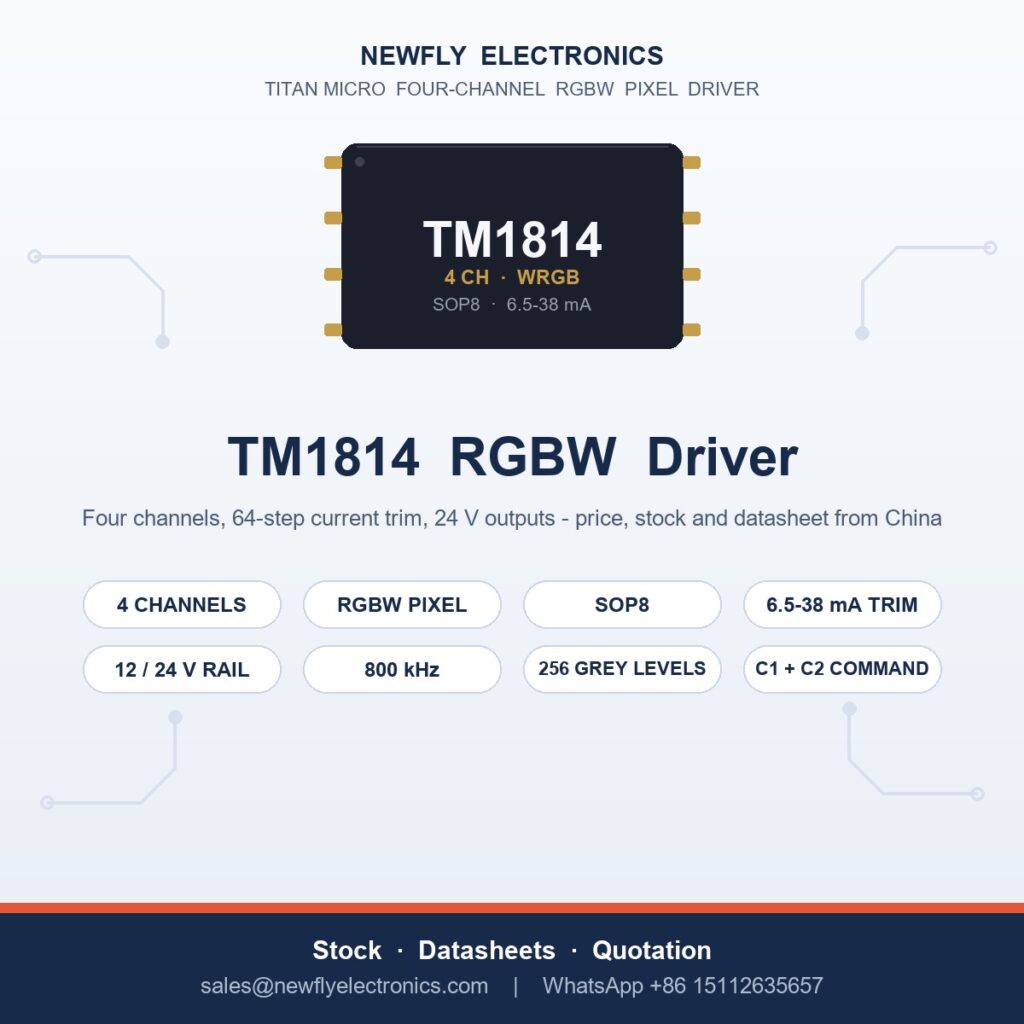
TM1814 is a four-channel constant-current LED driver from Titan Micro Electronics (天微电子) that turns one SOP8 into one WRGB pixel. Data arrives on a single wire, each device keeps the first 32 bits of the frame and forwards the remainder downstream, and every channel is trimmed in 64 steps between 6.5 mA and 38 mA by a command word sent ahead of the pixel data. It is a narrow part, and that is exactly why buying it is awkward: the factories using it know the number by heart, and almost nobody publishes what a current lot costs or when it actually ships.
Searches for a TM1814 supplier come from three situations. A lighting OEM in Gujarat or Ho Chi Minh City has a WS2814-class fixture in production and wants a second source that is not a marketplace listing. A distributor is being asked for RGBW by a customer already running our TM1804 and TM1812. Or an engineer has inherited a board with TM1814 on it and needs 500 pieces for a repair run. All three need the same three things: a traceable lot, the datasheet revision the factory ships today, and a price that holds after the sample is approved.
TM1814 at a glance
Four constant-current sinks — OUTW, OUTR, OUTG, OUTB — one per colour plus a dedicated white channel, in SOP8 at 1.27 mm pitch. Current is set in firmware rather than by resistors: four 6-bit values in a command word, 6.5 mA to 38 mA per channel in 64 steps, 256 grey levels each. The output stage is rated 32 V absolute and 24 V recommended, and the logic side runs 4.5–6.5 V from an internal 5 V regulator with a series resistor dropping the difference — so the part sits directly on 12 V and 24 V architectural rails.
Two behaviours separate it from the 24-bit RGB parts around it. A current word C1 is followed by C2, its exact bitwise inverse, and the device validates the pair at reset. And if DIN stops for 450–550 ms, internal-control mode runs a fixed ten-step white/red/green/blue sequence while still forwarding data — a fault-visibility feature or a nuisance, depending on what the installation should do when the controller dies.
TM1814 technical specifications
| Parameter | Value | Why a buyer should care |
|---|---|---|
| Manufacturer | Titan Micro Electronics (天微电子) | Datasheet revision V1.1 is the current issue |
| Function | 4-channel constant-current RGBW pixel driver, single-wire cascade | One device per pixel, not per module |
| Channels | OUTW, OUTR, OUTG, OUTB — open-drain, constant current | A real white channel, not an RGB mix |
| Data per device | 32-bit PWM word, 8 bits per channel | Not interchangeable with 24-bit firmware |
| Grey scale | 256 levels per channel | Adequate for video-rate dimming |
| Channel current | 6.5–38 mA, 64 steps, set by C1 | Trim the white point without changing the BOM |
| Current accuracy | ±3 % channel-to-channel, ±5 % chip-to-chip | Stops visible steps between nodes at low grey |
| Output withstand | 32 V absolute maximum, 24 V recommended | Suits 12 V and 24 V rails directly |
| Logic supply VDD | 4.5–6.5 V, 5 V typical, internal 5 V regulator | Not a 3.3 V part — level shifting may be needed |
| Series resistor | R = (VDC − 5.5 V) / 10 mA — about 50 Ω at 6 V, 1.8 kΩ at 24 V | Sized once, then fixed for the rail |
| Data rate | 800 kHz external control, 500 kHz internal mode | Same nominal clock as the 800 kbps family |
| Bit timing | T0L 360–410 ns, T1L 650–720 ns | Timing tolerance decides controller compatibility |
| Byte gap limit | Above roughly 50 µs the chain may reset | Long ISRs and debugger halts break the frame |
| Internal pattern mode | Enters after 450–550 ms without DIN, ten-step WRGB sequence, forwards 1,918 points | Fail-visible behaviour with no way to disable it |
| Refresh rate | 400 px = 16 ms (62.5 Hz); 800 px = 32.2 Hz; 1,000 px = 25 Hz | Cascade depth is a frame-rate decision, not a pin count |
| Paralleled outputs | Four channels tied = 152 mA | Buys current, loses four independent channels |
| Dissipation | PD 250 mW at 25 °C | The real limit on high-rail, low-drop designs |
| Supply current | IDD 2.8 mA typical | Relevant on long strings with shared rails |
| Temperature | −40 to +85 °C operating; −50 to +150 °C storage | Commercial grade only — no AEC-Q100 |
| ESD | HBM 3 kV, MM 200 V | Handling procedure, not a selling point |
| Package | SOP8 — 1 OUTR, 2 OUTG, 3 OUTB, 4 GND, 5 DO, 6 DIN, 7 VDD, 8 OUTW | Pin 8 breaks the pattern — see below |
| Line resistor | 100 Ω recommended on DIN and DO | Cheap insurance against edge ringing |
The pinout catches out first-time layouts
Pins 1 to 3 carry red, green and blue in order, which is what a designer arriving from a WS2811-class SOP8 expects. Then pin 4 is ground, pin 5 is data out, pin 6 is data in, pin 7 is VDD — and the white output is on pin 8, diagonally opposite the other three. On a two-layer board with the RGB traces already routed, that means the white trace has to cross either the supply or the data line. It is the single most common layout query we get on this part, and it is visible in the datasheet pin table before anyone orders tooling.
The 100 Ω series resistors on DIN and DO are in the reference circuit for a reason: at 800 kHz with a 360 ns zero-level pulse, a long unterminated run reflects enough to read as data errors on the last devices in the chain. Buyers reporting “the end of the strip flickers on white only” are usually looking at a signal-integrity problem, not a driver problem.
Why the current-trim architecture decides what you buy
A fixed-current RGB driver forces the white point to be matched by other means: a series resistor on W, a different white bin, or a white point that drifts as the fixture warms. On a 500-pixel facade that is two thousand resistors and a tuning step in production. TM1814 moves the trim into firmware — white at 12 mA with red, green and blue at 30 mA, on the same reel, re-tuned for a new bin without a layout change. For an OEM running one board across several white bins, that is the difference between one approved BOM and one BOM per bin.
The command pair is what to understand before you buy. C1 carries four 6-bit current values with the top two bits of each byte fixed at zero, C2 is every bit inverted, and the device checks the pair at reset. If C2 is not the exact inverse, the new current is simply not applied and the device continues at its previous setting. That validation is dull in normal operation and extremely useful at goods-in, because it is a behaviour a substitute is unlikely to reproduce faithfully.
How to check a TM1814 lot before you commit the carton
Counterfeit and re-marked display drivers are a real cost in this category, and TM1814’s small SOP8 body gives a re-marker plenty of room. These are the checks that actually discriminate, in the order we run them.
- Marking and date code consistency. One lot code across the reel, laser marking that is even in depth and alignment, and a reel label that matches the inner box. Mixed date codes inside a single sealed reel is a repack, and we will say so rather than quote it as normal stock.
- The C2 validation test. Send a C1 whose C2 is deliberately not the inverse. A device built to the Titan Micro specification will reject the new current value and stay on its previous setting. A device that adopts the new current anyway is not following the datasheet, which tells you what else it may not be following.
- Internal-control mode timing. Pull DIN and hold it. Between roughly 450 and 550 ms the device should enter its ten-step white/red/green/blue sequence and carry on forwarding downstream data. Substitutes frequently have no internal mode at all, which is a fast and unambiguous rejection.
- The forwarded-data offset. Every device consumes the first 32-bit word after the command pair and forwards the rest, so what arrives at the far end always trails what the controller sent by 32 bits. A chain that behaves as if the offset were zero is not the same silicon.
- Output current at your rail. Measure the sink current on all four channels at the current setting you intend to ship, on the rail you intend to use. The datasheet figure is at a defined output voltage; your board is not the datasheet.
- Datasheet revision. The current issue is V1.1. A seller who cannot name the revision they are working from is reselling a listing, not the part.
We run the first four checks on every TM1814 lot before it is offered, and will send the results with the quotation if you ask. That is the minimum for a part whose failure mode is a facade that looks fine on the bench and shows colour steps at low grey after two weeks outdoors.
Where TM1814 is actually designed in
Architectural and landscape lighting is the largest pool: 24 V rails, and the white channel used for warm-white ambience rather than as an RGB mix, which is why the adjustable trim matters more here than raw channel count. Retail signage and channel letters use it where a true white is part of the brand specification and the backlight must hold its colour point across a 4 m sign. Stage and rental fixtures value the internal pattern mode: if the controller drops out, the fixture keeps doing something instead of going dark mid-show.
Regional demand differs enough to change what you ask for. India and Bangladesh are volume-driven on outdoor facade and festival lighting — price-sensitive, mostly 24 V, increasingly asking for RoHS paperwork. Vietnam, Thailand and Malaysia host contract manufacturers building for European and US brands, so traceability beats the last cent on the reel. Middle East projects run high ambient temperatures, which makes the 250 mW dissipation figure a derating conversation rather than a footnote. European and US buyers ask first whether the part is automotive grade — it is not, and we say so before the quote goes out.
What moves a TM1814 quotation
Price on this part is not a single number that improves with quantity. Five variables move it, and only two of them are under the buyer’s control.
Reel quantity and packaging. SOP8 ships on tape and reel; a partial reel means someone absorbs the remainder, and that lands in the unit price rather than on a line item. Lot continuity. A single lot from current production prices differently from a lot assembled across date codes to fill a quantity. Source channel. A franchised-channel reel, an export distributor lot and an open-market broker lot are three products at three price levels, and only the first two carry a paper trail you can show an auditor.
Destination and terms. Freight and incoterms change landed cost more than most buyers expect on a part this light — the reel is not the cost, the clearance is. What else is in the box. Samples, reference resistors, a kitted set for a pilot run, or a written test report all change the shape of the offer.
What we will not do is quote a number that only holds for a lot we cannot verify. If your target price is only reachable with an unverifiable lot, the honest answer is that we are not the right supplier for that order.
Six things to confirm before the purchase order
One: the datasheet revision and the supplier’s source. V1.1 is current. Ask which revision the supplier works from and who their upstream is; a supplier who cannot answer either is a listing, not a channel.
Two: the reel label against the inner box. Quantity per reel, lot code, date code. Photograph it at goods-in — this is the only evidence you will have if a batch behaves differently from the sample.
Three: a sample on your own board. Twenty to fifty pieces, run the C2 test and the internal-mode test, then measure colour point at the grey levels your product actually uses. A sample that passes on a test jig and fails at 5 % grey has told you something the jig cannot.
Four: the dissipation arithmetic at your rail. Four channels at 38 mA into a short LED string on a 24 V rail will exceed the 250 mW package rating at 25 °C, and the package degrades as ambient rises. Work the numbers with your supplier before fixing a current setting — this failure mode appears as thermal drift, not as a dead part.
Five: whether TM1814 is the right part at all. If you need four RGB pixels rather than one WRGB pixel, the part is TM1812 — the TM1814 vs TM1812 comparison walks through the frame-format difference. If you need a segment display driver, none of this family applies.
Six: continuity for the second order. A pilot that works and a production run six months later on a different lot is the normal pattern. Ask whether the same lot code can be held, and what happens to the price if it cannot.
TM1814: where it does not belong
Specification tables tell you what a part can do. Design failures come from what it cannot do. Before you commit a TM1814 to a production board, check these cases — if any of them applies to your design, this is the wrong part and we will say so.
- your panel is a segment display or an appliance control board — TM1814 is a pixel driver with no digit decode, no display RAM and no key scan. Use TM1637 or TM1650 for a 16-pin segment driver, TM1628 or TM1668 where you need more digits and keys, and TM1621B, TM1621C or TM1621D for LCD glass.
- your MCU rail is 3.3 V and you intended to drive DIN from it directly — VDD is 4.5–6.5 V and the minimum input high level sits above a 3.3 V rail. Add a level shifter or run the logic at 5 V. This is the most common mis-order on the part.
- your controller is a 24-bit-per-pixel loop written for TM1812, WS2811 or WS2812 — TM1814 needs a 32-bit word per device plus the C1/C2 current command pair and its inverse. A 24-bit library produces scramble on the string, not a colour error you can trim out in software.
- the installation must go dark when the controller fails — after 450–550 ms without DIN the device enters internal-control mode and cycles a fixed ten-step white/red/green/blue pattern while still forwarding data. There is no way to disable it. Use TM1812 and a hold-or-blank policy in the controller if silence is a requirement.
- you need more than 38 mA on four independent channels at the same time — the four outputs can be paralleled to reach 152 mA, but then they are one channel, not four. If the design needs four independent channels above 38 mA, this part cannot do it.
- your LED string forward voltage sits far below the rail — the difference is dissipated inside the package, which is rated 250 mW at 25 °C. Four channels at 38 mA into a short string on a 24 V rail will exceed that. Reduce the current setting, lengthen the string, or move to a part with an external switch.
- your programme requires AEC-Q100 qualification or a formal PPAP package — these are commercial-grade parts specified over −40 to +85 °C with no automotive qualification attached. We will decline the quotation rather than imply a grade the part does not carry.
Working with Newfly: the numbers
Buyers evaluating a supplier want the commercial parameters stated, not implied. Here is ours. Where a figure depends on your quantity, package or destination, we say so rather than publishing a number that will not hold.
| Item | What we commit to |
|---|---|
| Sample order | Sample and small-batch quantities are supported. Sample fee, freight terms and dispatch time are confirmed in writing with each quotation. |
| Minimum order | Flexible. We support partial-reel and small-batch quantities for first orders and scale with you. |
| Lead time | Confirmed in writing per order, against the quantity and destination you specify. |
| Inspection | Marking, packaging and date-code verification before dispatch. Tell us your acceptance criteria and we will align to them. |
| Defect claims | The defect resolution process is agreed in writing before the order, not after a problem appears. |
When we tell you not to buy
A supplier who accepts every enquiry without question is not screening anything. These are the situations where we will recommend against the purchase:
- You are re-laying a board to TM1814 only to gain a white channel, and the existing TM1812 design already meets the specification with a resistor on W. We will show you the arithmetic before you spend on tooling.
- The lot offered to you has mixed date codes on a single reel and no traceable origin. We will describe the risk rather than quote it as normal stock.
- You want a full carton before the part is validated on your own board. We will say so before you commit working capital to an unproven design.
- You are specifying the 38 mA maximum on a 24 V rail without checking the output drop. We will run the dissipation figure with you rather than ship a reel that runs at the edge of its package rating.
- Your procurement rules require a franchised-channel paper trail that only the manufacturer’s authorised channel can issue. We are an export distributor, not the franchised channel. If that paper trail is mandatory for the line, we are not your supplier for it.
- Your target price can only be met with a lot we cannot verify as original Titan Micro product. We will decline the order rather than ship an unverifiable lot.
- You are asking us to quote WS2814, SK6812 or another vendor’s RGBW driver alongside TM1814. We supply the Titan Micro side only and will say so rather than imply stock we do not hold.
TM1814 supplier questions buyers ask
Where can I buy TM1814 LED driver ICs?
Newfly Electronics supplies original Titan Micro TM1814 from China, in SOP8, on tape and reel, with samples before a production order. Send quantity and destination to sales@newflyelectronics.com for price, stock position and shipping window in writing. We also supply TM1804, TM1809 and TM1812 from the same family.
Is TM1814 still in production?
Yes — a current Titan Micro part, not an end-of-life line, datasheet revision V1.1. Availability tightens around Chinese New Year and peak architectural season, so the shipping window is confirmed per order.
What package does TM1814 come in?
SOP8, 1.27 mm pitch: OUTR, OUTG, OUTB, GND, DO, DIN, VDD, OUTW. There is no DIP8 or SOP16 option for this part.
Can you send the TM1814 datasheet?
Yes — revision V1.1, with the pin assignment, the C1/C2 command format, the bit-timing table and the internal-control mode description. Ask with your enquiry and we will send the PDF, plus a 24 V reference circuit if that is your design.
Is TM1814 a drop-in replacement for WS2814 or SK6812?
No. They solve the same problem — a four-channel pixel with a white element — but frame format, command structure and timing differ, so moving between them is a firmware project, not a part swap. We supply the Titan Micro side only and do not stock WS2814 or SK6812; the alternative and replacement guide sets out what a substitution requires.
What is the difference between TM1814 and TM1812?
TM1814 is four channels for one WRGB pixel with 64-step current trim, in SOP8. TM1812 is twelve channels for four RGB pixels at a fixed 45 mA class current, no trim command, in SOP16 or DIP16. Different frame lengths, so firmware is not portable.
Can TM1814 run on 24 V?
Yes, with a series resistor sized as (VDC − 5.5 V) / 10 mA — about 1.8 kΩ at 24 V against 50 Ω at 6 V; the output stage withstands 32 V. What limits a 24 V design is dissipation, not voltage: rail minus LED string is burned in a package rated 250 mW at 25 °C.
What is the minimum order quantity for TM1814?
Flexible. Partial-reel and small-batch quantities are supported for first orders and sample runs, scaling to full reels and cartons for production. Anything that depends on your quantity or destination is confirmed in writing with the quotation rather than published as a fixed figure.
Request a Quotation
Send us the part number, the package and the quantity you need. We will reply with price, confirmed stock and lead time for the a TM1814 requirement.
See also the TM1814 vs TM1812 comparison. See also the TM1804 vs TM1809 vs TM1812 comparison. See also the TM1804 LED driver IC supplier page. See also the TM1809 LED driver IC supplier page. See also the Titan Micro LED driver IC selection guide. See also the Titan Micro IC product portfolio. See also how to select a reliable IC supplier from China. See also where to buy Titan Micro IC chips online.
Contact Newfly Electronics
Email: sales@newflyelectronics.com
WhatsApp: +86 15112635657
Comparing the wider family first? Start with the TM1804 vs TM1809 vs TM1812 comparison, or the Titan Micro LED driver IC selection guide if the model number is still open. Buyers new to sourcing from China usually want how to select a reliable IC supplier and where to buy Titan Micro IC chips online before they ask for a price.