
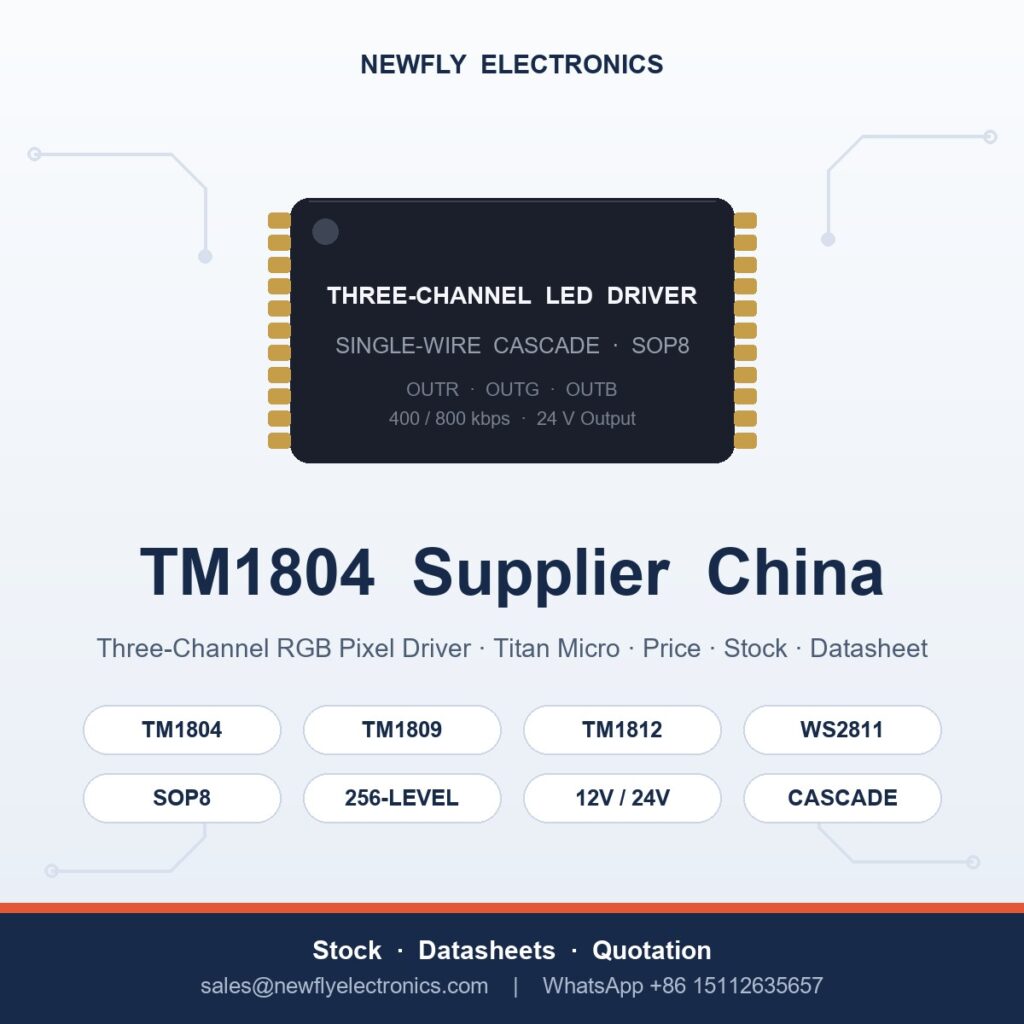
TM1804 is a three-channel LED driver and control IC made by Shenzhen Titan Micro Electronics (天微电子) in an 8-pin package. Each device drives one RGB pixel — a red, a green and a blue output, each with 256 levels of brightness — and devices chain together on a single data wire, so a strip or a building outline of several hundred pixels can run from one controller pin.
Buyers search for TM1804 because it sits at the centre of a specific design problem: a cascade of addressable LEDs on a 12 V or 24 V rail, using the single-wire return-to-zero protocol that the WS2811 generation of controllers made familiar. The part has been designed into decorative and architectural lighting for well over a decade.
That long service life is also the risk. When a part has been in the field that long, the open market fills with lots of uncertain origin, mixed date codes and inconsistent colour binning. For a lighting manufacturer, the gap between two reels of the same part number shows up as a visible mismatch across a facade, or as dead pixels at the head of a strip after one season outdoors. This page covers what TM1804 is, where it belongs and where it does not, and how to buy it without inheriting that risk.
What the TM1804 actually is
The TM1804 is a dedicated three-channel LED drive and control circuit. Titan Micro integrates the MCU digital interface, the data latch and the LED output stage into one device, so the host controller only has to send serial data — it does not have to multiplex, scan or hold the LED current itself.
Three things about the architecture matter when you are specifying it:
- One pixel per device. The three outputs are OUTR, OUTG and OUTB — one pixel. A strip with 60 LEDs per metre and 20 TM1804 devices per metre is driving one three-LED group per device. Designs that need every LED addressed individually use a different part.
- Single-wire cascade with reshaping. Data arrives on DIN, the device latches its own 24 bits, and everything after that is reshaped and forwarded out of DO. Because each device re-times the signal rather than passing the analogue edge along, data does not degrade as the chain gets longer.
- Self-contained timing. There is no external clock. The device uses an internal RC oscillator, recovers its clock from the data line, and includes a power-on reset circuit. That is what allows a long chain to run from a single MCU pin.
Per-channel brightness is 256 levels, so one device holds 24 bits of colour data. Titan Micro also states the low-brightness behaviour as an effective 1024 steps, which matters in dark-toned architectural work where the bottom of the range is where banding appears.
TM1804 technical specifications
The table below is taken from the Titan Micro TM1804 datasheet (revision V2.2). Where a design decision depends on a value, confirm it against the revision you are working to before you commit a PCB — ask us for the current revision rather than using a copy found in a forum thread.
| Parameter | Value |
|---|---|
| Manufacturer | Titan Micro Electronics (Shenzhen 天微电子) |
| Device type | Three-channel LED driver / control IC, externally controlled |
| Output channels | 3 — OUTR, OUTG, OUTB |
| Brightness levels | 256 per channel (24-bit colour data per device) |
| Data interface | Single-wire serial cascade, return-to-zero coded |
| Data rate | 400 kbps low-speed mode / 800 kbps high-speed mode |
| Cascade capacity at 30 fps | At least 512 pixels in low-speed mode, at least 1024 in high-speed mode |
| Logic supply (VDD) | 4.5 V min / 5.0 V typical / 6.5 V max |
| Output port withstand voltage | 24 V |
| Channel sink current | 40 mA min, 45 mA typical at OUT = 0.5 V |
| PWM period | 3.0–4.0 ms (scan frequency at least 400 Hz) |
| Power dissipation | 250 mW at Ta = 25 °C |
| Operating temperature | −40 to +85 °C (junction −40 to +125 °C) |
| Package | SOP8 (DIP8 also offered) |
| Pin assignment | 1 OUTR, 2 OUTG, 3 OUTB, 4 GND, 5 DO, 6 DIN, 7 SET, 8 VDD |
Two points in that table drive most of the design questions we get. First, the logic supply is a 5 V-class rail while the output stage withstands 24 V — which is why the part appears in 12 V and 24 V strips, where the LED anode rail sits well above the logic rail. Second, pin 7 (SET) selects the speed mode. Neither point is safe to assume from a schematic you inherited from someone else.
Applications and the problems they create
TM1804 is designed into decorative and architectural lighting rather than appliance displays: LED guardrail tubes, point light sources, flexible and rigid light bars, pixel lamps, LED modules, luminous characters and channel-letter signage.
- India — festival and decorative lighting, channel-letter signage, event lighting. Production is highly seasonal, so the buying risk is a reel arriving mid-peak with mismatched colour binning.
- Vietnam, Thailand, Malaysia, Philippines — building outline and facade lighting, hospitality and retail fit-out, signage. This is device substitution territory, so protocol compatibility matters.
- Middle East — facade and landscape lighting for hospitality and public projects, where a mismatched run is expensive to fix because the installation is already up.
- Europe and USA — architectural and stage lighting, and pixel-light retrofits where the existing controller is written for the WS2811 protocol family.
Three problems come up regardless of market. The first is colour consistency across lots: if two reels differ in output current binning, the mismatch is visible on a large surface even though both carry the same part number. The second is cascade headroom, which depends on the data rate and therefore on the speed mode actually selected. The third is control protocol: TM1804 timing is close to the WS2811 family but not identical, and a strip that works on a bench can fail on a long run if the controller timing sits at the edge of the window.
How TM1804 compares with the parts buyers cross-shop
Most TM1804 enquiries are really a choice between the Titan Micro three-channel part, the higher-channel Titan Micro parts on the same protocol, and the WorldSemi device most controllers were written for.
| Device | Channels / pixels per device | Protocol | Typical reason to choose it |
|---|---|---|---|
| TM1804 | 3 channels — one RGB pixel | Single wire, return-to-zero, 400/800 kbps | One pixel per device, 12 V or 24 V rail, 24 V output withstand, 8-pin footprint |
| TM1809 | 9 channels — three RGB pixels | Same single-wire family | Individually addressed LEDs at a lower device count per pixel |
| TM1812 | 12 channels — four RGB pixels | Same single-wire family | Denser pixel control, fewer devices per metre of strip |
| WS2811 (WorldSemi) | 3 channels — one RGB pixel | Single wire, 800 kbps | Ecosystem and controller support; large installed base |
If your controller firmware is already written and validated for one of these timings, changing part family is a firmware project, not a line substitution — cost it as one before you approve it. If you are choosing for a new board, TM1804 is the simplest option per pixel and the 24 V output withstand is genuinely useful on 12 V and 24 V rails.
One point of honesty, because it affects how you read that table: we supply the Titan Micro side of every pair here. We do not stock WorldSemi or other competing manufacturers’ product, so a comparison on this page is never a quotation for the other brand.
TM1804: where it does not belong
Specification tables tell you what a part can do. Design failures come from what it cannot do. Before you commit a TM1804 to a production board, check these cases — if any of them applies to your design, this is the wrong part and we will say so.
- your product is a segment display — digits, a 7-segment or 8-segment readout, or an appliance control panel — TM1804 is a pixel driver, not a display segment driver. It carries no digit decode, no keyboard scan and no display RAM. That job belongs to TM1637 or TM1650 in a 16-pin package, TM1628 or TM1668 in SOP24/SOP28, or TM1638 where you need more keys.
- your panel is LCD glass — nothing in the TM18xx family drives LCD segments at any voltage or in any package. Use TM1621B, TM1621C or TM1621D. This is the most common mis-order in the entire range.
- your MCU rail is 3.3 V and you intended to use TM1804 on that bus — the logic supply is a 5 V-class rail (4.5–6.5 V per the datasheet). Do not use it as a level translator — add a real level shifter, or move the function to a part specified for the lower rail.
- you need every individual LED addressed rather than one address per three-LED group — one TM1804 is one RGB pixel. The same single-wire protocol is carried by TM1809 (nine channels, three pixels per device) and TM1812 (twelve channels) when you need higher pixel density per device.
- your LED anode rail is above 24 V — the output port withstand voltage is 24 V. Above that you are outside the datasheet specification, not working near its limit.
- your programme requires automotive qualification or a formal PPAP package — TM1804 is a commercial-grade part rated −40 to +85 °C. If your line requires AEC-Q100 or a documented PPAP, this is not that part and we will say so rather than quote it.
- you are dropping TM1804 into a board designed around a WS2811-class controller and treating the timing as identical — the protocols are close but not identical. Validate the chain length and the exact controller you will ship with before you release the substitution.
How to qualify a TM1804 supplier
TM1804 is a mature part with a wide open-market footprint, which makes supplier selection matter more than the datasheet. These are the checks we apply, and the ones we expect you to apply to us.
- Origin and marking. Laser marking should be consistent in font, depth and position across the lot. Mixed marking styles inside one reel is the strongest single signal that the lot was assembled from more than one source.
- Date-code consistency. Ask for the date code before the quotation, not after the order. A wide spread inside one reel points to repackaging.
- Output current binning. This is the check that guards colour consistency on a large installation. If the supplier cannot state how the lot was binned, assume it was not.
- Cascade and refresh testing. Test the chain length you intend to build, in the speed mode you intend to use. Bench-testing ten devices proves nothing about a 512-device run.
- Packaging integrity. Reels, desiccant, humidity indicator and carrier tape. Moisture uptake before reflow causes field failures that get blamed on the part.
- Sample order before production. Validate on your own board, at your own rail voltage, with your own controller. A sample is the cheapest risk reduction available.
- Export documentation. Commercial invoice, packing list and, where your customs regime requires it, certificate of origin. For an export distributor this should be routine, not a favour.
- Continuity for the second order. The real question is not whether the first shipment is good, but whether the second one matches it. Ask how the supplier holds a repeat lot.
If you are building a wider sourcing relationship rather than buying one line item, our guide to selecting a reliable IC supplier from China sets out the same framework at more length, and where to buy Titan Micro IC chips online compares the sourcing channels themselves.
Why buy TM1804 from Newfly Electronics
Newfly Electronics is a Titan Micro IC supplier and export distributor working from the China supply chain. Titan Micro has no dedicated foreign trade sales team and quotes overseas buyers high prices on small quantities, which is the gap we exist to fill.
- China supply-chain pricing. We buy on the same terms our domestic customers do, and quote those terms instead of a marked-up export list.
- Stable supply. We secure stock against a stated requirement, and tell you which position you are in — stock or backorder — before you commit.
- Export experience. International shipping is routine business for us, with the documentation your customs broker will ask for.
- Technical support. We work with the Titan Micro range daily, so questions about speed mode, cascade length, package variants and cross-part selection get an engineer’s answer rather than a catalogue restatement.
- Small quantity and bulk. First orders, partial reels and prototype quantities are supported, and the same account scales to production volume.
We also carry the rest of the Titan Micro display and driver families, so a mixed requirement — pixel drivers alongside segment display drivers — can be quoted as one shipment. The Titan Micro IC product portfolio maps the three families, and the LED driver IC selection guide is the fastest route to the right part number if you are not yet fixed on one.
Working with Newfly: the numbers
Buyers evaluating a supplier want the commercial parameters stated, not implied. Here is ours. Where a figure depends on your quantity, package or destination, we say so rather than publishing a number that will not hold.
| Item | What we commit to |
|---|---|
| Sample order | Sample and small-batch quantities are supported. Sample fee, freight terms and dispatch time are confirmed in writing with each quotation. |
| Minimum order | Flexible. We support partial-reel and small-batch quantities for first orders and scale with you. |
| Lead time | Confirmed in writing per order, against the quantity and destination you specify. |
| Inspection | Marking, packaging and date-code verification before dispatch. Tell us your acceptance criteria and we will align to them. |
| Defect claims | The defect resolution process is agreed in writing before the order, not after a problem appears. |
When we tell you not to buy
A supplier who accepts every enquiry without question is not screening anything. These are the situations where we will recommend against the purchase:
- You have not validated the part on your own board yet, and you are asking for a full carton to hold speculative stock. We will say so before you commit working capital to an unproven design.
- The lot being offered to you has no traceable origin and mixed date codes across a single reel. We will describe the risk rather than quote it as if it were normal stock — including when that lot is the only one that meets your target price.
- You want to substitute TM1804 for a WS2811-class part on price alone, with no firmware timing validation. The saving is a few cents per device; the failure mode is a whole strip.
- Your procurement rules require a franchised-channel paper trail that only the manufacturer’s authorised channel can issue. We are an export distributor, not the franchised channel. If franchised traceability is mandatory for that line, we are not your supplier for it.
- You actually need individually addressable LEDs and you are trying to make TM1804 do it by adding devices. We will point you to TM1809 rather than sell you a higher device count than you need.
- You are buying on the strength of a datasheet copy pulled from a forum thread rather than the current revision. We will send the current revision and ask you to check it before you commit a PCB, even when it delays the order.
TM1804: frequently asked questions
Where can I buy the TM1804 IC in small quantities?
Contact us with the package and quantity. We support sample and small-batch quantities as well as production volumes, so a first order of a partial reel is not a problem.
Is the TM1804 still available?
Yes. It is an active Titan Micro part and remains in production use in decorative and architectural lighting. Availability of a specific package and lot is confirmed per enquiry — we tell you whether we are shipping from stock or from a production position.
What package does the TM1804 come in?
SOP8 is the standard surface-mount package, and a DIP8 option is also offered. Confirm the package you need when you request the quotation so the price and stock position refer to the right part.
Is TM1804 compatible with WS2811?
The protocols are close — both are single-wire return-to-zero in the 400/800 kbps class — but not identical, and controllers written for WS2811 timing can sit at the edge of the TM1804 window on long runs. Validate on your own board and at your own chain length before releasing a substitution.
How many TM1804 devices can I cascade?
Per the Titan Micro datasheet, at a 30 fps refresh rate the device supports at least 512 pixels cascaded in low-speed mode and at least 1024 in high-speed mode. Your practical limit depends on the speed mode, the controller and the physical data run — test the length you intend to build.
Can Newfly Electronics provide the TM1804 datasheet?
Yes. We send the current datasheet revision with the quotation, along with package drawings if your layout team needs the land pattern. Ask for the revision number so you are designing to a documented version.
What is the minimum order quantity?
It depends on package and quantity. We support partial-reel and small-batch orders for first purchases, and the commercial parameters for your specific requirement are confirmed in writing with the quotation rather than published as a single headline number.
Can I get TM1804 samples before placing a production order?
Yes, and we recommend it. Samples let you validate the part on your own board, at your own rail voltage and with your own controller firmware — the only test that actually predicts production behaviour.
Request a Quotation
Send us the part number, the package and the quantity you need. We will reply with price, confirmed stock and lead time for the the TM1804 quantity and package you need.
See also the Titan Micro IC product portfolio. See also the LED driver IC selection guide. See also the TM1637 supplier page. See also how to select a reliable IC supplier from China.
Contact Newfly Electronics
Email: sales@newflyelectronics.com
WhatsApp: +86 15112635657