
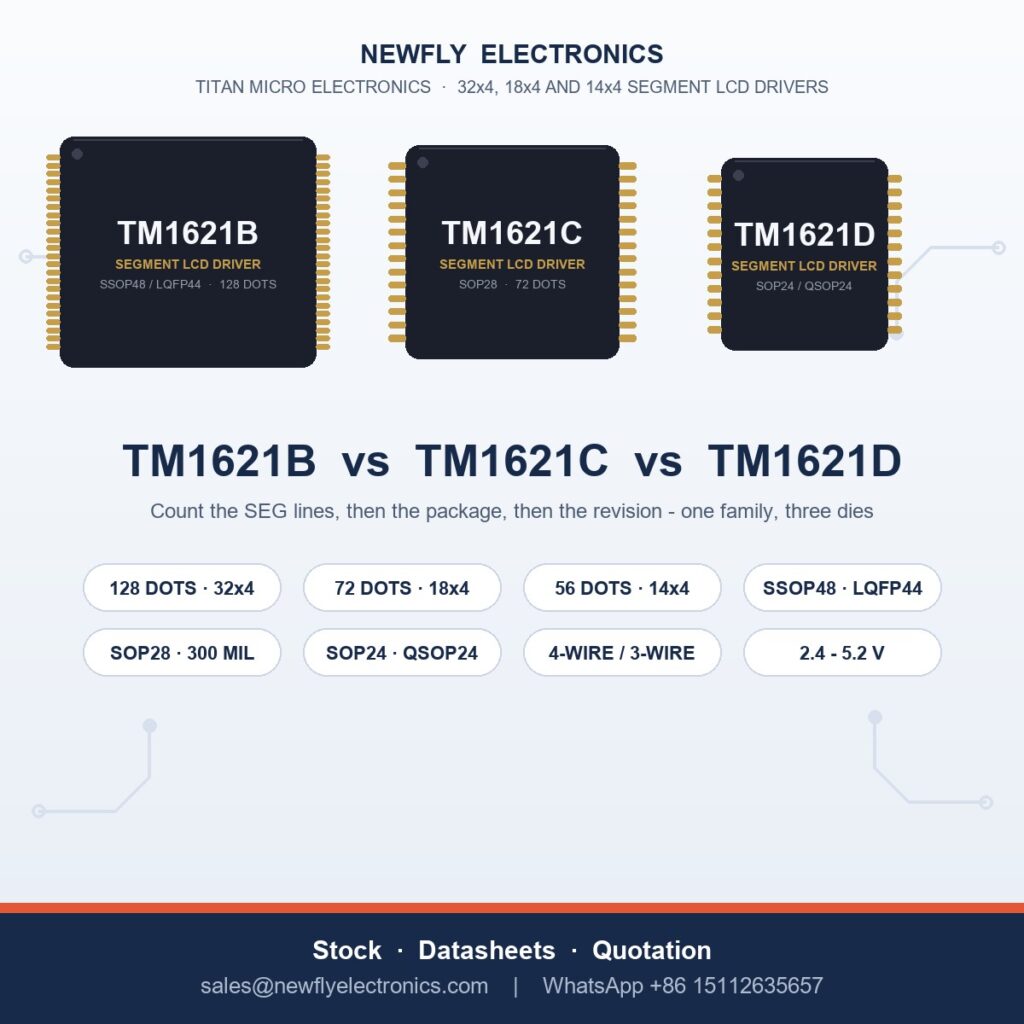
Three quotations arrive in the same week, all for a “TM1621” LCD driver, and all three are for different dies. It happens because the TM1621 stem covers a family: Titan Micro (天微电子) makes the TM1621B, TM1621C and TM1621D as distinct parts with different segment counts, different pinouts, different packages and, in one case, a different interface. A BOM that says only “TM1621” has not specified a part — it has specified a family, and picking the wrong member means a glass that lights partially, a footprint that does not fit, or a firmware port that was never budgeted.
This guide compares the three parts we ship in volume — TM1621B, TM1621C and the TM1621D — using the Titan Micro datasheets we hold, then gives four decisions in the order a design engineer actually meets them: segment count, package, temperature, and read-back. Where the family cannot answer the requirement at all, we say which part leaves the family, and why. If you already know you need the 18×4 part, the TM1621C supplier page carries the deeper pinout and goods-in detail; this page is the decision layer above it.
One stem, three dies: what each part actually is
The TM1621B is the large-format member: 32 segment outputs by 4 commons — 128 dots — in SSOP48 or LQFP44. It is also the only member with a four-wire serial interface that includes a read line: CS, WR, RD and DATA. That /RD pin means the host can read display RAM back, which changes how blink, icon and bar-graph logic is written. Its RAM is organised 16 × 8 bits and mapped to the outputs, and the duty is fixed at 1/4 with 1/3 bias — the classic configuration for meter and thermostat glass. The dedicated comparison for that part is the TM1621B vs HT1621B page.
The TM1621C is the mid-format member: 18 × 4 — 72 dots — in a 300 mil SOP28. The TM1621D is the compact member: 14 × 4 — 56 dots — in SOP24 or QSOP24. These two share an identical three-wire write-only interface and command set: /CS, /WR and DATA, with SYS DIS, SYS EN, LCD OFF, LCD ON and BIAS&COM commands, and a software-selectable bias of 1/2 or 1/3 and duty of 1/2 to 1/4. The part powers up in SYS DIS with the panel blank, which is a feature worth knowing before anyone writes a complaint about a “dead” sample.
Two further stem members exist — the base TM1621 and the TM1621E — and listings blur them together with the three above. We hold and quote against the datasheets for the B, C and D; if your BOM carries the bare stem, the first thing we ask for is the glass drawing, and the second is the package on the existing board.
TM1621B vs TM1621C vs TM1621D: specification table
Every value below comes from the Titan Micro datasheets we hold: TM1621B (32×4 LCD driver), TM1621C revision V1.0 and TM1621D revision V1.3. Where the documents differ, we show the difference rather than an average.
| Parameter | TM1621B | TM1621C | TM1621D |
|---|---|---|---|
| Display capacity | 128 dots (32 SEG × 4 COM) | 72 dots (18 SEG × 4 COM) | 56 dots (14 SEG × 4 COM) |
| Interface | 4-wire serial: CS, WR, RD, DATA | 3-wire serial: /CS, /WR, DATA | 3-wire serial: /CS, /WR, DATA |
| Display RAM read-back | Yes — dedicated /RD line | No — write-only | No — write-only |
| Display RAM | 16 × 8 bits, RAM-mapped | 31 × 4 bits; only SEG0–5, 13–19 and 26–30 bonded | 23 × 4 bits; only SEG9–22 bonded |
| Duty / bias | 1/4 duty, 1/3 bias (fixed) | 1/2–1/4 duty, 1/2 or 1/3 bias, software selected | 1/2–1/4 duty, 1/2 or 1/3 bias, software selected |
| Supply voltage VDD | 2.4–5.2 V | 2.4–5.2 V | 2.4–5.2 V |
| Contrast | Set by the external drive-voltage arrangement | VLCD pin with external VR divider; VLCD must be below VDD | Same as TM1621C |
| System clock | Built-in RC oscillator | 256 kHz RC; 32.768 kHz crystal selectable by command | Same as TM1621C |
| Serial clock ceiling | Per datasheet write timing — request the document | 500 kHz at 5 V, 300 kHz at 3 V | 500 kHz at 5 V, 300 kHz at 3 V |
| Operating temperature | −40 to +85 °C | −25 to +75 °C (revision V1.0) | −40 to +85 °C (revision V1.3) |
| Storage temperature | −50 to +120 °C | −50 to +120 °C | −50 to +120 °C |
| ESD | — | HBM 4000 V, MM 400 V | HBM 4000 V, MM 400 V |
| Package | SSOP48, LQFP44 | SOP28, 300 mil | SOP24, 300 mil; QSOP24 |
| Datasheet revision held | 32×4 document, published on our supplier page | V1.0; factory site lists a later revision | V1.3 |
Decision 1: count the segment lines, not the dots
The family sorts itself mechanically once you count SEG lines on the glass drawing — the nets going to the segment electrodes, not the total dot count. Up to 14 segment lines, the TM1621D covers it and the TM1621C also fits. Fifteen to 18 lines, the TM1621C is the only member that reaches. Nineteen to 32 lines, the TM1621B is the answer. Beyond 32, no member of this family fits, and the honest options are the TM16C21 at 20 segments by 4 commons or a different driver family entirely.
Two calibration points make the counting concrete. A four-digit seven-segment panel with a colon and a handful of icons usually lands between 12 and 15 segment lines depending on how the icons are matrixed — the exact band where the 56-dot TM1621D and the 72-dot TM1621C compete, and where a single added decimal point per digit can push the design from one die to the other. Classic utility-meter or thermostat glass with three or four full digits, a bar graph of load icons and annunciators across the top typically needs 25 to 32 lines — TM1621B territory, and the reason that part dominates the weighing-indicator and metering segment of our order book.
Decision 2: package and board area
Segment count decides which die; package decides whether it fits the board. The QSOP24 TM1621D has a body 3.80 to 4.00 mm wide on a 0.635 mm pitch. The SOP28 TM1621C is a 300 mil body — roughly 7.5 mm. The SSOP48 and LQFP44 TM1621B are larger again by pin count and body area. On a narrow controller PCB squeezed behind a 40 mm glass — the standard geometry for water-heater panels, rice cookers and small inverters across Vietnam, Thailand and Malaysia — halving the driver body is often worth more than the 16 dots given up by dropping from C to D. Contract manufacturers in those markets shortlist suppliers by package availability as often as by price, because a QSOP24 shortage stops a line in a way a 2-cent price gap never repays.
The reverse case exists too: a board laid out years ago around the 300 mil SOP28 keeps its footprint when the die inside changes, and the TM1621C is the drop-in for that geometry. Measure the existing body before optimising anything else.
Decision 3: temperature range and revision
The TM1621D revision V1.3 is rated −40 to +85 °C and the TM1621B likewise; the TM1621C revision V1.0 we hold is rated −25 to +75 °C, while the factory site lists a later revision. For an outdoor meter enclosure in Gujarat, a rooftop inverter in Thailand or a pump controller in the Gulf, the temperature column decides the part before price is even discussed. For indoor consumer appliances the narrower range rarely matters.
The commercial warning is the same one we give on every TM1621-family order: reseller catalogues lag the factory documents. Parametric listings still circulate older and sometimes contradictory temperature figures for this family. Quote against a revision number and confirm the revision your supplier will actually ship, not the one an aggregated catalogue page shows. We state the revision in writing with every quotation.
Decision 4: read-back, interface lines and bus sharing
The /RD line is the quiet differentiator. On the TM1621B the host can read display RAM back, so blinking one digit or updating one icon is a read-modify-write on the chip. On the TM1621C and TM1621D there is no read path at all — the same behaviour must come from a shadow copy of the display buffer in MCU RAM, written wholesale on every change. Neither approach is wrong, but the firmware effort differs, and a routine written assuming read-back will not port to the C or D without rework.
Interface pin count differs for the same reason: the TM1621B needs four GPIO lines, the C and D need three. On a pin-starved small MCU that is a real constraint. And if the plan is to hang two display drivers on one bus, the TM1621B takes it — each device has its own hardware CS line — while the I²C TM16C21 cannot, because its slave address is fixed at 0x70 write / 0x71 read with no address pins. That single fact settles more second-display designs than any datasheet table.
The RAM map trap is different on every die
On the TM1621C and TM1621D the display RAM address equals the segment number, and only the bonded segments exist as addresses. The TM1621C’s valid addresses inside a 31 × 4 space are 0–5, 13–19 and 26–30; the TM1621D’s are 9–22 inside 23 × 4. A driver loop that writes addresses 0 to N sequentially, ported from another part, spends most of its writes on unbonded addresses and lights only part of the panel — the classic “right-hand digits dead” symptom that arrives in our support inbox and is never a bad chip. The TM1621B avoids the trap with its contiguous 16 × 8 mapped RAM, which is one more reason firmware teams migrating from a C or D upward re-test rather than re-compile.
The same address-boundary logic doubles as a goods-in test: write only the first and last valid address for the die you ordered and confirm both respond. It is the fastest bench check that the die inside the package matches the label, and the full five-check sequence is on the TM1621C supplier page.
When none of the three is the answer
Three requirements send a design out of this family, and it is cheaper to know them on day one. Glass with eight common backplanes: every member here drives four COMs, so the part is the TM16C21 in its 16 × 8 configuration — the TM16C21 versus TM1621B comparison works that end of the decision. Contrast that must be adjustable from firmware: the TM16C21’s 16-step internal VLCD does it in a register, where the B, C and D all rely on the external drive-voltage arrangement. And if the display is an LED matrix rather than segment glass, none of this family applies — start from the Titan Micro LED driver selection guide, or at the TM1730 if an I²C LCD driver that also scans keys is the actual requirement.
Which revision and marking are you buying
Revision drift is the family’s pricing hazard. The factory site lists a later TM1621C revision than the V1.0 document most catalogues carry; the TM1621D is stable at V1.3. Listings also circulate with suffixes such as “(TA1901-A)” marked as a new version — we do not invent what changed, we quote against the marking on your drawing and confirm the suffix before shipping. Date-code spread is the other tell: one lot and one date code is normal stock; a reel assembled from mixed codes at a low price is broker material, and on a metering product the field-failure cost lands on your certification, not the broker’s invoice. The wider sourcing framework is in where to buy Titan Micro IC chips online and how to select a reliable IC supplier from China.
Where these parts actually ship
Geographically, the split in our order book is consistent: India takes the largest share, overwhelmingly metering, stabiliser, inverter and weighing-indicator builds around the TM1621B; Southeast Asia — Vietnam, Thailand, Malaysia, the Philippines — is contract manufacturing of appliance panels where the QSOP24 TM1621D wins on board area; the Middle East skews to outdoor and industrial enclosures where the −40 °C ratings of the B and D decide; Europe and the United States are lower-volume but documentation-heavy, and those buyers want revision, date-code rule and marking photographs before price. The distributor page and the Titan Micro IC product portfolio map the rest of the range.
Working with Newfly: the numbers
Buyers evaluating a supplier want the commercial parameters stated, not implied. Here is ours. Where a figure depends on your quantity, package or destination, we say so rather than publishing a number that will not hold.
| Item | What we commit to |
|---|---|
| Sample order | Sample and small-batch quantities are supported. Sample fee, freight terms and dispatch time are confirmed in writing with each quotation. |
| Minimum order | Flexible. We support partial-reel and small-batch quantities for first orders and scale with you. |
| Lead time | Confirmed in writing per order, against the quantity and destination you specify. |
| Inspection | Marking, packaging and date-code verification before dispatch. Tell us your acceptance criteria and we will align to them. |
| Defect claims | The defect resolution process is agreed in writing before the order, not after a problem appears. |
the TM1621 family: where it does not belong
Specification tables tell you what a part can do. Design failures come from what it cannot do. Before you commit a the TM1621 family to a production board, check these cases — if any of them applies to your design, this is the wrong part and we will say so.
- your glass has more than 32 segment lines — no member of this family reaches it — the TM1621B stops at 32 SEG × 4 COM and the TM16C21 tops out at 20 SEG in 1/4 duty. Beyond 32, plan a glass change or a different driver family: firmware cannot recover segments that are not bonded out.
- your glass has 8 common backplanes — every member here drives four COMs. An 8-COM layout needs the I²C TM16C21 in its 16 × 8 configuration — pairing 8-COM glass with this family is a guaranteed re-tool.
- you chose the TM1621C or TM1621D and the firmware reads display RAM back — both are write-only: there is no /RD pin. Any blink, icon or bar-graph update needs a shadow buffer in MCU RAM. If read-back is mandatory, move to the TM1621B before the firmware is written, not after.
- your MCU runs at 3.3 V but the driver rail is 5 V — on the C and D, VIH is specified at 4.0 V minimum at 5 V VDD — a 3.3 V toggle does not meet it. Run the driver from the MCU rail or add level shifting; do not assume it works because the datasheet says 2.4 V minimum.
- you plan to swap dies on an existing footprint — the B, C and D are not pin-compatible with each other — pin count, pin order and RAM map all differ. This is a layout and firmware revision, not a reel substitution, and we will say so before you book the SMT line.
- the product must be sold as AEC-Q100 or otherwise automotive-qualified — these are commercial-grade parts with no automotive qualification. We will decline the order rather than imply a grade they do not hold.
When we tell you not to buy
A supplier who accepts every enquiry without question is not screening anything. These are the situations where we will recommend against the purchase:
- Your BOM says “TM1621” with no package, dot count or die revision and you want us to pick one. We will ask for the glass drawing first — a wrong die at layout freeze costs a respin, and guessing is how that happens.
- You need 19 or more segment lines and want the TM1621C anyway. It cannot reach them. We would rather quote the TM1621B than ship a partially dark display.
- You want a price 40 % under the factory with no traceable origin. That material exists; we do not sell it, and we will explain the field-failure pattern instead of quoting it.
- The lot on offer is one reel of mixed date codes for a product carrying a utility approval. On metering that risk lands on your certification, not on the broker.
- You want the Holtek or another brand equivalent quoted alongside for convenience. We supply the Titan Micro side only and do not stock competitor product.
- You plan an outdoor or industrial enclosure on the TM1621C without confirming which revision you receive. We will quote the part, but we will also flag the temperature column against the TM1621D before you freeze the design.
Frequently asked questions
What is the difference between the TM1621B, TM1621C and TM1621D?
Segment count, package and read-back. The TM1621B drives 32 SEG × 4 COM (128 dots) in SSOP48/LQFP44 with a four-wire interface that includes a read line. The TM1621C drives 18 × 4 (72 dots) in SOP28, and the TM1621D drives 14 × 4 (56 dots) in SOP24/QSOP24 — both three-wire, write-only, with the same command set.
Can I replace a TM1621C with a TM1621B?
Not as a reel swap. The pin count, pin order, RAM organisation and serial protocol all differ — 44/48 pins against 28, a 16 × 8 RAM against a 31 × 4 bonded map, four-wire against three-wire. It is a layout and firmware revision. Do it only when the glass genuinely needs more than 18 segment lines.
Which TM1621 family part should I use for an energy meter?
Count the segment lines on the meter glass. Classic meter and thermostat layouts with annunciators and bar graphs usually need 19 to 32 lines, which puts them on the TM1621B. A compact single-phase panel under 14 lines fits the TM1621D. Send us the glass drawing and we will confirm before you commit the layout.
Is the TM1621D available in a smaller package than the TM1621C?
Yes. The TM1621D comes in QSOP24 with a 3.80–4.00 mm body on a 0.635 mm pitch — roughly half the width of the TM1621C’s 300 mil SOP28 — as well as a standard 300 mil SOP24.
Which TM1621 parts can read the display RAM back?
Only the TM1621B, through its dedicated /RD line. The TM1621C and TM1621D are write-only; blink and icon logic on those parts runs from a shadow buffer in MCU RAM.
What temperature range do the TM1621C and TM1621D support?
The TM1621D revision V1.3 is rated −40 to +85 °C, as is the TM1621B. The TM1621C revision V1.0 we hold is rated −25 to +75 °C; the factory lists a later revision, so confirm the figure against the revision your supplier ships.
Where can I buy TM1621B, TM1621C or TM1621D in small quantity?
From us, at partial-reel and sample quantities. Send the part number, package and destination country, and we reply with price, confirmed stock and the shipping window — revision stated in writing.
Can you send the datasheets before I order?
Yes, for all three parts, including the revision number we would ship against. Send the part number and we will reply with the PDFs and the quotation.
Request a Quotation
Send us the part number, the package and the quantity you need. We will reply with price, confirmed stock and lead time for the TM1621B, TM1621C or TM1621D requirement.
See also the TM1621C supplier page. See also the TM1621B supplier page. See also the TM16C21 I2C LCD driver supplier page. See also the TM16C21 vs TM1621B comparison. See also the TM1621B vs HT1621B comparison. See also the TM1621B product page. See also the weighing-scale IC guide (TM7711 + TM1621B). See also the Titan Micro IC product portfolio. See also the Titan Micro IC alternative and replacement guide. See also where to buy Titan Micro IC chips online.
Contact Newfly Electronics
Email: sales@newflyelectronics.com
WhatsApp: +86 15112635657