
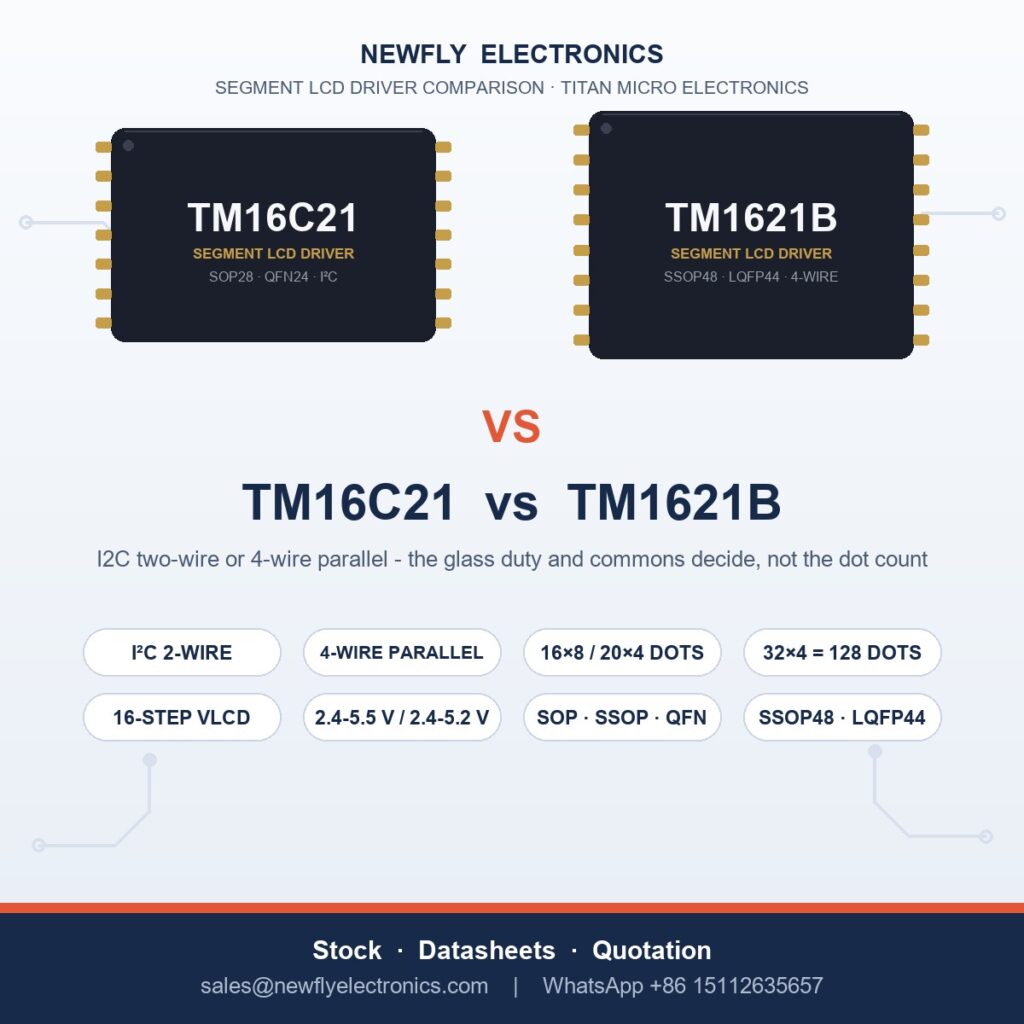
Searches that put the TM16C21 and the TM1621B side by side come from a very specific buyer: an engineer or purchasing manager who has settled on a segment LCD, has a Titan Micro driver shortlist, and now has to commit to one of them before the glass is tooled. Both parts are segment LCD drivers from Titan Micro Electronics (天微电子), both hold 128 dots of display RAM, and both are supplied by Newfly Electronics with datasheet support and export service. They are not interchangeable, and the wrong choice is expensive to discover after tooling.
This guide compares the two parts on the parameters that actually decide the purchase: the interface your MCU must support, the glass geometry each part can drive, contrast control, supply range, and package footprint. Every TM16C21 figure below comes from the official TM16C21 V1.1 datasheet; every TM1621B figure matches the specification table already published on our TM1621B supplier page. Where a value is not in our published data, the table says so instead of guessing.
TM16C21 vs TM1621B at a Glance
The short version: the TM16C21 is the two-wire part. It hangs on an I²C bus, drives either 16×8 or 20×4 dot glasses, and adjusts contrast in firmware through a 16-step internal VLCD supply. The TM1621B is the classic four-wire meter part: 32 segments on 4 commons, RAM-mapped, happy on any MCU with four free GPIO lines, and built around the 1/4-duty, 1/3-bias glass geometry that dominates energy meters and thermostats.
| Parameter | TM16C21 (Titan Micro) | TM1621B (Titan Micro) |
|---|---|---|
| Interface | I²C, two-wire (SCL, SDA) | 4-wire serial (CS, WR, RD, DATA) |
| Slave / chip select | Fixed address 0x70 write / 0x71 read — no address pins | Hardware CS line per device |
| Display configuration | 16 SEG × 8 COM (128 dots) or 20 SEG × 4 COM (80 dots) | 32 SEG × 4 COM (128 dots) |
| Duty / bias pairings | 1/8 Duty + 1/4 Bias, or 1/4 Duty + 1/3 Bias | 1/4 Duty + 1/3 Bias (fixed) |
| Display RAM | 128 bit (1/8 Duty) / 80 bit (1/4 Duty) | 16 × 8 bit, RAM-mapped |
| Contrast control | 16-step internal VLCD (1.00 × VDD down to 0.529 × VDD at 1/3 bias) | No register-level adjustment — set by the external drive-voltage arrangement |
| Supply voltage VDD | 2.4 V to 5.5 V | 2.4 V to 5.2 V |
| Bus clock | 100 kHz (VDD 2.4–5.5 V), 400 kHz (VDD ≥ 3.0 V) | Per datasheet write timing (request the document) |
| Frame frequency | 80 Hz or 160 Hz, register selected | Driven by the built-in RC oscillator |
| Oscillator | Internal RC, no external components | Built-in RC oscillator |
| Standby current | ≤ 1 µA at 3 V / ≤ 2 µA at 5 V | Low — battery-oriented (see datasheet for the figure) |
| Packages | SOP16/20/24/28, SSOP20/24/28, QSOP24, QFN16/20/24/28 | SSOP48, LQFP44 |
| Operating temperature | −40 °C to +85 °C | −40 °C to +85 °C |
Where the Two Parts Agree
Before the differences, the common ground — because it explains why these two parts keep landing on the same shortlist:
- Both are Titan Micro (天微电子) segment LCD drivers with RAM-mapped display memory. The MCU writes segment data once and the IC maintains the panel autonomously — no continuous refresh loop, which is what makes both parts effective in battery-powered meters and instruments.
- Both hold 128 dots of display capacity in their primary configuration. The dot count alone never separates them; the glass geometry does.
- Both run from a 2.4 V-class supply and integrate the RC oscillator, so neither needs an external clock component or a level-shifting stage on a 3 V rail.
- Both are commercial-grade parts rated −40 to +85 °C, covering indoor instrumentation, metering, and appliance-panel environments. Neither carries automotive qualification.
Everything that decides the choice is in the differences below.
Difference 1: I²C Bus vs 4-Wire Parallel — the Decision That Costs GPIO or Costs Flexibility
The TM16C21 speaks I²C on two lines (SCL, SDA) with a fixed slave address of 0x70 write / 0x71 read. There are no address-select pins. That has two consequences that belong in the schematic review, not the firmware review:
- An MCU with a hardware or bit-banged I²C peripheral can add the display with two GPIO lines, sharing the bus with an EEPROM, an RTC, or a sensor — provided none of them sits at 0x70/0x71.
- Two TM16C21 devices cannot share one bus. The address is fixed in silicon. If the roadmap includes a second panel, plan a bus switch or a second bus now.
The TM1621B takes the opposite position: four lines (CS, WR, RD, DATA) and a hardware chip select per device. It costs two more GPIO lines than I²C and it does not share a bus — but each additional TM1621B needs only its own CS line, so multi-panel designs are straightforward. If your MCU has no I²C peripheral free, or your firmware team already owns a 4-wire driver routine, the TM1621B integrates faster.
Difference 2: The Glass Decides — Duty and Common Count Are Hard Rules
This is the single most common sourcing mistake with these two parts, and it is worth stating as a rule: the LCD glass chooses the driver, not the other way around.
- An 8-common glass (16 SEG × 8 COM) can only be driven by the TM16C21. The TM1621B has four commons and physically cannot drive the eighth backplane. No firmware trick changes this.
- A classic 32 SEG × 4 COM meter or thermostat glass can only be fully driven by the TM1621B. The TM16C21 in its 1/4 Duty mode drives 20 segments × 4 commons — 80 dots, not 128. Dropping a TM16C21 onto a 32×4 layout leaves a quarter of the panel dark.
- The TM16C21 offers exactly two duty/bias pairings: 1/8 Duty + 1/4 Bias and 1/4 Duty + 1/3 Bias. The TM1621B is fixed at 1/4 Duty + 1/3 Bias. If your glass was tooled around any other pairing, neither part is correct.
So when a buyer emails us asking “TM16C21 or TM1621B?”, the first question back is always the glass drawing: segment count, commons, duty, bias. Send those four numbers and the answer is usually obvious in one reply.
Difference 3: Contrast Control — Firmware Steps vs External Hardware
The TM16C21 integrates a 16-step VLCD generator, register-adjustable from 1.00 × VDD down to 0.529 × VDD (1/3 bias) or 0.600 × VDD (1/4 bias). Contrast becomes a firmware value instead of a resistor decision — useful when one PCB serves multiple glass vendors or multiple product tiers with different viewing-angle requirements.
It has one cost: pin 28 (in the 28-pin packages) is shared between the twentieth segment and the VLCD function. Keeping contrast adjustable in firmware costs you segments — in 1/8 Duty mode the panel tops out at 120 dots instead of 128 when the shared pin works as VLCD. Decide which of the two you need before the glass is tooled; it cannot be changed afterwards.
The published TM1621B specification carries no register-level contrast adjustment. Contrast is fixed by the external drive-voltage arrangement. For a meter product with one glass and one supply rail, that is not a limitation — it is one less register to configure. For a product family with multiple glass variants, it pushes you toward the TM16C21.
Difference 4: Package and Footprint
The TM1621B ships in SSOP48 and LQFP44 — large bodies, because 36 segment lines and 4 commons need the pins. The TM16C21 spreads the same 128 dots across multiplexed commons, so it fits far smaller bodies: SOP16 through SOP28, SSOP20/24/28, QSOP24, and QFN16 through QFN28. On a dense metering PCB or a compact instrument board, the TM16C21’s QFN24 footprint is a fraction of the TM1621B’s SSOP48 area.
Neither part is a drop-in for the other: the footprints, the pinout, and the bus are all different. A migration between them is a redesign, not a reel swap — which is exactly why the decision belongs before tooling, with the glass drawing in hand.
Decision Table: Choose This If
| Your situation | Choose | Why |
|---|---|---|
| Glass has 8 commons (16 × 8 layout) | TM16C21 | TM1621B has only 4 COM lines |
| Classic 32 SEG × 4 COM meter / thermostat glass | TM1621B | TM16C21 drives only 20 SEG in 1/4 Duty — 80 of 128 dots |
| Only 2 GPIO lines free, I²C available | TM16C21 | Two-wire bus; TM1621B needs 4 lines |
| No I²C peripheral, 4 GPIOs free, simple bit-bang driver | TM1621B | 4-wire interface works on any MCU |
| Contrast must be adjustable in firmware | TM16C21 | 16-step internal VLCD (mind the shared-pin dot cost) |
| Second display planned on the same bus | TM1621B (per-device CS) | TM16C21’s fixed 0x70/0x71 address blocks bus sharing |
| Smallest possible PCB footprint | TM16C21 | QFN24-class packages vs SSOP48/LQFP44 |
| Migrating from Holtek HT1621B firmware | TM1621B | 4-wire adaptation is the smaller step — see the TM1621B vs HT1621B comparison |
Applications and Regional Demand
The TM1621B remains the default for energy meters across India, Vietnam, and Bangladesh, where prepaid and postpaid meter programs standardised on 32×4 glass years ago. It is equally entrenched in thermostats and control panels across Southeast Asia — Thailand, Malaysia, Indonesia — and in the measurement instruments assembled for European utility programs. If you are carrying one of these designs forward unchanged, the TM1621B is the continuity choice, and our weighing-scale signal-chain guide shows it paired with the TM7711 ADC in exactly those builds.
The TM16C21 wins new designs: compact battery instruments, smart-home panels, and next-generation meters where the MCU is already I²C-centric and every GPIO is contested. Manufacturers in Vietnam, the Philippines, and the Middle East moving from discrete-segment glass to denser 8-common layouts use it for the 16×8 configuration; contract manufacturers in Europe use the 16-step VLCD to keep one PCB across several glass vendors. Middle East architectural and HVAC panels also use the TM1730 when the same two-wire bus must also scan keys — the TM16C21 drives glass only.
Newfly Electronics supplies both parts globally from Shenzhen with datasheet support, sample and production quantities, and export documentation. Both ship to India, Southeast Asia, the Middle East, Europe, and the USA.
What Moves a TM16C21 / TM1621B Quotation
Five variables shape the number we send back, and every one of them is under your control:
- Package variant. The TM16C21 family spans four package systems (SOP, SSOP, QSOP, QFN); the TM1621B spans two (SSOP48, LQFP44). Different variants carry different production positions.
- Quantity and schedule. A single sample set, a pilot batch, and an annual volume with call-offs are quoted differently — tell us the trajectory, not just the first order.
- Glass specification. Duty, bias, and dot count. We ask because the wrong-part order is the most expensive outcome for both of us.
- Destination market. Freight mode, documentation, and delivery terms depend on it.
- Support expectations. Register-level questions (VLCD steps, I²C initialisation, 4-wire timing) are answered by our technical team; knowing your firmware context upfront gets you usable answers in the first reply.
the TM16C21 vs TM1621B decision: where it does not belong
Specification tables tell you what a part can do. Design failures come from what it cannot do. Before you commit a the TM16C21 vs TM1621B decision to a production board, check these cases — if any of them applies to your design, this is the wrong part and we will say so.
- your glass has 8 common backplanes (a 16 SEG × 8 COM layout) — only the TM16C21 can drive it — the TM1621B has four commons and physically cannot connect to the eighth backplane. If a quote arrived pairing the TM1621B with an 8-COM glass, stop the order.
- your glass is a classic 32 SEG × 4 COM meter or thermostat layout — only the TM1621B drives it in full. The TM16C21 in 1/4 Duty mode reaches 20 SEG × 4 COM — 80 of the 128 dots. The remaining quarter of the panel stays dark.
- you need a second display on the same I²C bus — the TM16C21 slave address is fixed at 0x70/0x71 with no address pins, so two devices cannot share one bus. Either move to the TM1621B with one CS line per panel, or plan a bus switch in the schematic now.
- your glass duty/bias pairing is anything other than 1/8+1/4 or 1/4+1/3 (TM16C21) or 1/4+1/3 (TM1621B) — neither part creates a third pairing in firmware. Re-check the glass drawing before the driver — re-tooling glass is the expensive version of this lesson.
- you expect a pin-for-pin swap between the TM16C21 and the TM1621B — the footprints, pinouts and bus are all different. A migration is a redesign, decided before the glass is tooled — not a reel swap on the same PCB.
- you need key scanning or a buzzer driver on the same chip — both parts drive segment LCD glass only. For an I²C part that also scans keys, look at the TM1730; for LED displays start from the LED driver selection guide.
- the product must be sold as AEC-Q100 or otherwise automotive-qualified — both parts are commercial-grade, rated −40 to +85 °C, with no automotive qualification. We will decline the order rather than imply a grade they do not hold.
Working with Newfly: the numbers
Buyers evaluating a supplier want the commercial parameters stated, not implied. Here is ours. Where a figure depends on your quantity, package or destination, we say so rather than publishing a number that will not hold.
| Item | What we commit to |
|---|---|
| Sample order | Sample and small-batch quantities are supported. Sample fee, freight terms and dispatch time are confirmed in writing with each quotation. |
| Minimum order | Flexible. We support partial-reel and small-batch quantities for first orders and scale with you. |
| Lead time | Confirmed in writing per order, against the quantity and destination you specify. |
| Inspection | Marking, packaging and date-code verification before dispatch. Tell us your acceptance criteria and we will align to them. |
| Defect claims | The defect resolution process is agreed in writing before the order, not after a problem appears. |
When we tell you not to buy
A supplier who accepts every enquiry without question is not screening anything. These are the situations where we will recommend against the purchase:
- You want us to quote the Holtek HT16C21 or HT1621B alongside the Titan Micro parts to make the comparison convenient. We supply the Titan Micro side only and do not stock Holtek product — the comparison tables on this page say so in the tables themselves.
- You plan to drop either part into the other’s footprint because both are “128-dot Titan Micro LCD drivers”. They are not interchangeable — package, pinout and bus all change, and we would rather scope the redesign with you than ship a board problem.
- Your glass specification has not been fixed yet and you want the driver chosen first. On segment LCD parts the glass decides the driver, not the reverse — we will ask for duty, bias and dot count before quoting.
- You need two panels on one I²C bus and cannot add a bus switch or move to per-panel CS lines. The TM16C21 cannot do it, and we would rather lose the line item than ship you a schematic problem.
- The lot on offer is mixed date codes across one reel with no traceable origin. On metering and instrument products that carry an approval, we will describe that risk instead of quoting it as normal stock.
- Your target price can only be met with material we cannot verify as original Titan Micro product. We will decline the order rather than carry that exposure into your build.
FAQ: TM16C21 vs TM1621B Sourcing Questions
What is the main difference between the TM16C21 and the TM1621B?
The interface and the glass geometry. The TM16C21 uses an I²C two-wire bus (fixed address 0x70/0x71) and drives 16×8 or 20×4 dot glasses with firmware-adjustable contrast. The TM1621B uses a 4-wire serial interface (CS, WR, RD, DATA) and drives a classic 32×4 glass — 128 segments at 1/4 duty, 1/3 bias. Both are Titan Micro segment LCD drivers with RAM-mapped display memory.
Can the TM16C21 replace the TM1621B in an existing design?
No — and the reverse is equally true. The packages, pinouts, and buses are different, and the glass constraints point in opposite directions: a 32×4 glass needs the TM1621B (the TM16C21 drives only 80 of its 128 dots in 1/4 duty), while an 8-common glass needs the TM16C21 (the TM1621B has only 4 commons). Treat a migration as a redesign, decided before the glass is tooled.
Which glasses work with the TM16C21 but not the TM1621B?
Any glass with 8 common backplanes — for example a 16 SEG × 8 COM layout — can only be driven by the TM16C21. The TM1621B is limited to 4 commons. Conversely, a full 32-segment × 4-common layout can only be completely driven by the TM1621B.
Do the TM16C21 and TM1621B run from the same supply voltage?
Almost. The TM16C21 is specified from 2.4 V to 5.5 V for both VDD and VLCD. The TM1621B is specified from 2.4 V to 5.2 V. Both work on a 3 V battery rail; check the upper limit if your design sits at 5.5 V.
Where can I buy TM16C21 and TM1621B LCD driver ICs?
Newfly Electronics supplies original Titan Micro TM16C21 and TM1621B ICs from China with datasheet support and export service. Email sales@newflyelectronics.com or WhatsApp +86 15112635657 with the part, package, glass specification, and quantity. We ship to India, Southeast Asia, the Middle East, Europe, and the USA. Our TM16C21 supplier page and TM1621B supplier page carry the full specifications.
What packages are available for each part?
The TM16C21 is offered in SOP16/20/24/28, SSOP20/24/28, QSOP24, and QFN16/20/24/28. The TM1621B is offered in SSOP48 and LQFP44. Confirm the exact suffix against your PCB footprint before ordering — variants are not interchangeable.
Does Newfly Electronics provide datasheets for both parts?
Yes. We provide the official Titan Micro datasheets to verified customers — the TM16C21 V1.1 document and the current TM1621B datasheet, including electrical characteristics, timing, register maps, and reference circuits. Request them by email or WhatsApp.
Which part is better for a battery-powered meter?
For a conventional 32×4 meter glass, the TM1621B: its RAM-mapped display holds the panel with no MCU refresh, and the glass geometry matches it exactly. For a new compact instrument where GPIO is scarce, the bus is I²C, or contrast needs firmware adjustment, the TM16C21 with its sub-1 µA-class standby in low-power mode is the stronger fit. Send us the glass drawing and the MCU budget and we will confirm the choice before you commit.
Request a Quotation
Send us the part number, the package and the quantity you need. We will reply with price, confirmed stock and lead time for the a TM16C21 or TM1621B segment LCD driver requirement.
See also the TM16C21 I2C LCD driver supplier page. See also the TM1621B LCD driver supplier page. See also the TM1621B vs HT1621B comparison. See also the TM1621B product page. See also the TM1730 product page (I2C LCD driver with key scan). See also the weighing-scale IC guide (TM7711 + TM1621B). See also the Titan Micro IC product portfolio. See also the Titan Micro IC alternative and replacement guide. See also where to buy Titan Micro IC chips online. See also how to select a reliable IC supplier from China.
Contact Newfly Electronics
Email: sales@newflyelectronics.com
WhatsApp: +86 15112635657