
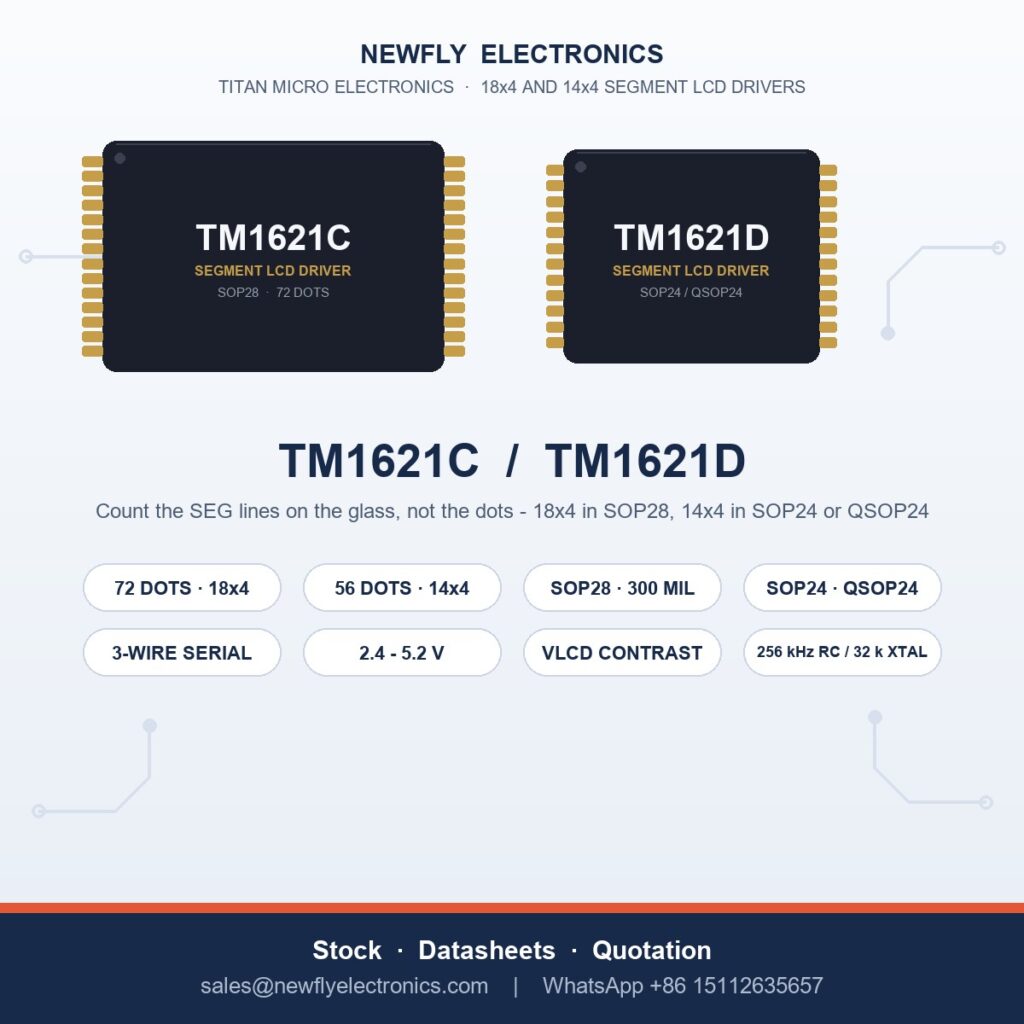
A purchase order arrives with “TM1621” on the line and nothing else: no package, no dot count, no revision. Titan Micro (天微电子) ships at least five parts under that stem — TM1621, TM1621B, TM1621C, TM1621D and TM1621E — and two of them, the TM1621C and TM1621D, get confused most often. Both are three-wire, memory-mapped segment LCD drivers. Both run 2.4 to 5.2 V. Both use the identical command set. The difference is 16 dots and a package width, and that difference decides whether your glass lights up or stays half dark.
This page turns that one-line BOM entry into a shippable part: what the two parts are per the Titan Micro datasheets, where the pin numbering and RAM map bite a layout or a firmware port, and what we verify before a reel ships. One correction up front, because it is why buyers end up here — the TM1621C is a 72-dot driver. Reseller pages still call it a 184-point part. Compare quotes against a revision number, not a listing.
What the TM1621C is, in the terms a BOM needs
The TM1621C is a segment LCD driver with an 18 × 4 matrix — 18 segment outputs, 4 common backplanes, 72 dots. Display RAM sits inside the chip and maps directly onto the segment and common outputs, so the host controller writes a byte and walks away; the driver keeps the panel alive on its own. Communication is three-wire serial: chip select, write strobe, bidirectional data. Contrast comes from a VLCD pin feeding an external divider, which is what lets one part number serve glasses from several suppliers with different threshold behaviour.
Two clock options matter commercially. By default the part runs from an on-chip 256 kHz RC oscillator with no external components — the reason this family is cheap to design in. Where the product needs a real time base, a 32.768 kHz crystal can be selected by command instead, and the same order code becomes the time source. The TM1621D is that architecture cut to 14 segment outputs — 56 dots — in a 24-pin body.
TM1621C and TM1621D: specification table
Every value below is from the Titan Micro datasheets: TM1621C revision V1.0 (18×4 LCD driver) and TM1621D revision V1.3 (14×4 LCD driver). Where the two documents differ, both figures are shown rather than averaged.
| Parameter | TM1621C | TM1621D |
|---|---|---|
| Display capacity | 72 dots (18 SEG × 4 COM) | 56 dots (14 SEG × 4 COM) |
| Display RAM | 31 × 4 bits; only addresses 0–5, 13–19 and 26–30 are bonded to pins | 23 × 4 bits; only addresses 9–22 are bonded to pins |
| Interface | 3-wire serial: /CS, /WR, DATA (write-only) | 3-wire serial: /CS, /WR, DATA (write-only) |
| Mode codes | 101 = write RAM data, 100 = command | 101 = write RAM data, 100 = command |
| Supply voltage VDD | 2.4–5.2 V | 2.4–5.2 V |
| Absolute max VDD | VSS −0.3 to VSS +5.5 V | VSS −0.3 to VSS +5.5 V |
| System clock | On-chip 256 kHz RC; 32.768 kHz crystal or external clock selectable by command | Same |
| LCD clock | fSYS/1024 (RC) or fSYS2/128 (crystal) | Same |
| Bias | 1/2 or 1/3, software selectable | 1/2 or 1/3, software selectable |
| Duty / commons | 1/2, 1/3 or 1/4 duty (2, 3 or 4 COM) | 1/2, 1/3 or 1/4 duty (2, 3 or 4 COM) |
| Contrast | VLCD pin with external VR divider; VLCD must be below VDD | Same |
| COM drive (5 V) | 250 µA sink typ, −200 µA source typ | Same |
| SEG drive (5 V) | 200 µA sink typ, −100 µA source typ | Same |
| IDD, RC oscillator, no load | 300 µA typ / 600 µA max at 5 V; 150 / 300 µA at 3 V | Same |
| Standby current | 0.3 µA typ / 10 µA max at 5 V; 0.1 / 5 µA at 3 V | Same |
| Serial clock ceiling | 500 kHz at 5 V, 300 kHz at 3 V | 500 kHz at 5 V, 300 kHz at 3 V |
| Operating temperature | −25 to +75 °C (revision V1.0) | −40 to +85 °C (revision V1.3) |
| Storage temperature | −50 to +120 °C | −50 to +120 °C |
| ESD | HBM 4000 V, MM 400 V | HBM 4000 V, MM 400 V |
| Package | SOP28, 300 mil | SOP24, 300 mil; QSOP24 |
| Body width / pitch | 300 mil body | SOP24: 7.42–7.62 mm body, 1.27 mm pitch · QSOP24: 3.80–4.00 mm body, 0.635 mm pitch |
| Datasheet revision | V1.0 held; V1.2 listed on the factory site | V1.3 |
The 16 dots you gain, and when they are worth paying for
Sixteen dots sounds trivial until you count the way a display engineer counts: in segment lines, not dots. A four-digit seven-segment panel with a colon and four status icons needs roughly 12 to 15 segment lines depending on how the icons are matrixed. Add a decimal point per digit, a bar graph or an alarm bell, and 18 lines fill up fast. The TM1621D stops at 14.
The rule is therefore mechanical. Count the SEG lines on the glass drawing: up to 14, either part works; 15 to 18, TM1621C only; 19 or more, neither — move to the TM1621B (32 segment lines, 128 dots) or to the TM16C21 if a two-wire bus matters more than dot count. The TM16C21 versus TM1621B comparison covers that end of the family.
What you buy by staying on the 24-pin part is board area. The QSOP24 body is 3.80 to 4.00 mm wide on a 0.635 mm pitch, against roughly 7.5 mm for a 300 mil SOP. On a narrow controller PCB behind a 40 mm glass, halving the driver body is worth more than the 16 dots you give up.
Temperature is the column people skip. The TM1621D revision V1.3 is rated −40 to +85 °C; the TM1621C revision V1.0 we hold is rated −25 to +75 °C. For a water heater panel, an outdoor meter enclosure in Gujarat or a rooftop inverter in Thailand, that is not a detail. If you need the wider range at 18 segment lines, raise it before the order: the factory site lists a later TM1621C revision, and we will confirm the range of the revision we can actually ship rather than quote a catalogue figure.
The pin numbers are not sequential, and the RAM map follows the pins
Both datasheets use the same unusual pin order, and it causes more support email than any other characteristic of this family. On the TM1621C in SOP28: pins 1 to 5 are SEG4 down to SEG0; pin 6 /CS; pin 7 /WR; pin 8 DATA; pin 9 VSS; pin 10 VLCD; pin 11 VDD; pins 12 to 15 COM0 to COM3; pins 16 to 20 SEG30 down to SEG26; pins 21 to 27 SEG19 down to SEG13; pin 28 SEG5. The TM1621D compresses the same arrangement into 24 pins: SEG17 down to SEG9 on pins 1 to 9, the interface and supplies on 10 to 15, COM0 to COM3 on 16 to 19, and SEG22 down to SEG18 on 20 to 24.
Two consequences follow. For layout: segment outputs arrive in contiguous groups, not numeric sequence — SEG0 to SEG5 at one end, SEG13 to SEG19 in the middle, SEG26 to SEG30 at the other. That helps if you route group by group, provided the footprint came from the datasheet pin table rather than the assumption that SEGn sits next to SEGn+1.
For firmware: the RAM address is the segment number, not a sequential index. On the TM1621C the valid display addresses are 0–5, 13–19 and 26–30 inside a 31 × 4 RAM space; on the TM1621D, 9–22 inside 23 × 4. A routine ported from a 32-segment TM1621B design that writes addresses 0 to 31 in a loop spends most of its writes on unbonded addresses and lights only part of the panel. The symptom is always the same — “the display works but the right-hand digits are dead”. It is not a bad chip; it is an address map written for a different die.
Five rules that decide whether it works on the first board
1. VLCD must sit below VDD. Both datasheets state this in the application note, and it is the easiest rule to break when a design carries 5 V and a separate 4 V contrast rail. For VDD 5 V and VLCD 4 V the reference divider is 15 kΩ ±20 %.
2. Power-on state is SYS DIS. Oscillator and LCD bias generator both start off, so the panel is blank until the host initialises it. The sequence that works: a high pulse on /CS to reset the serial interface, SYS EN, BIAS&COM with the duty and bias your glass needs, LCD ON, then write the RAM. Reorder it and you get a blank panel on a bus that looks healthy.
3. There is no /RD pin. These are write-only parts; you cannot read display RAM back. Any design relying on read-modify-write — blinking one digit, updating one icon, dimming a bar — must keep a shadow copy in MCU RAM. If read-back is a hard requirement, the four-wire TM1621B with its RD line is the part you want.
4. /CS and /WR are specified with pull-up resistors. Internal pull-ups sit in the 30–150 kΩ band depending on VDD, but the datasheet still calls for external ones. A floating /CS at power-up holds the serial interface in reset, and the failure looks intermittent because it depends on how the rail ramps.
5. The serial clock ceiling is 500 kHz at 5 V, 300 kHz at 3 V. A bit-banged driver written for a faster bus will not error out; it drops bits, which shows as random segments ghosting. Check the actual toggle rate, not the nominal loop time.
Where these two parts actually ship
India is the largest single market for this family in our order book, and the applications are unglamorous: energy meters, stabilisers, inverters, solar charge controllers, weighing indicators and industrial panel meters. Buyers there usually re-engineer an existing design around a scarce or expensive part, so they arrive with glass already tooled — exactly the case where the 72 versus 56 dot decision must be right before the first PO. The weighing-scale IC guide covers the instrument end of that market.
Vietnam, Thailand, Malaysia and the Philippines are mostly contract-manufacturing demand: water heater panels, rice cookers, induction cooktops, air-conditioner indoor units, e-bike and power-bank displays. These builds favour the 24-pin QSOP24 because the driver shares a narrow board with the MCU and the triac section, so package availability often decides the supplier more than price does.
The Middle East skews to outdoor and industrial enclosures — pump controllers, street-light timers, generator panels, prayer-time clocks. Ambient temperature is the first question we ask, and the TM1621D’s −40 to +85 °C rating wins some of those sockets. Europe and the United States are lower volume but documentation-heavy: laboratory instruments, HVAC thermostats, legacy aftermarket and maker projects turning into products. Those buyers want the revision, date-code rule and a marking photograph before they want price.
Why the same part number quotes three times apart
Three quotes for a TM1621C that are nowhere near each other are rarely sales strategy. Five things explain the gap, and all five are worth asking about directly.
Die revision in circulation. The factory site lists a later revision than the V1.0 document most catalogues still carry, and revisions move electrical and temperature tables. A quote without a revision number is a quote for an unknown document.
Packaging and part suffix. Tube versus reel changes unit price and handling cost, and a QSOP24 is a different cost base from a 300 mil SOP28. Listings also show the TM1621C with a suffix such as “(TA1901-A)” marked as a new version; we do not invent what changed, we quote against the marking on your drawing and confirm the suffix before shipping.
Date-code spread and test status. One lot and one date code is normal stock. A reel assembled from mixed codes at a low price is broker material, and parts re-taped from a decommissioned line pass a continuity check and fail in the field. There is no price at which that is a good trade on a product carrying a utility approval. More in where to buy Titan Micro IC chips online.
Goods-in verification: five checks before you release the lot
These separate a TM1621C from something sold as one, and they run in under ten minutes on a bench with a socket and a known-good glass.
Blank on power-up. Apply VDD and do nothing else. The panel must stay blank, because the part powers up in SYS DIS. If it lights uncommanded, stop before soldering.
Command walk. Send SYS EN, then BIAS&COM for 1/3 bias and 4 commons, then LCD ON. Expect a uniform, faintly visible background across all segments; a patchy result indicates a clock or bias problem, not a display problem.
Address-boundary walk. Write only the first and last valid addresses — 0x00 and 0x1D (29) on the TM1621C, 0x09 and 0x16 (22) on the TM1621D — and confirm those segments respond. This one test separates the 18-SEG and 14-SEG dies from a rebadged 32-SEG part, the most common substitution risk in the family.
Contrast sweep. Rotate the VR divider across its range and confirm the display darkens and clears progressively. A panel with only “on” and “off” is usually a divider fault, occasionally a VLCD pin fault.
Marking, body width and date code. Compare the laser marking to the purchase order, measure the body — a 300 mil SOP28 and a QSOP24 differ visibly — and record the date code for your traceability. The wider checklist sits in how to select a reliable IC supplier from China.
Which revision you are designing against
The TM1621D document we hold is V1.3. The TM1621C document we hold is V1.0, dated 2012, while the factory product page now offers a later revision — and catalogues have kept up with neither. Before design freeze, ask your supplier for the revision they will ship against and design to that document. We send it with the quotation, not after the complaint. The alternative and replacement guide walks through the same decision for the wider family.
Working with Newfly: the numbers
Buyers evaluating a supplier want the commercial parameters stated, not implied. Here is ours. Where a figure depends on your quantity, package or destination, we say so rather than publishing a number that will not hold.
| Item | What we commit to |
|---|---|
| Sample order | Sample and small-batch quantities are supported. Sample fee, freight terms and dispatch time are confirmed in writing with each quotation. |
| Minimum order | Flexible. We support partial-reel and small-batch quantities for first orders and scale with you. |
| Lead time | Confirmed in writing per order, against the quantity and destination you specify. |
| Inspection | Marking, packaging and date-code verification before dispatch. Tell us your acceptance criteria and we will align to them. |
| Defect claims | The defect resolution process is agreed in writing before the order, not after a problem appears. |
TM1621C and TM1621D: where it does not belong
Specification tables tell you what a part can do. Design failures come from what it cannot do. Before you commit a TM1621C and TM1621D to a production board, check these cases — if any of them applies to your design, this is the wrong part and we will say so.
- your glass carries more than 18 segment lines — the TM1621C has no pin for SEG31 and the TM1621D stops at 14. Move to the TM1621B (32 SEG × 4 COM, 128 dots) or plan a glass change — firmware cannot recover segments that are not bonded out.
- your glass has 8 common backplanes — neither part can drive it. Both are four-COM drivers. An 8-COM layout needs the TM16C21 or a different family entirely, and pairing these parts with 8-COM glass is a guaranteed re-tool.
- you need to read the display RAM back — the TM1621C and TM1621D are write-only: there is no /RD pin. Any blink, icon update or bar-graph refresh must run from a shadow buffer in MCU RAM. If read-back is mandatory, use the four-wire TM1621B.
- you need key scanning or a buzzer on the same die — this family drives segment glass only. For an I²C part that also scans keys, look at the TM1730; for LED displays start from the LED driver selection guide.
- the product must hold a −40 °C rating at 18 segment lines — the TM1621C revision V1.0 we hold is rated −25 to +75 °C. Do not assume the wider range because the TM1621D has it — ask us to confirm the revision and its temperature table before design freeze.
- you are swapping a TM1621C for a TM1621D, or either for a TM1621B, on the same footprint — pin count, pin order, RAM address map and bus all differ. This is a layout and firmware revision, not a reel substitution, and we will say so before you book the SMT line.
- the product must be sold as AEC-Q100 or otherwise automotive-qualified — these are commercial-grade parts with no automotive qualification. We will decline the order rather than imply a grade they do not hold.
When we tell you not to buy
A supplier who accepts every enquiry without question is not screening anything. These are the situations where we will recommend against the purchase:
- Your BOM says “TM1621” with no package, dot count or revision and you want us to pick one. We will ask for the glass drawing first — a 16-dot mistake costs a respin, and guessing is how that happens.
- You need 19 or more segment lines and want the TM1621C anyway. It cannot reach them. We would rather quote the TM1621B than ship a partial display.
- You want a price 40 % under the factory with no traceable origin. That material exists; we do not sell it, and we will explain the field-failure pattern instead of quoting it.
- The lot on offer is one reel of mixed date codes for a product carrying a utility approval. On metering that risk lands on your certification, not on the broker.
- You plan to run an outdoor or industrial enclosure on the TM1621C without confirming which revision you receive. We will quote the part, but we will also tell you the TM1621D route.
- You want the Holtek or another brand equivalent quoted alongside for convenience. We supply the Titan Micro side only and do not stock competitor product.
Frequently asked questions
Where can I buy the TM1621C in small quantity?
From us, at partial-reel and small-batch quantities. Send the package (SOP28), quantity and destination country, and we reply with price, stock position and the shipping window. Sample quantities are supported before you commit to a production run.
Is the TM1621C still in production?
Yes. It is an active Titan Micro part. The caveat is revision, not availability: confirm which revision your supplier ships, because the operating temperature figure differs between them.
What package does the TM1621C come in?
SOP28, 300 mil. The TM1621D comes in SOP24, 300 mil, or QSOP24 with a 0.635 mm pitch and a body only 3.80 to 4.00 mm wide.
Can I substitute the TM1621D for the TM1621C?
Only if your glass uses 14 segment lines or fewer. Above that the extra segments have no output pin on the 24-pin part and the display stays partially dark. The RAM address map changes too, so firmware must be revised, not just recompiled.
Is the TM1621C pin-compatible with the TM1621B?
No. The TM1621B is a 32×4, 128-dot part in SSOP48 or LQFP44 with a four-wire interface including a read line. Different footprint, bus and firmware — a redesign, not a reel swap. The TM1621B vs HT1621B comparison covers that part.
Does the TM1621C need an external crystal?
No. The default clock is the on-chip 256 kHz RC oscillator. A 32.768 kHz crystal can be selected by command when the product needs a real time base.
Can I drive the TM1621C from a 3.3 V microcontroller?
Yes, if VDD is at least 2.4 V and the logic thresholds are met — VIH is 2.4 V minimum at 3 V VDD. The serial clock ceiling drops to 300 kHz at 3 V, so check the actual toggle rate.
Can you send the datasheet before I order?
Yes, including the revision number we would ship against. Send the part number and we will reply with the PDF and the quotation.
Request a Quotation
Send us the part number, the package and the quantity you need. We will reply with price, confirmed stock and lead time for the a TM1621C or TM1621D segment LCD driver requirement.
See also the TM1621C product page. See also the TM1621D product page. See also the TM1621B LCD driver supplier page. See also the TM16C21 vs TM1621B comparison. See also the weighing-scale IC guide (TM7711 + TM1621B). See also the Titan Micro IC product portfolio. See also the Titan Micro IC alternative and replacement guide. See also where to buy Titan Micro IC chips online. See also how to select a reliable IC supplier from China. See also Titan Micro IC distributor China.
Contact Newfly Electronics
Email: sales@newflyelectronics.com
WhatsApp: +86 15112635657