
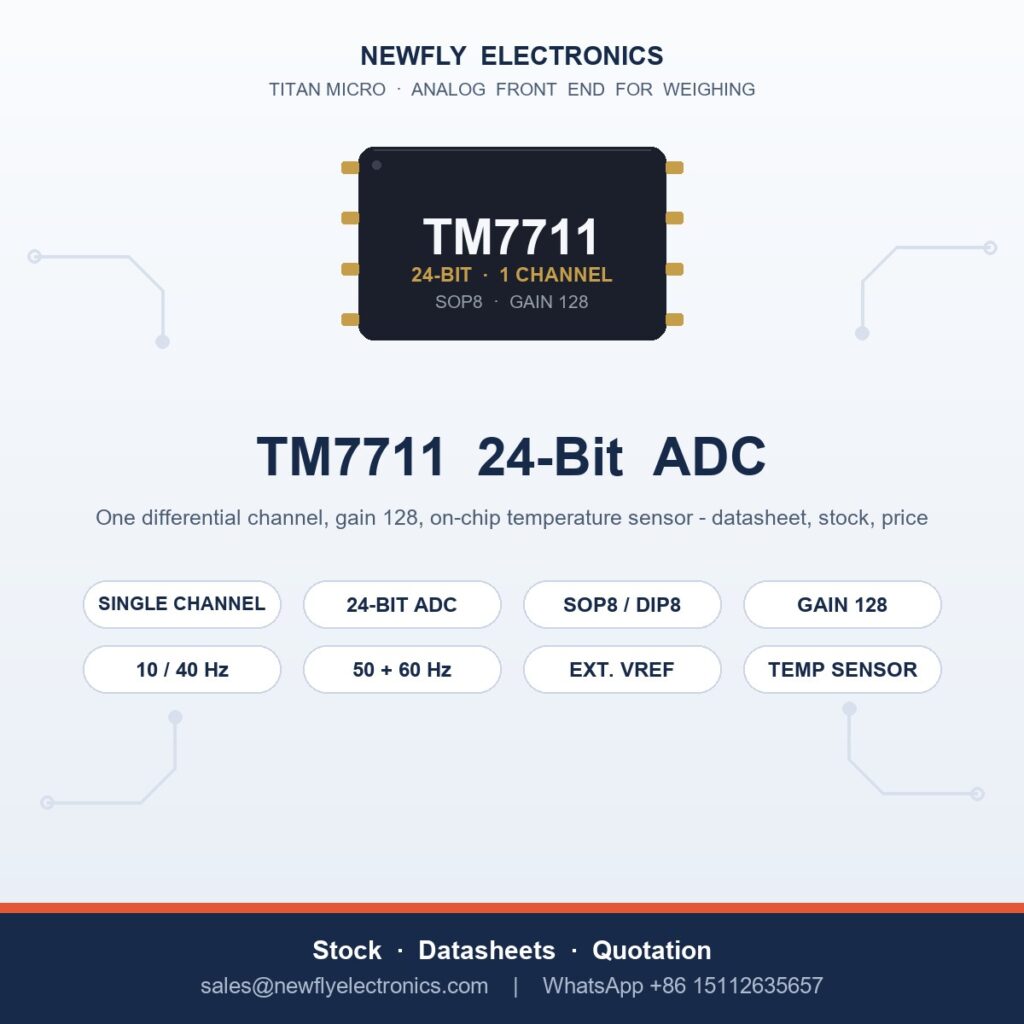
The TM7711 is a single-channel 24-bit analog front end built by Shenzhen Titan Micro Electronics (天微电子) for one job: reading a load cell in a low-frequency weighing instrument. Sigma-delta converter, fixed-gain 128 low-noise amplifier in front of it, on-chip digital filter, two-wire serial port. Eight pins.
Engineers reach for this part number for a specific reason. The 24-bit converter most weighing designs start from is a sixteen-pin device with two input channels, a selectable gain and an on-chip regulator. On a bench scale, a price-computing scale or a body-weight scale, most of that is unused hardware paid for on every board. The TM7711 strips it back to the one differential channel those products use, and adds something the larger part does not have: an on-chip temperature sensor with a digital output.
That is also why supplier selection matters more here than on a logic IC. A weighing instrument is calibrated, sealed and often verified by a trading-standards authority in the destination market. A delivery that introduces a different die revision or an untraceable date code does not show up as a dead board. It shows up as a scale that drifts after fifteen minutes, in a market where the container has already shipped.
TM7711 at a glance
| Item | TM7711 |
|---|---|
| Manufacturer | Titan Micro Electronics (天微电子), Shenzhen |
| Function | Single-channel 24-bit sigma-delta analog front end for low-frequency weighing measurement |
| Input | One fully differential input pair (AIN+ / AIN−) |
| Resolution | 24-bit, no missing codes |
| On-chip amplifier | Low-noise, gain 128 (fixed) |
| Nonlinearity | ±0.001 % |
| Output data rate | 10 Hz or 40 Hz, selectable |
| Line rejection | Simultaneous 50 Hz and 60 Hz rejection |
| Reference | External, via VREF (1.8 V to AVDD) |
| Clock | Internal oscillator, no external components |
| Interface | Two-wire serial (PD_SCK clock, DOUT data) |
| Supply | 2.6–5.5 V, separate AVDD and DVDD pins |
| Temperature | −40 to +85 °C operating, junction to +125 °C |
| Packages | SOP8, DIP8, TSSOP8 |
| Extra function | On-chip temperature measurement with digital output; power-down mode |
What the electrical specification actually constrains
On this part the specification table is not a shopping list. It is a list of design decisions you have already made the moment you select it.
| Parameter | Value | What it forces in your design |
|---|---|---|
| AVDD / DVDD supply | 2.6 V min, 5.0 V typ, 5.5 V max each | AVDD must not sit above DVDD. A 5 V analog rail over a 3.3 V digital rail is outside the stated condition. |
| Absolute max supply | −0.4 to 6.0 V | A 5 V rail with a weak regulator has little margin — a 6.3 V unloaded adapter is already a stress case. |
| Input high level VIH | 0.7 × DVDD | At DVDD = 5 V the threshold is 3.5 V. A 3.3 V MCU cannot reliably clock PD_SCK. |
| VREF range | 1.8 V to AVDD | The reference is external. Ratiometric from the bridge excitation removes excitation drift from the reading. |
| VREF / AIN / PD_SCK abs max | −0.4 V to VCC + 0.4 V | Driving any of these with the supply off forward-biases the die. Hot-plugging a load cell on an unpowered board is the usual way to lose a batch. |
| DOUT abs max | −0.4 V to +6.0 V | Wider than the input pins, so a 5 V MCU can read it with DVDD lower. |
| ESD | HBM 4000 V, MM 300 V | Ordinary commercial handling. Nothing here makes it suitable for an exposed connector without your own protection. |
Two rows decide most designs. The external reference is the first: this part does not generate one, so your bill of materials includes a reference either as a dedicated IC or as the bridge excitation node. The fixed gain of 128 is the second. If a prototype returns with a saturated reading, the fix is mechanical or in the excitation voltage, not a register setting.
The eight-pin layout, and the two traps in it
Pinout as published, top view, DIP-8 and SOP-8:
| Pin | Name | Function |
|---|---|---|
| 1 | VREF | Reference input, 1.8 V to AVDD |
| 2 | AGND | Ground |
| 3 | AIN− | Differential input, negative |
| 4 | AIN+ | Differential input, positive |
| 5 | PD_SCK | Power-down control and serial clock input (shared) |
| 6 | DOUT | Serial data output |
| 7 | DVDD | Digital supply, 2.6–5.5 V |
| 8 | AVDD | Analog supply, 2.6–5.5 V; must not exceed DVDD |
Trap one: PD_SCK is two functions on one pin. It is the serial clock and the power-down control, active high. Firmware that parks the clock line high between conversions — common when a pin is set as a push-pull output and left at its idle level — is holding the device down. The symptom is not an error code. It is a converter that returns a plausible but frozen reading, or that takes far longer than expected to settle after reset. Driving PD_SCK low when idle costs nothing, but finding this after tooling is cut costs a week.
Trap two: AVDD must not exceed DVDD. This catches designs that power the analog side from a clean 5 V rail while the MCU and DVDD run at 3.3 V. Either run both rails at 5 V and level-shift DOUT into the MCU, or run both at 3.3 V and accept lower bridge excitation. The mixed case is the one the datasheet tells you to avoid.
The rest is ordinary analog discipline. AIN+ and AIN− feed a gain-of-128 amplifier, so a millivolt of ground shift between the load cell and AGND is amplified like signal. Star the analog ground at AGND and keep the excitation return off the digital plane.
TM7711 against the part most scale designs start with
Buyers usually arrive at the TM7711 after pricing, or trying to shrink, a design built around the HX711. Both are 24-bit sigma-delta converters for load cells and they are not interchangeable. The HX711 column below reflects that vendor’s published datasheet; check it against the revision you hold.
| Decision | TM7711 | HX711 (per its vendor datasheet) |
|---|---|---|
| Pin count and package | 8 pins — SOP8, DIP8, TSSOP8 | 16 pins — SOP-16 |
| Differential input channels | One | Two (A and B) |
| Gain | Fixed 128 | 128 or 64 on channel A, fixed 32 on channel B |
| Output data rate | 10 Hz or 40 Hz | 10 Hz or 80 Hz |
| Reference | External only (VREF pin) | On-chip, brought out for bypass |
| Load-cell excitation regulator | Not included — supply it yourself | On-chip regulator with external pass transistor |
| Temperature sensor | On-chip, digital output | Not provided |
| Board area for the converter | 8 pins, few external parts | 16 pins plus regulator pass components |
| Pin-compatible swap | No. Different pin count, different pin functions, different reference topology. This is a board re-layout, not a substitution. | |
The HX711 gives you a second channel and a selectable gain of 64. The second channel is how many designs measure battery voltage without adding an ADC. The gain of 64 doubles the full-scale input window, which matters when a stiff load cell on high excitation swings further than gain 128 can take. The TM7711 gives you neither. If either is on your feature list, this is the wrong part and no board-space saving compensates.
What it gives back is the temperature channel. Load cell zero drift with temperature is the largest source of rejection in inexpensive scales, and the usual fix is a thermistor, a second ADC channel and a compensation table. A temperature reading from the same die that is doing the conversion lets the compensation loop close on die temperature rather than on an approximation of it. For a product sold into markets with real seasonal swing, that is worth more than a spare channel.
The 40 Hz ceiling is a genuine limitation. A 25 ms update is adequate for a static instrument and not adequate for a checkweigher where the display has to settle while the load is still moving. Look at higher-rate parts rather than averaging your way out of it. The missing excitation regulator is a bill-of-materials cost, not a technicality — but on a ratiometric design the excitation node doubles as the reference, so one rail serves both purposes. The schematic is yours to get right, and a noisy excitation rail shows up directly in the reading.
Where this part earns its place
Retail and bench scales. Price-computing, kitchen and postal scales are single-load-cell static instruments whose display only has to settle between transactions. Single channel, 10 or 40 Hz, eight pins that let the analog section sit close to the load cell connector instead of being pushed to the board edge.
Body-weight and health scales. Low parts count and a power-down mode matter more than channel count. A single-point load cell on a battery platform is exactly where a fixed gain of 128 and an external ratiometric reference are enough.
Counting scales and small industrial weighing. Where the instrument is static but the environment is not, the simultaneous 50 Hz and 60 Hz rejection is the relevant feature: one design ships to 50 Hz and 60 Hz markets without a firmware variant, which is a real advantage for an exporter running one product family across regions.
Instruments that already need temperature. Any product where the reading must be compensated, or where an ambient temperature readout is a feature, gets it from the converter instead of a second sensor and a second conversion path.
Regionally, demand concentrates where scale assembly concentrates. India has a large domestic weighing industry serving retail and legal-metrology markets, and 50 Hz rejection is not optional there. Vietnam, Thailand and Malaysia assemble both for domestic retail and for export, and the 50/60 Hz question comes up on nearly every enquiry. Middle East buyers more often source finished instruments, so enquiries are smaller and more mixed. European and US buyers arrive with a certification path already chosen and ask about revision consistency before they ask about price.
What moves a TM7711 quotation
A single figure quoted without questions is a guess. Five variables do most of the work.
Package. SOP8 and TSSOP8 are the volume packages. DIP8 is a different proposition, because through-hole parts for a new design are usually a legacy or repair requirement and availability is what it is. Quoting DIP8 at SOP8 pricing creates a problem two weeks later.
Quantity and packaging format. Tape and reel, tube and cut tape carry different handling cost. A partial reel is a normal first-order request and a poor production-schedule one. The price step sits at the packaging boundary as much as at the quantity boundary.
Date code and revision. Current production and older but genuine stock are not the same purchase. If you are mid-qualification on a sealed product, paying slightly more for a single date-code lot is cheaper than re-validating a mixed one.
Consolidation. Few buyers order only a converter. If the same order carries the display driver, the regulator and the passive bill of materials, freight and handling are amortised and the landed cost falls without the unit price moving.
Destination and terms. Air to a landlocked point in northern India and sea to Ho Chi Minh City are not comparable, and the incoterm decides who carries which part. We confirm the shipping window in writing per order rather than publishing a figure that will not survive the next peak season.
Verifying that what arrives is what you qualified
Sealed and legally verified instruments make incoming inspection more valuable here than on a display driver. Five checks catch almost everything.
Marking and date-code consistency. One lot per reel, laser marking matching the documented format, and a date code plausible against the shipping date. Mixed date codes inside one reel is the clearest signal that a lot came from more than one source.
Functional check at your own rail. Not at the supplier’s bench supply. Use the excitation and reference voltages your board actually runs and confirm the reading settles and repeats. Offset behaviour is where a re-marked or downgraded die shows first.
Power-down and wake behaviour. Hold PD_SCK high, release it, and confirm the device responds as the revision you designed against describes. This exercises the one pin that is easy to get wrong and hard to fake.
Data-rate selection. Confirm both 10 Hz and 40 Hz are reachable and that noise at each rate matches what your filter design assumed. A part that behaves at only one rate is telling you something.
Datasheet revision match. Ask which revision the shipment was produced against and compare the pin description and electrical table with the one your design was validated on. Revisions of this family have been issued repeatedly; the pinout has been stable, the printed conditions have not always been identical.
We handle marking, packaging and date-code verification before dispatch and align to your acceptance criteria. If your quality system requires third-party inspection or a test report before shipment, raise it at the enquiry stage, because it changes the schedule.
Working with Newfly: the numbers
Buyers evaluating a supplier want the commercial parameters stated, not implied. Here is ours. Where a figure depends on your quantity, package or destination, we say so rather than publishing a number that will not hold.
| Item | What we commit to |
|---|---|
| Sample order | Sample and small-batch quantities are supported. Sample fee, freight terms and dispatch time are confirmed in writing with each quotation. |
| Minimum order | Flexible. We support partial-reel and small-batch quantities for first orders and scale with you. |
| Lead time | Confirmed in writing per order, against the quantity and destination you specify. |
| Inspection | Marking, packaging and date-code verification before dispatch. Tell us your acceptance criteria and we will align to them. |
| Defect claims | The defect resolution process is agreed in writing before the order, not after a problem appears. |
Why buyers source the TM7711 through Newfly
Newfly Electronics is an export distributor for Titan Micro devices. We are not the factory and do not present ourselves as one. We source and hold Titan Micro parts for overseas buyers who cannot buy from the manufacturer directly and who need the commercial side handled in a way that survives an import inspection.
That matters on this part number because Titan Micro sells into the domestic Chinese instrument industry first. There is no dedicated export desk quoting overseas buyers in small quantities, and a direct approach tends to produce either a volume-based minimum or a price built for a domestic customer. Our position is to aggregate demand, hold stock against it, and quote a buyer in India or Vietnam on terms that suit a first order as well as a production schedule.
Practically: pricing that reflects the China supply chain rather than a distributor margin stacked on an offshore quote; stock information checked against a real position rather than a catalogue line; export documentation and shipping handled by someone who has shipped to your market before; and technical support from someone who will tell you when a part does not fit. The TM7711 has one channel and a fixed gain, and a meaningful share of enquiries for it should really be for something else.
Small quantities and production volumes are both workable. A first order that lets you validate the part on your own board is a better way to start than a carton. Ask for the datasheet revision we are currently shipping and we will send it before you enquire.
The TM7711 product page carries the specification summary and package options. If you are mapping the wider range, the Titan Micro IC product portfolio groups display drivers, LCD segment drivers and specialty parts by function, and the distributor overview explains how the supply side works.
TM7711: where it does not belong
Specification tables tell you what a part can do. Design failures come from what it cannot do. Before you commit a TM7711 to a production board, check these cases — if any of them applies to your design, this is the wrong part and we will say so.
- your instrument is a checkweigher, a filling line or anything that weighs a moving load — the maximum output data rate is 40 Hz, so a conversion takes 25 ms. That is adequate for a static platform and not adequate for settling under motion. Averaging cannot create update rate that the converter does not produce — specify a higher-rate part instead.
- you need a second measurement channel for battery voltage or a system parameter — TM7711 has one differential channel. There is no multiplexer and no second input pair. Use a small external ADC for the housekeeping measurement, or choose a two-channel converter and accept the larger package.
- your bridge output saturates the converter and you intended to fix it in a register — the on-chip amplifier gain is fixed at 128. There is no selectable 64 setting. Reduce the excitation voltage, re-specify the load cell, or move to a part with a programmable gain.
- your digital rail is 3.3 V and your analog rail is 5 V — AVDD must not exceed DVDD. Run both rails at the same voltage, or accept a lower excitation, or level-shift the interface. 5 V on AVDD over 3.3 V on DVDD is the condition the datasheet tells you to avoid, and it will produce readings that look like a firmware fault.
- your firmware leaves PD_SCK high when idle — PD_SCK is both the serial clock and the power-down control, active high. A clock line parked high holds the device down. Drive it low between reads or the converter will appear to hang.
- your design assumes an on-chip reference or an on-chip excitation regulator — VREF is an input, 1.8 V to AVDD, and there is no load-cell supply regulator on the die. Both have to exist on your board. This is the largest schematic difference between TM7711 and the 16-pin converter most teams are migrating from.
- your product must be sold as an AEC-Q100 or otherwise automotive-qualified part, or you require a formal PPAP submission — TM7711 is a commercial-grade device specified over −40 to +85 °C with no automotive qualification. We will decline the order rather than imply a grade the part does not hold.
- the instrument will be legally verified in the destination market and you have not planned for lot traceability — a sealed, verified instrument cannot absorb a mixed date-code batch. State the single-lot requirement at quotation, not at goods-in, because it changes what we can ship.
When we tell you not to buy
A supplier who accepts every enquiry without question is not screening anything. These are the situations where we will recommend against the purchase:
- Your product genuinely needs two measurement channels or a selectable gain of 64. We will point you at the 16-pin alternative and lose the sale rather than ship a converter your feature list will outgrow in the second revision.
- You are planning to swap TM7711 into a board laid out for a 16-pin converter without a re-spin. The two are not pin-compatible. We will say so before you buy the first reel, not after.
- The lot available to you is mixed date codes on one reel with no traceable origin. We will describe the risk on a verified weighing instrument rather than quote it as normal stock.
- You want a full carton before the part has been validated on your own board at your own excitation and reference voltages. We will recommend a sample first and say why.
- Your target price can only be met with material we cannot verify as original Titan Micro product. On an instrument that gets sealed and stamped, we will decline the order rather than carry that exposure into your verification.
- Your procurement rules require a franchised-channel certificate of conformity that only the manufacturer or its authorised channel can issue. We are an export distributor, not the franchised channel. If that paper is mandatory, we are not the right supplier for the line.
- You are asking us to quote an HX711, an ADS1232 or another vendor’s converter alongside the TM7711. We supply the Titan Micro side only and will say so rather than imply stock we do not hold.
FAQ: TM7711 buying questions
Where can I buy the TM7711 outside China?
Through an export distributor, which is what we are. Titan Micro does not run a direct overseas channel for small and mid-size buyers, so an enquiry to the manufacturer is usually quoted at production volume. Send part number, package and quantity to sales@newflyelectronics.com for price, stock and lead time.
Is the TM7711 a drop-in replacement for the HX711?
No. Different package, different pin count, different pin assignment, different reference arrangement. The HX711 has 16 pins, two channels, selectable gain and an on-chip excitation regulator; the TM7711 has 8 pins, one channel, fixed gain 128 and an external reference. Moving between them is a board re-layout and a firmware port. Anyone who says otherwise has not read both datasheets.
What package options are offered?
SOP8, DIP8 and TSSOP8. SOP8 is the usual volume choice. TSSOP8 is worth asking about if board height or area is the constraint. DIP8 availability is narrower and should be confirmed against your quantity before you commit a through-hole footprint.
Does the TM7711 need an external reference?
Yes. VREF is an input, 1.8 V to AVDD. The usual approach is ratiometric, with the bridge excitation node also feeding VREF so excitation drift cancels in the conversion. A design that assumes an internal reference will produce readings that move with the supply.
10 Hz or 40 Hz — which should I specify?
Update rate against noise. 10 Hz gives a reading every 100 ms with a narrower noise bandwidth; 40 Hz gives one every 25 ms with a wider one. For a static retail or bench scale, 10 Hz is the better default because display stability is what the customer judges. Test both on your own mechanics — platform response often dominates the converter specification.
Can I get a datasheet and a sample before ordering production quantity?
Both. Ask for the revision we are currently shipping so your validation and our shipment refer to the same document, and ask for a sample quantity to test at your own excitation and reference voltages. Sample fee, freight terms and dispatch timing are confirmed in writing with the quotation.
Is the part still active, or being discontinued?
It is active in the Titan Micro analog line and we are shipping it. We do not publish a discontinuation date we have not been given. If a specific revision or package is being wound down we say so at quotation. If your product has a multi-year production life, ask explicitly and we will confirm the current status in writing.
Request a Quotation
Send us the part number, the package and the quantity you need. We will reply with price, confirmed stock and lead time for the a TM7711 requirement.
See also the TM7711 product page with package options. See also the Titan Micro IC product portfolio. See also the Titan Micro IC alternative and replacement guide. See also the Titan Micro IC distributor overview. See also how to select a reliable IC supplier from China. See also where to buy Titan Micro IC chips online. See also the Titan Micro TM IC sourcing guide.
Contact Newfly Electronics
Email: sales@newflyelectronics.com
WhatsApp: +86 15112635657