
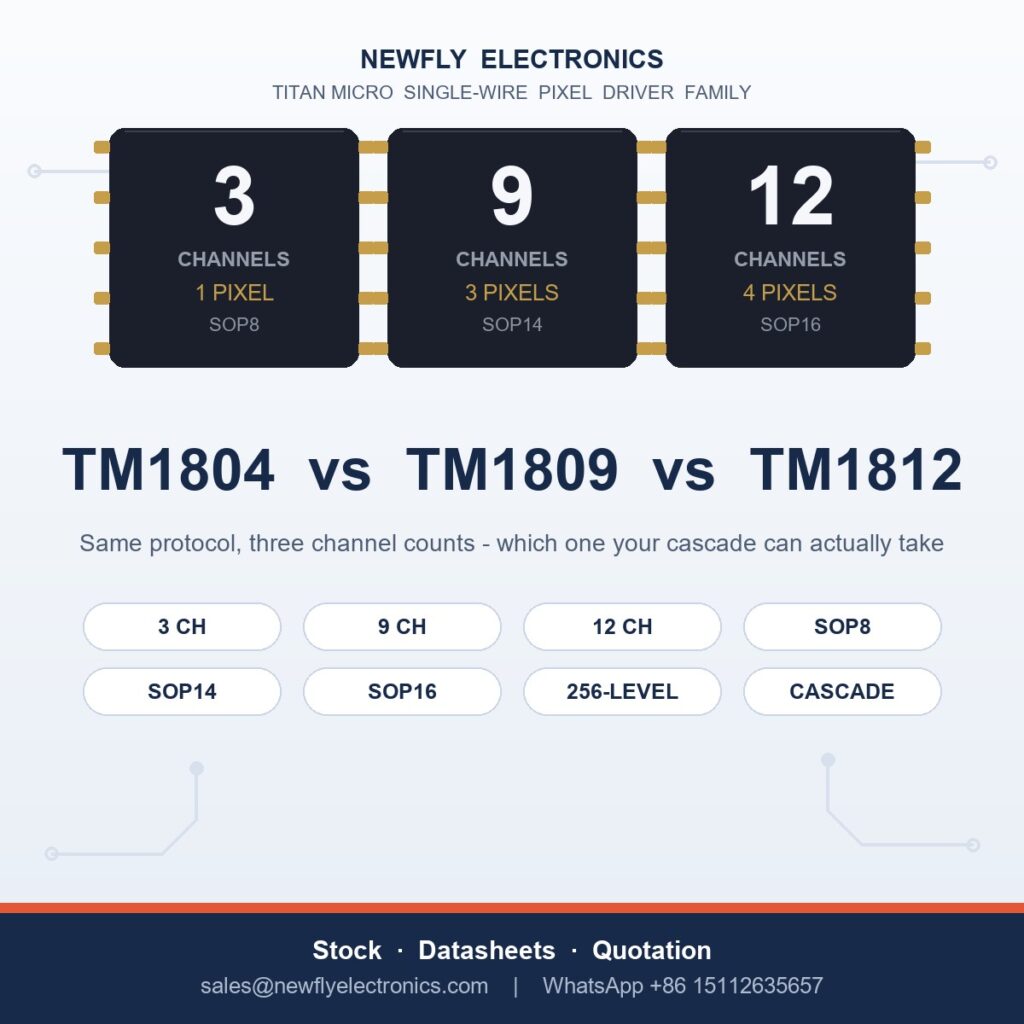
Three part numbers dominate every pixel-driver enquiry we receive: TM1804, TM1809 and TM1812. They are frequently treated as interchangeable options in an RFQ, and they are not. They are the same driver function built at three channel counts, and the choice changes your bill of materials, your cascade budget, your firmware mapping and — in one specific case — whether the board works at all with the controller you already own.
This page compares them on the parameters that decide a purchase: channels per package, pixels per device, cascade depth at 30 frames per second, data rate, pin count, thermal range. All technical values come from the Titan Micro datasheets; where published revisions disagree, we say so rather than pick the flattering number.
What the three parts share
The common ground is what makes a substitution conversation possible at all. All three are Titan Micro (天微电子) single-wire cascaded LED drivers. Each device receives a serial data stream on DIN, latches its own share, reshapes the remainder and forwards it on DOUT. Each channel carries 8 bits of grey scale — 256 levels, with an effective 1024-level resolution at the low end of the brightness curve. On-chip RC oscillators synchronise to the incoming data, so no external clock is needed and the signal is regenerated at every device, which is why a chain of several hundred pixels does not progressively distort.
All three run a 5 V logic supply with an internal 5 V regulator and accept 6–24 V through an external series resistor on VDD — the arrangement that puts them on 12 V and 24 V decorative rails without a separate logic supply. All three quote a 24 V output withstand in the electrical characteristics table and a PWM refresh of at least 400 Hz, the threshold that keeps a fixture from banding on camera.
TM1804 vs TM1809 vs TM1812: side-by-side specification
| Parameter | TM1804 | TM1809 | TM1812 |
|---|---|---|---|
| Driver channels | 3 (OUTR, OUTG, OUTB) | 9 (three RGB groups) | 12 (four RGB groups) |
| RGB pixels per device | 1 | 3 | 4 |
| Package | SOP8 (DIP8 also listed) | SOP14, DIP14 | SOP16, DIP16 |
| Pin count | 8 | 14 | 16 |
| Data consumed per device | 24 bits | 72 bits | 96 bits |
| Interface | Single-wire return-to-zero cascade, DIN in / DOUT out, internal latch and reshape | ||
| Data rate | 400 kbps or 800 kbps, selected by the SET pin | 400 kbps or 800 kbps, selected by the SET pin | 800 kbps, fixed — no SET pin |
| Pixels cascaded at 30 fps | ≥512 low-speed · ≥1024 high-speed | ≥540 low-speed · ≥1080 high-speed | ≥1080 |
| Grey scale | 256 levels per channel, 1024-level equivalent at low brightness | ||
| PWM refresh | ≥400 Hz (TM1804 period 3.0–4.0 ms) | ||
| Logic supply VDD | 5 V ±10 %, internal 5 V regulator, external series resistor for 6–24 V input | ||
| Output withstand | 24 V in the electrical characteristics table | ||
| Channel sink current | 45 mA typ at OUT = 0.5 V | 50 mA typ at OUT = 0.3 V | 45 mA class (parametric listing) |
| Power dissipation | 250 mW at 25 °C | 250 mW at 25 °C | Refer to current revision |
| Operating temperature | −40 to +85 °C, Tj to +125 °C | −40 to +80 °C; normal operating range −20 to +70 °C | −40 to +85 °C |
| Typical use | Single-pixel point sources, narrow strips, tight boards | Guardrail tube, mid-density strip, 3-pixel modules | High-density strip, outdoor screen, long cascade |
Two notes on the table. First, several revisions of the TM1809 and TM1812 feature lists quote a 30 V output withstand voltage, while the electrical characteristics table in the same document quotes 24 V. Design to 24 V. Second, the sink current figures are test conditions, not a licence to run the part at that current continuously in a sealed enclosure — thermal design is covered further down.
Channel count is a BOM decision, not a feature bullet
The practical difference is how many packages you place to reach a given pixel count. On a 300-pixel RGB strip: 300 devices with TM1804, 100 with TM1809, 75 with TM1812.
That is 225 fewer placements, 225 fewer sets of eight solder joints and 225 fewer cascade insertion points where a cold joint or a reversed device kills the chain from that point onward. On a high-volume strip line both assembly time and field failure rate move with device count — the reason a buyer who prototyped on TM1804 at 30 pixels asks for TM1809 or TM1812 when the design moves to 500.
The reverse is equally real. On a narrow flexible strip or a small indicator board a SOP16 body may not fit the available copper. TM1804 in SOP8 is roughly half the body length of TM1812 and keeps placement freedom the wider package removes. If board area is the constraint rather than assembly cost, the single-pixel device is correct and the higher channel count is a liability.
Cascade depth: where the three parts actually separate
This is the parameter buyers underestimate. The cascade figures in the datasheet are quoted at 30 frames per second and depend on the data rate:
- TM1804 — at least 512 pixels in low-speed mode, at least 1024 in high-speed mode.
- TM1809 — at least 540 in low-speed mode, at least 1080 in high-speed mode.
- TM1812 — at least 1080 pixels, at a fixed 800 kbps.
The difference between 512 and 1024 pixels on TM1804 is one pin. SET tied to VDD selects low speed; SET floating selects high speed. TM1809 uses the same convention. TM1812 has no SET pin at all — its pinout runs VDD, DOUT, twelve outputs, GND and DIN — and runs only at 800 kbps.
That missing pin is the most common compatibility failure we see. A buyer running an existing 400 kbps controller, built around TM1804 at low speed, orders TM1812 to get more pixels per package. The controller cannot clock TM1812 at 400 kbps and the chain stays dark. The part is not defective; the data rate is wrong. If your controller is fixed at 400 kbps, TM1809 in low-speed mode is the highest-channel-count device in this family you can use.
The data stream is identical; only the device count changes
Because every device in this family consumes 24 bits per pixel, a chain’s data frame is defined by pixel count, not by part number. Ninety-six bits drives four pixels whether those four sit in one TM1812 or in four TM1804 devices. Firmware written for TM1812 addressing therefore moves to a TM1804 chain without a frame-format change; what changes is how many packages the bits pass through and how much current each package sinks.
Two things still need validating on your own hardware. Timing first: the bit period and the low-level interval that resets a device are specified per revision, and a controller tuned for one vendor’s pixel driver is not automatically inside the window for another. Then the mode pin: if the design relies on high-speed cascade depth, confirm SET is genuinely floating on every device rather than tied by a stray pull-up or a copper pour.
Thermal and current budget
These are low-side sinking outputs. Current through each channel is set by the LED supply, the forward voltage and the series element in your circuit; the datasheet sink figure is the current the output can pull at a stated output voltage, not a regulated current source. A fixture drawing 45 mA per channel across twelve channels is dissipating roughly half a watt inside a SOP16 body rated at a quarter watt at 25 °C, before any ambient rise. In a sealed aluminium profile at 60 °C ambient that arithmetic does not close.
Three consequences follow. Distribute the load across more devices rather than running TM1812 at its limit. Derate against the ambient inside the fixture, not the ambient in the room. And if the enclosure is sealed and your channel current sits near the datasheet figure, ask for the thermal calculation before you commit the reel — we would rather quote a higher device count than ship a strip that browns out after twenty minutes.
Which part belongs in which product
TM1804 suits single-pixel point sources, small RGB indicator assemblies, narrow flexible strip and boards where a SOP8 is the only package that fits. It is also the right part for prototypes, because one device equals one pixel and the firmware pixel map stays trivial.
TM1809 suits guardrail tube, mid-density architectural strip and 3-pixel modules where the mechanical pitch already groups three pixels. Its low-speed cascade figure of 540 is marginally better than TM1804’s 512, so it is also the part when a 400 kbps controller needs slightly more length than TM1804 allows.
TM1812 suits high-density strip, outdoor screen modules and long runs where 1080 pixels at 800 kbps is the requirement and the controller is known to run at that rate. It is the highest channel count in the family and the wrong choice whenever the controller cannot be reconfigured.
Demand differs by market in ways that affect what you should stock. Assembly houses in India and Vietnam buying for export programmes standardise on TM1812 to cut placement cost on long strips. Buyers in Malaysia and Thailand on architectural projects often specify TM1809 because the tube pitch matches 3-pixel grouping. Middle East facade work puts the operating temperature range first, which is why we quote the TM1809 range plainly instead of calling the whole family industrial. European and US stage buyers ask about PWM refresh before price, because the fixture will be filmed.
TM1804 / TM1809 / TM1812: where it does not belong
Specification tables tell you what a part can do. Design failures come from what it cannot do. Before you commit a TM1804 / TM1809 / TM1812 to a production board, check these cases — if any of them applies to your design, this is the wrong part and we will say so.
- your product is a segment display — digits, a 7-segment readout or an appliance control panel — none of these three parts is a segment driver. They carry no digit decode, no display RAM and no keyboard scan. That job is TM1637 or TM1650 in a 16-pin package, TM1628 or TM1668 in SOP24/SOP28, or TM1638 where you need more keys.
- your panel is LCD glass — the TM18xx family drives LEDs only. Use TM1621B, TM1621C or TM1621D. This is the most common mis-order in the entire Titan Micro range and it is not recoverable by changing firmware.
- your controller output is fixed at 400 kbps and you want TM1812 for the higher channel count — TM1812 has no SET pin and runs only at 800 kbps. It will not accept a 400 kbps stream. Use TM1809 in low-speed mode — it is the highest channel count you can reach on a 400 kbps bus.
- your MCU rail is 3.3 V and you intended to put any of these on that bus directly — the logic supply is a 5 V ±10 % rail with an internal regulator. Do not use the part as a level translator — add a real level shifter or move the function to a part specified for the lower rail.
- your LED anode rail is above 24 V — the electrical characteristics table specifies 24 V output withstand. Some revisions of the feature list quote 30 V; design to 24 V and treat the difference as revision noise, not headroom.
- you need a regulated, matched channel current rather than a switched sink — these are low-side sinking outputs. Channel current is set by your supply, LED forward voltage and series element. If your design depends on per-channel current accuracy, this family is the wrong architecture and we will say so before quoting.
- your programme requires AEC-Q100 qualification or a formal PPAP package — these are commercial-grade parts. If the line requires automotive qualification paperwork, we will decline the quotation rather than imply a grade the part does not carry.
How to buy these parts without ordering the wrong one
The failure modes in this family are almost never manufacturing defects. They are specification mismatches that only appear after the reel is on the line. Five checks, in the order that catches the most money:
- State the controller and its data rate in the enquiry. “1000 pieces TM1812” cannot be validated. Naming the controller, its output rate and the pixel count tells us immediately whether the part will cascade to your length.
- State the package, not just the model. SOP8 and DIP8 for TM1804, SOP14 and DIP14 for TM1809, SOP16 and DIP16 for TM1812. A quotation for the wrong package costs an air freight and a week of schedule.
- Ask for the current datasheet revision, not a copy from a forum thread. The 24 V versus 30 V discrepancy above lives in circulating copies.
- Validate on your own board before production quantity. Timing, SET pin state and thermal behaviour in your enclosure cannot be verified from a datasheet. Ten pieces on your own PCB answers more than a page of email.
- Check date-code consistency across the reel. Mixed date codes in one reel is the signature of a re-taped lot built from remnants, and it is what separates traceable stock from grey-market stock.
If you are comparing this family against other sourcing routes rather than against each other, the alternative and replacement guide covers the substitution decision, and how to select a reliable IC supplier from China covers vendor verification.
Working with Newfly: the numbers
Buyers evaluating a supplier want the commercial parameters stated, not implied. Here is ours. Where a figure depends on your quantity, package or destination, we say so rather than publishing a number that will not hold.
| Item | What we commit to |
|---|---|
| Sample order | Sample and small-batch quantities are supported. Sample fee, freight terms and dispatch time are confirmed in writing with each quotation. |
| Minimum order | Flexible. We support partial-reel and small-batch quantities for first orders and scale with you. |
| Lead time | Confirmed in writing per order, against the quantity and destination you specify. |
| Inspection | Marking, packaging and date-code verification before dispatch. Tell us your acceptance criteria and we will align to them. |
| Defect claims | The defect resolution process is agreed in writing before the order, not after a problem appears. |
When we tell you not to buy
A supplier who accepts every enquiry without question is not screening anything. These are the situations where we will recommend against the purchase:
- You are ordering TM1812 against a 400 kbps controller and cannot change the controller. We will refuse the order and quote TM1809 instead, because the failure would arrive as a dead strip and a return freight bill.
- You have not validated the part on your own board and you want a full carton to hold speculative stock. We will say so before you commit working capital to an unproven design.
- The lot being offered has no traceable origin and mixed date codes across a single reel. We will describe the risk rather than quote it as normal stock.
- You intend to run all twelve TM1812 channels near the datasheet sink current in a sealed aluminium profile. We will show you the dissipation arithmetic first and recommend a higher device count instead of the cheaper BOM.
- Your procurement rules require a franchised-channel paper trail that only the manufacturer’s authorised channel can issue. We are an export distributor, not the franchised channel. If that paper trail is mandatory for the line, we are not your supplier for it.
- Your target price can only be met with a lot we cannot verify as original Titan Micro product. We will decline the order rather than ship an unverifiable lot.
- You are asking us to quote Holtek or WS2811-class parts as part of the same comparison. We supply the Titan Micro side only and will say so rather than imply stock we do not hold.
Why buyers source TM1804, TM1809 and TM1812 from Newfly Electronics
Newfly Electronics is an export distributor for Titan Micro (天微电子) display and LED driver ICs. Titan Micro runs no dedicated export sales desk and structures overseas quotations around large production volumes — that is the gap we fill. We source this family against real order requirements, quote from the China supply chain rather than through a re-export layer, and ship to India, Malaysia, Thailand, Vietnam, the Philippines, the Middle East, Europe and the United States.
In practice: the part number, package and quantity you specify are checked against actual stock and the current datasheet revision before we quote; the shipping window is stated in writing rather than implied; and if the specification will not do the job — wrong data rate, wrong package, wrong channel count for your cascade — we say so before you pay. We supply the Titan Micro side of every comparison on this site and stock no other vendor’s pixel drivers, so a wrong substitution claim costs us the sale. Technical support is available in English for pin mapping, SET pin configuration, cascade budgeting and thermal derating.
Related pages: TM1804 LED driver IC supplier page, the Titan Micro LED driver IC selection guide, and the Titan Micro IC product portfolio.
FAQ: TM1804, TM1809 and TM1812
Are TM1804, TM1809 and TM1812 interchangeable?
Not by substitution on an existing board. They share the same single-wire protocol and the same 24 bits per pixel, so the data frame is unchanged, but the device count per chain, the package footprint and — for TM1812 — the fixed 800 kbps data rate all differ. A chain designed for one part needs re-layout and a data-rate check before another can replace it.
Can TM1812 replace TM1804 on a 400 kbps controller?
No. TM1812 has no SET pin and runs only at 800 kbps. If your controller output cannot be changed to 800 kbps, use TM1809 in low-speed mode instead.
How many pixels can each part cascade at 30 fps?
TM1804 at least 512 pixels in low-speed mode and 1024 in high-speed mode. TM1809 at least 540 low-speed and 1080 high-speed. TM1812 at least 1080 at its fixed 800 kbps. These are datasheet minimums, not targets to design against at the edge.
What package does each part come in?
TM1804 in SOP8, with DIP8 also listed by the factory. TM1809 in SOP14 and DIP14. TM1812 in SOP16 and DIP16.
Do these parts need a separate 5 V supply?
No. Each has an internal 5 V regulator and accepts 6–24 V through an external series resistor on VDD. Size the resistor for your rail and check its dissipation in the datasheet application circuit.
Is TM1809 suitable for outdoor fixtures in hot climates?
Check the temperature range rather than the marketing category. The TM1809 revision we verified quotes −40 to +80 °C operating and a normal operating range of −20 to +70 °C. For a sealed enclosure in a hot climate, that range needs to be checked against the internal ambient, not the outdoor air temperature.
Can I get samples and the current datasheet before ordering production quantity?
Yes. Send the part number, package and quantity, and we will return the current datasheet revision with the quotation, then arrange sample quantities for validation on your own board. Sample fee, freight and dispatch terms are confirmed in writing with the quotation rather than published as a fixed number here.
Do you supply the Holtek or WS2811 equivalents?
No. We supply the Titan Micro side of these comparisons only. If you need a cross-brand substitute quoted, we will say plainly that it is outside our stock rather than imply availability.
Request a Quotation
Send us the part number, the package and the quantity you need. We will reply with price, confirmed stock and lead time for the the channel count, package and quantity you need.
See also the TM1804 supplier page. See also the Titan Micro LED driver IC selection guide. See also the Titan Micro IC product portfolio. See also where to buy Titan Micro IC chips online.
Contact Newfly Electronics
Email: sales@newflyelectronics.com
WhatsApp: +86 15112635657